












There are plenty of challenges unique to the pool industry, and that’s before taking into account recent developments involving inflation, tariffs, and general economic anxiety. Navigating it all can be tough. There’s pressure to reduce profit margins to keep customer pricing as low as it can go.
With just a little strategic thinking and attentiveness to which products and services provide the safest, soundest markup, erosion of margins can be avoided. That’s according
to Dan Lenz, vice president of the Midwest chapter of the Pool & Hot Tub Alliance (PHTA).
Lenz has four decades of experience in the field, and he has valuable suggestions for keeping the bottom line healthy.
THINK OUTSIDE THE SEASON
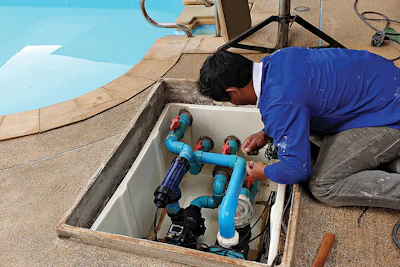
Working out of the Chicago area, facing brutal winters, Lenz had to think creatively about ways to keep profits rolling in during the lean months. “In the Midwest, obviously, that’s a tough nut to crack,” he says. “But through the years, I found ways of getting people to do things in the off-season. Replacing equipment, for example. Pump filters, heaters, things like that.”
With just a little guidance, customers can see the stretch of the year when they’re not swimming as the right time for larger maintenance projects. For many pool owners, scheduling these jobs when they won’t cut into their time in the water is a major enticement.
When thinking about off-season maintenance, it’s important to not undercut the value of the work. It’s one of those instances when it’s tempting to offer the customer big discounts to close the deal. Because it can feel like bringing in bonus revenue at a time when business is slower, the idea of slightly diminishing profit might appear to be a fair trade-off.
Lenz says that’s the wrong mindset. There are other ways to make the customer see value. When everyone is keenly aware of raising prices, it’s not hard to convince people that getting ahead of possible inflation is a good idea.
“In recent years, the incentivizing has simply been a matter of noting the increases that are going to come,” he notes, adding that it’s helpful to remind customers that maintenance work is trickier to schedule during the peak season. “Tell them to get it done before everyone is crazy busy, and they can’t get it done, as opposed to discounting.”
LAYING THE GROUNDWORK
Getting customers to commit to major purchases takes more than a single conversation. Selling the high-margin items requires building trust.
Lenz stresses that ongoing work with customers should include conversations beyond the task at hand. Every moment with a customer is an opportunity for education.
“I always stress that the technicians, when they’re in the backyard, need to look at everything,” explains Lenz. “If they’re sent out to work on the heater, they should take a look at the pump and the filter and the pool and the this and the that.”
Managing customer expectations is a critical piece of this profitability puzzle. If a technician is on a routine maintenance visit for the heater, they should provide an honest forecast of how much longer the equipment has.
For example, the technicians might take a look at a heater and reasonably believe it has two or three more years in it. That’s information that should be conveyed directly to the customer. Tell them it’s worth it to spend $500 now to keep it going but also let them know that it will cost around $6000 to replace the whole unit within the next few summers.
It’s a long-term investment in getting the customer ready to commit to you when the big-ticket item is needed.
“You put that six grand in their mind,” Lenz says. “If you were to tell them today that they need to replace the heater for six grand, the first thing they’re going to do is open their phone and go online and see how much heaters cost. But when they don’t need it right now, when you’re telling them, ‘Well, you’re going to get a few years out of this yet, but today, it’s this much money, and just kind of keep it in mind,’ then when the time comes, you’re prepped for it.”
When the unit reaches the end of its lifespan, the customer is likely to trust the technician who saw it coming.
“They’re not even shopping you anymore,” says Lenz. “That relationship and that confidence really allow you to extend your margins pretty significantly.”
The same strategy applies to staff members in the store. Even when the customer is coming in to pick up something as simple as a bottle of chlorine or a quart of algaecide, it’s a chance to talk.
Get everyone on staff speaking to the customer with one voice and one purpose. Continuously feed important information to the customer. This doesn’t mean a relentless sales pitch. There’s no need to pivot to a call to action. Instead, keep the customer apprised of everything that’s helpful in maintaining their pool and managing their budget around that maintenance. Let them know how long a heater lasts, how long a liner lasts, and how long a plaster job lasts.
“When inevitably they make the decision, you’re the one they’re going to,” explains Lenz. “They don’t even think of anyone else because you’re the one that’s been informing them, educating them, you’ve been their friend and their counselor with this backyard for a period of time, and they are comfortable with you and they believe in you because you are teaching them.”
HIGH-MARGIN EQUIPMENT AND WORK
After building relationships that lock in that customer commitment, another important question that needs answering centers on which equipment and jobs will maximize that connection. Where are the margins?
In addition to the most basic calculations of wholesale cost versus the price that can be reasonably presented to the end consumer, there are several other considerations that go into answering the margins question. What are the parts of the pool maintenance, repair, and upgrading that are so complex that customers are reluctant to take a DIY approach but are also comparatively simple for skilled pool professionals?
Liners are the most obvious example. Installing a new liner is a major job, but if a company has the process down pat, it can be in and out fast with a thick profit in pocket.
Variable-speed pumps are another major opportunity. Although variable-speed pumps have been the standard since a stringent set of efficiency standards were issued by the U.S.
Department of Energy nearly 4 years ago, plenty of single-speed pumps are still in use. The benefits of upgrading to a variable-speed pump make sense to customers if they’re pressed home: They save money in energy costs, they’re quieter, and they’re technologically advanced enough to be controlled from an app on the phone.
SET PRICES TO COVER EVERYTHING
When pricing out jobs for a customer, there’s always the possibility that the customer can poke around online to check equipment costs. It’s tempting to sell equipment at a lower markup in response to that digital detective work. Lenz suggests flat-rate pricing is a better response.
Instead of giving customers an itemized breakdown of parts and labor, Lenz opted for one all-encompassing price. That way customers aren’t second guessing how much is being charged for the equipment.
To go the route of flat-rate pricing, be prepared to do some planning on the front end.
“Before we did flat rate pricing, we analyzed everything,” Lenz says. “This is before computers, so I had stacks of legal pads, and I literally wrote down every expense that went into every pump filter heater we installed over the course of a couple of years.”
Lenz also urges pool professionals to not short-change themselves. If equipment costs are going up, that should be reflected in customer prices.
“There’s a big fear in our industry around increasing prices,” Lenz notes. “There’s no way you can do the same thing today at the same price that you did it for a year ago. You can’t. If you do, you’re going backwards, so don’t be afraid to increase your prices. Make it as normal as anything else.”
Additionally, service technicians are providing work of tremendous value to pool owners, and that final bill can and should reflect that. A good service technician is a mason, an electrician, a plumber, and a carpenter all in one. Helping customers understand the skill that’s been brought into their backyards makes it easier to keep margins healthy.
This article first appeared in the January 2026 issue of AQUA Magazine — the top resource for retailers, builders and service pros in the pool and spa industry. Subscriptions to the print magazine are free to all industry professionals. Click here to subscribe.