











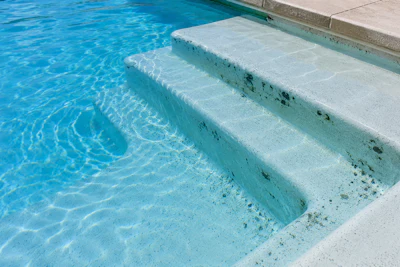
Black algae — the dark blue-black or greenish spots you see on pool floors, steps, and corners — isn’t actually algae. It’s a form of cyanobacteria. These are photosynthetic bacteria that may grow slowly, but they make up for it by forming tough, protective layers that are hard to break through. This is done through the production of extracellular polymeric substances (EPS) which can provide a layer of protection for the algae and can help contribute to the development of biofilm.
The dark color comes from chlorophyll along with pigments like phycocyanin and carotenoids, which help the organism capture light and also help make it more resistant to sunlight and chlorine. This broad range of pigments help black algae absorb a broader range of wavelengths and allows growth in shaded areas. The carotenoids in cyanobacteria also help to protect against oxidative damage. Black algae tends to like rough or porous surfaces, where they can get down into tiny cracks and are protected from chlorine or algaecide treatments. However, in areas of the pool where water flow is low, even smooth surfaces are not immune.
The combination of slow growth, strong pigmentation, and a built-in protective layer can make black algae more persistent compared to green or mustard algae.
Black algae gets into pools from the outside environment. Cyanobacteria are everywhere in the environment, especially in soil, dust, structures (trees, fences, buildings) and surface source water. It doesn’t take much for black algae to be introduced in the pool. Wind, rain runoff, fill-water, swimmers, animals, and even equipment like nets and brushes used between pools can carry it in. Several studies have shown that algae is very ubiquitous in the air and can even be brought in on the wings of birds or the bodies of insects. Let’s not forget that merely walking through the yard and jumping in the pool can bring small amounts of moist soil which may contain algae cells. This is one of the reasons that we shower before entering the pool and rinse off our feet before we jump in. There is documentation on numerous types of black algae found in swimming pools.
Once the algae cells are there, they only need the right conditions to take hold. Warm water, light, low sanitizer level, and coarse, unsmooth surfaces are ideal conditions for growth. Rough plaster, small surface defects, and shaded areas are also ideal. As previously mentioned, smooth surfaces with low water flow will allow cells to settle and grow. This is one reason why circulation should be checked and corrected if black algae is seen in the pool.
Attachment doesn’t happen all at once; it builds in stages. First, the cells latch onto the surface via physicochemical interactions. Cyanobacteria then start producing the EPS protective layer that anchors them in place and shields them from disinfectants.
EPS is the sticky, gel-like material that cyanobacteria produce outside their cells. It’s made up mostly of polysaccharides, along with proteins and other components, and forms the backbone of the biofilm you see in black algae. In practical terms, EPS is what makes black algae so difficult to remove. It acts like a glue that anchors the organisms to pool surfaces, especially rough plaster and small cracks. At the same time, it creates a protective barrier that prevents chlorine and other oxidizers from fully penetrating the algae colony.
EPS also helps the organisms survive environmental stress like UV exposure and temperature swings, and it plays a role in surface movement and spread. Without breaking the protective EPS layer, chemical treatments alone often won’t be enough to fully eliminate the infestation. This is why aggressive brushing is critical for treatment.

Once established, it spreads efficiently. Cyanobacteria reproduce by simple cell division, allowing colonies to expand across the surface and within the EPS. In addition to the regular cells of a colony, cyanobacteria also can form specialized cells that have specific functions such as nitrogen fixation. This helps in surviving less than ideal water conditions. Some forms can also break apart into small segments that move and reattach elsewhere in the pool. Under stress, some cells can go dormant and survive until conditions improve. This is important in understanding that the colony will not simply die off in the winter months but will lie in wait until growth conditions improve.
Cyanobacteria have a key advantage over many other organisms in that some species are capable of fixing atmospheric nitrogen. This means they can convert nitrogen gas (N₂) from the air or dissolved in water into forms they can use for growth, such as ammonia. This allows them to persist even in environments where dissolved nitrogen levels are low. In a pool environment, this ability reduces their dependence on external nutrient inputs compared to actual algae species. While nitrogen is still important for growth, cyanobacteria can often meet their needs internally if conditions are favorable.
Cyanobacteria rely on a balance of nutrients to grow and expand, including nitrogen, phosphorus, and trace elements. Of these, phosphorus is often the most limiting nutrient in swimming pools. They can store large amounts of phosphates within their cells which can be used when nutrient conditions are less than ideal. Even small amounts of available nutrients can support growth when combined with favorable conditions such as warmth, light, and surfaces for attachment. This is why black algae can persist in pools even when water chemistry appears “balanced.” Nutrients can accumulate in biofilms or from organic debris, providing enough support for localized growth. Once established, the biofilm structure helps retain and recycle nutrients, further supporting the colony.
From a control perspective, maintaining good water balance, minimizing organic load, and preventing nutrient buildup through proper circulation and sanitation are all important. However, because cyanobacteria can partially bypass nitrogen limitations, nutrient limitation alone is not an effective strategy and must be accompanied by mechanical disruption and regular sanitation.
Another reason that black algae is so persistent is that it doesn’t just stay where it lands — in some cases it can move. Many of the filamentous cyanobacteria associated with black algae are capable of what’s called “gliding motility,” which is a slow, surface-based movement that doesn’t rely on flagella. Instead of swimming, these organisms move along surfaces by secreting small amounts of slime (part of their EPS layer) and using that to essentially pull themselves forward. This allows them to spread laterally across pool finishes, especially in low-flow or stagnant areas where there is less water flow. In practical terms, this means black algae can gradually expand across plaster surfaces even without obvious disturbance. It also helps explain why it is often seen creeping out from cracks, seams, or shaded corners over time. Once established, it is not just growing in place; it is actively colonizing nearby surfaces.
Gliding also plays a role during and after treatment. When you brush a surface, breaking up the biofilm also frees up fragments that can move and reattach elsewhere if sanitizer levels are not high enough to kill them quickly. From a control standpoint, this reinforces the need for thorough brushing, immediate follow-up with strong sanitizer levels, and maintaining good circulation to limit low-flow zones where spreading is easier.
Black algae is also highly seasonal. It grows best in warm water, typically from late spring through early fall. This is one of the reasons that black algae outbreaks typically occur late in the pool season. As mentioned earlier, in cooler months, it slows down and hides in protected areas like pores, cracks, and shaded walls, then comes back when conditions improve.
All of this has a direct impact on how black algae is treated, physically disrupting the growth first, immediately following with elevated sanitizer levels and maintaining higher levels until the algae is neutralized.
In summary, getting rid of black algae takes a combination of mechanical and chemical steps. It’s rarely a one-and-done process. Maintaining proper circulation and recommended sanitizer levels along with regular treatment with an algaecide specific for black algae can prevent reoccurrence. One source suggests that the use of ozone can be an effective method for treatment of cyanobacteria in the water before it has a chance to settle. Additionally, in white plaster pools, granular or puck forms of chlorine can be applied with direct contact or rubbed onto affected areas to provide high doses of chlorine directly to the algae. Consistency in treatment is what keeps it from coming back.
SOURCES:
- José Martínez-Burgos, W., Pozzan, R., Aguiar Severo, I., & Carlos Ordonez, J. (2024). Introductory Chapter: Cyanobacteria – An Overview. In Insights Into Algae - Fundamentals, Culture Techniques and Biotechnological Uses of Microalgae and Cyanobacteria. IntechOpen. https://doi.org/10.5772/intechopen.1004953
- Hoiczyk, E. Gliding motility in cyanobacteria: observations and possible explanations. Arch Microbiol 174, 11–17 (2000). https://doi.org/10.1007/s002030000187
- Hirschberg, Joseph et al. Carotenoids in Cyanobacteria. The Molecular Biology of Cyanobacteria, pp 559-579.
- Faria, Sara I. et al, The Relative Importance of Shear Forces and Surface Hydrophobicity on Biofilm Formation by Coccoid Cyanobacteria. Polymers. 2020, 12, 653.
- Faria, Sara I. et al. The Association Between Initial Adhesion and Cyanobacterial Biofilm Development. FEMS Microbiology Ecology. 2021, 97.
- Hoiczyk, E. Envelope Structure of Four Gliding Filamentous Cyanobacteria. Journal of Bacteriology. May 1995, p. 2387-2395.
- Rossi, Federico, et al. Role of Cyanobacterial Exopolysaccharides in Phototrophic Biofilms and in Complex Microbial Mats. Life. 2015, 5, 1218-1238.
- Suwanvitaya, Patcharaporn, et al. Control of Algae in Swimming Pool by Ozonation. Thai Environmental Engineering Journal. 2019, 33, 13-19.
- Holmes, Paul E. Bacterial Enhancement of Vinyl Fouling by Algae. Applied and Environmental Microbiology. Dec. 1986, p 1391-1393.
- Adamson, Richard P. et al. Survey of Swimming Pool Algae of the Phoenix, Arizona, Metropolitan Area. Journal of Phycology. 1978, 14, 519-521.
- Christie-Oleza, Joseph A. Black Algae Biofilms in Recreational Swimming Pools: Causes and Solutions. Environmental Technology & Innovation. 2025, 40.
- Zakar, Tomas, et al. Carotenoids Assist in Cyanobacterial Photosystem II Assembly and Function. Frontiers in Plant Science. 2016, 7, 295.
- Bellinger, Edward G. and David C. Sigee, Freshwater Algae, Identification, Enumeration and Use as Bioindicators, 2015, 2 ed.
- Wehr, John D. et al., Freshwater Algae of North America, 2015, 2nd ed.