










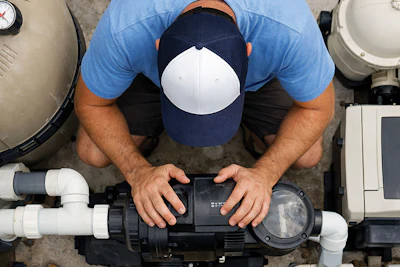
Pool pumps and motors keep improving in energy efficiency thanks to variable-speed options that significantly conserve energy. Much of this trend has come from manufacturers looking for ways to deliver energy savings for pool owners, but the U.S. Department of Energy (DOE) has also played a hand by requiring these upgrades in new and replacement products. Over the last few years, DOE has added new rules on pool pump systems, with the most recent update requiring high-efficiency motors in both new and replacement pool pump systems.
These variable-speed pumps and motors allow pool professionals to adjust motor speed based upon need which dramatically reduces energy consumption as both motor and pump manufacturers tout potential energy savings of 80% or higher.
What does this mean for pool service companies? For one thing, it puts them in a unique position to help customers save on energy costs by installing new equipment. However, not every customer is in a position to purchase the newest pumps and motors and may prefer to delay replacement of either the pump or the motor until they fail.
To best guide customers on this decision, pool service professionals need to consider many factors, including age of the equipment and visible signs of damage such as corrosion or cracks.
AGE AND APPEARANCE OF THE PUMP
Any pump more than 10 years old should be replaced, mainly because newer pumps are considerably more efficient and will make a noticeable difference in pool owners’ utility bills. They are also much quieter, an advantage that people relaxing in pools will appreciate.
If the pump housing is cracked or is leaking water, these are clear signs of damage and signify the need for a new pump.
Other considerations include:
- Corrosion and discoloration are visible on the wet-end. This likely indicates internal damage, and it is time for a replacement.
- The pump is frequently losing prime. This indicates air and/or liquid leakage.
- The wet-end is making loud noises. This could indicate misalignment inside the pump end.
- If the cost of the replacement motor is more than two-thirds of the cost to replace the complete pump, it is recommended to purchase the complete pump assembly.
REPLACING THE MOTOR ONLY
When should the pool service professional replace only the motor? Here are six possible reasons why this option should be chosen:
- The customer is on a budget. Generally, a motor replacement plus an installation kit is the lowest cost option for the homeowner and no replumbing work will be required.
- The pump housing or wet-end is intact with no leaks or cracks.
- The motor is making noise or will not start. Bearings or capacitors fail, causing grinding or screeching noises.
- The pump is relatively new. If the pump end is less than 10 years old, replacing only the motor is generally the smarter and more cost-effective option.
- The homeowner may wish to simply upgrade their motor to a new variable-speed motor. Pool pros can confidently advise the homeowner they will achieve all the energy savings associated with variable speed by upgrading the motor only.
EDUCATING CUSTOMERS ON DOE RULES AND NEWEST TECHNOLOGIES
Keeping up with DOE rules and motor and pump technologies for pool systems can be challenging but it’s important for pool pros to know the basics so they can help customers understand their options.
Prior to about 2010, most pool pumps and motors were only available in a single speed. They functioned well but only for six or eight hours at a time, leaving the pool stagnant for as much as 16 hours a day, increasing the chance for algae and other bacteria to form.
Once the variable frequency drive (VFD) pool pump was introduced, flow rates could be adjusted to meet individual needs and could operate efficiently up to 24 hours a day without the issue of stagnation.
Manufacturers began shifting from single-speed motor-powered pumps and introduced the variable-speed pump and, to a lesser extent, the variable-speed motor that powers the pump. These variable-speed pumps and motors allow users to adjust motor speed based upon need, delivering energy savings potentials of 80% or higher.
Efficiency regulations greatly influenced the adaptation of these higher-efficiency products with California’s Title 20/24 leading the way. ENERGY STAR-certified pumps also materialized during this decade, alerting consumers that they are purchasing or installing an energy-efficient pump. Smarter, quieter and more energy-efficient pool pumps and motors began to be introduced. Pool service professionals became more aware, and pool professionals led the charge of educating homeowners regarding these energy-efficient products.
In 2021, the DOE announced regulations requiring most inground pool pumps to be variable speed. In September 2025, the DOE implemented a rule to regulate pool replacement motors so they are also variable speed. This is an advantage for the industry, as pool professionals will replace almost all failed pumps and motors on inground pool pumps with variable speed.
Motor manufacturers are also making their new variable-speed motor products versatile enough to communicate with pool control systems (PCSs), to connect with existing time clocks, or to operate completely on their own.
PCSs also integrate with homeowners’ SMART home systems therefore integrating the backyard with the SMART home. Now, a homeowner can control schedules, motor speeds, heaters, lights, and chlorinator settings from their smart phones. One great example is the ability of a pool owner to turn on their hot tub before leaving the office so that the temperature is just right when they get home. PCSs also allow for the pool service professional to better control water chemistry and create enhanced safety features such as alarms.
Today’s pool pumps and motors go well beyond just keeping pools properly filtered. Rather, they are “smart,” energy-efficient, eco-conscious products that can easily replace older, less efficient systems.
Jim Ellis is the Marketing Director for Nidec Motor Corporation. With a deep understanding of the pool and spa industry and a passion for innovation, he is proud to help professionals stay informed on the technologies shaping the future of aquatic equipment.