









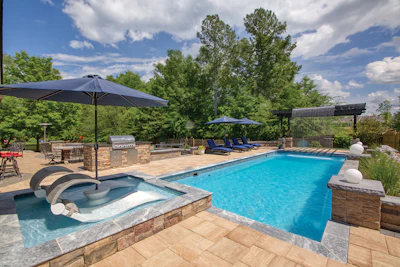
The fiberglass pool market has evolved significantly over the past several decades, Rick Black and Jason Hughes have experienced this evolution firsthand.
Black, Director of Product Training at Latham Pools, began selling fiberglass pools in 1992 and went on to cofound Trilogy Fiberglass Pools in 2000, which he and his partners sold to Latham Pool Products in 2011. Hughes is a Certified Advanced Pool Builder Professional and President of River Pools Franchising. Together, they co-teach C260: GENESIS Construction School: Vinyl Liner/Fiberglass Pools for the Pool & Hot Tub Alliance (PHTA).
“If this sector hadn’t changed any over the past 30 years, fiberglass wouldn’t be at approximately 22% of the inground residential pool market right now,” Hughes says. “Customers and installers both see how much easier it is.”
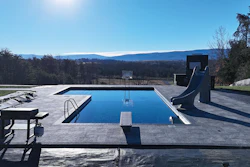
 Modern fiberglass pools can now be designed with integrated spas, tanning ledges and outdoor living areas, giving homeowners the high-end features once more commonly associated with concrete construction.
WHY FIBERGLASS?
“It was night and day on the builder side,” says Hughes, whose pool installation company went all fiberglass in 2001. “There are a lot less steps to manage, and a lot less calls to come back and take care of issues.”
“Our installations follow a step-by-step process,” Black explains. “You move through each step one at a time and don’t begin the next step until the previous one is complete. If you follow these steps, you can successfully install a fiberglass pool.”
These refined processes can “lead to great success” on the profit side for the company, Hughes explains. “A fiberglass pool can be installed in two to three days with a team of two to three people. Walk in on a Monday morning, have the pool done by the end of the day Tuesday or Wednesday. That is a lot of revenue that is being generated in a short amount of time.”
Black acknowledges that there is a learning curve when builders switch from concrete or gunite to fiberglass, “but when you get to pools four and five, you go, ‘Holy cow, this is sweet!’”

ENHANCEMENTS
On the consumer side, according to Hughes, the general awareness of fiberglass pools has really changed. He says, “Very few people thought of fiberglass as an option 20 years ago. They weren’t considered a luxury product.”
Today, however, fiberglass pools can have almost all of the bells and whistles of a concrete pool. “Manufacturers are creating nice molds with features integrated,” Black explains. “More and more water features are being built into the shell itself. It’s not just a flat pool anymore.” Some popular features include waterfalls, bubbler fountains, sun ledges or tanning ledges, sun shelves, and benches — “the things folks want,” Hughes says. “At least three-quarters of the shells we install have ledges now.”
Hughes also highlights that fiberglass is now much more compatible with other options like heaters, elevated spas, waterline tiles, and pool lighting. “Using fiberglass as your construction material is no longer a limitation,” he says. “Fiberglass pool owners can have the accessories they want and have a pool that’s easier to maintain, more durable, and looks great — and costs less money long-term.”
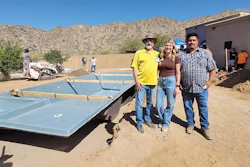
 Proper handling, placement and base preparation are critical steps in fiberglass pool installation, helping builders safely navigate tight jobsite conditions while supporting the shell for long-term performance.

MARKET SHARE
In Hughes’ experience, he sees the fiberglass sector growing when “one company got in and laid a foundation for fiberglass in that region. They had success, so others jumped on the bandwagon and started selling fiberglass, too.” That was how his company grew so rapidly in Virginia. “We really leaned into it,” he says.
Black has seen similar. “You get a market interrupter who believes in the product and the installation. People around them start losing market share and decide to join in.”
He also notes that it’s not just an increase in the number of fiberglass pool builders, “there are also many more fiberglass pool manufacturers now than there were 30 years ago,” he says.
LEARNING FIBERGLASS
The GENESIS C260 course, which is one of the core courses required for individuals to earn their Certified Builder Professional (CBP) designation, provides students with 24 hours’ worth of knowledge on engineering and design. It covers important construction fundamentals like soil mechanics, bearing capacity, compaction, and settlement; hydraulic information like plumbing, system curves, and flow rates; and popular design add-ons like tanning ledges and automatic pool covers.
Hughes and Black agree on the key takeaways from the course:
DEWATERING SYSTEM: Every pool will eventually be drained, and it’s critical that there’s a way to inspect and remove any perched water that accumulates around the outside of the pool shell. The C260 course teaches pool builders a simple yet effective way to accomplish this.
POOL HANDLING: Lifting and handling fiberglass pools is typically stressful for new installers. The C260 course covers how to safely handle pools with various types of equipment and rigging.
THE POOL BASE: “It’s very important to understand and create the right base with the proper material for the shell to sit on,” Black says. Selecting the proper material and the process of installing and grading that material at the right elevation is covered in the course.
FITTING AND PLUMBING INSTALLATION: Leaks around any type of pool should be avoided at all costs, Hughes says. The C260 course teaches how to properly secure the plumbing as well as hydraulically design the circulating system for a fiberglass pool.
BACKFILLING PROCESS: The void between the outside of the pool shell and the excavation needs to be properly filled with the right material and with the correct process. It’s also important that sun and tanning ledges are installed in a secure way. All these things are covered in the course.
CONTINUING EDUCATION WITH GENESIS
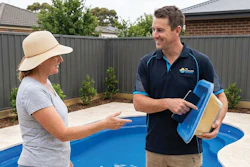
“The C260 course is worth every penny,” Black says. “It’s less expensive to take the course upfront and saves money by saving you from making mistakes down the road.”
“When I started in the industry, I had eight hours of training and no real installation guide,” Hughes says. “What I would give to be able to go back in time and take a 24-hour course like C260! Even as the instructor, I always walk away having learned something.”
Black encourages those who are new to the sector to take the course. “If you’re still hesitant, take advantage of the course to get well-trained and feel more confident.”