









The steady rise of the fiberglass pool is down to a simple fact — from a homeowner’s perspective, as a pool purchase, they’re a great value. However, their market share has lagged behind concrete and vinyl due to a couple main factors. One, inertia in the industry. Pools are complex interdisciplinary structures, and builders as a whole have always been slow to change for good reason — change risks calamity if the new method or material doesn’t deliver. It’s sensible to go with the tried and true and make incremental changes along the way.
But another reason is persistent myths among the pool customer base. Some of this has to do with the history of fiberglass pools, which, as a lowcost pool option, have seen their share of installation failures. And some of it has to do with the nature of humanity to invent explanations for phenomena they don’t understand. And some is just rumor that becomes folk legend — a pool pops out of the ground, and it’s an interesting story with legs, and the next thing you know, it’s as common as pump failure.
So today, we address some of those persistent myths and even invent a few of our own. You can show it to your next client, just for fun.
NO. 1: FIBERGLASS POOLS COMMONLY POP AND FLOAT.
This old saw has somehow endured for decades. A pool full of water presents no danger of floating, but as a matter of physics, any emptied pool shell surrounded by waterlogged soil can float just like a boat. Fiberglass pools are lighter than concrete pools, and therefore will float with less hydrostatic pressure. Has that ever happened? Yes, but it’s rare, and nowadays any reputable fiberglass builder will install a dewatering system during the build to remove the risk of floating. This is just a piece of PVC pipe that’s installed vertically on the side of the pool and reaches down below the deep end. At any time, a pump line can be dropped into the pipe to suck up and drain water surrounding the pool if for some reason the pool needs to be emptied.
NO. 2: FIBERGLASS POOLS LOOK BOXY AND PLAIN.
It’s true that concrete pools offer more complex shapes when complex shapes are required, but it’s a simple fact that the shape of a swimming pool shell has very little to do with the overall appearance of the project. That depends mostly on what you put around it.
In the words of Kate Wiseman, GENESIS instructor and designer at Sage Outdoor Designs, “The vessel’s material is not the design. A fiberglass pool backyard can be just as appealing and functional as a concrete one. And it starts with the beliefs and attitudes of the builder. I think my first question for builders taking my course is: ‘Why are you assuming that just because it’s fiberglass it has to look a certain way?’”
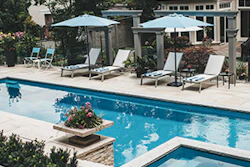
Sharpening this point even further, shell options for fiberglass broke out of standard rectangles many years ago, and have grown over time to include things like beach entries, tanning ledges, in-pool lounges, and much more. You can’t really determine at a glance a modern fiberglass pool from a concrete pool. The old stigma of the white bathtub is long gone. Builders now attach spas, spillways, vanishing edges, perimeter overflows and tile mosaics. They add high-end coping, decking, rockwork, and of course slides and fun features.
NO. 3: FIBERGLASS POOLS ARE CHEAPER BECAUSE THE MATERIALS ARE CHEAPER.
Well, the lower cost of a fiberglass pool is more about the time and labor involved for the builder. That is, the total number of skilled workers required and the total time they have to spend putting in the pool. Fiberglass pools are typically completed in 1-4 weeks (maybe even less!) rather than 1-4 months for cement. In addition to these benefits, there are fewer “go-backs,” as the fiberglass shell is handcrafted in a controlled environment rather than outdoors in unpredictable weather.
NO. 4: HOMEOWNERS ACTUALLY PREFER GUNITE’S LONG INSTALLATION TIME AS IT GIVES THEM A CHANCE TO GET TO KNOW THE CREW.
Yes, as anyone who’s had ongoing construction on their property knows, it always ends too soon with sad goodbyes and promises to keep in touch. 😂
NO. 5: FIBERGLASS POOLS ARE MUCH MORE POPULAR IN AUSTRALIA.

That is a little known, but rather telling fact. Fiberglass has seen explosive growth since the turn of the century in Australia, and has now become the pool of choice. Fiberglass pools have a larger market share of new pool construction than concrete pools. Why? That is subject for speculation, but there are two obvious reasons. One is that the pool industry didn’t develop in Australia as a concrete-dominant industry to the same extent as America. And two, higher-end builders have embraced fiberglass pools and apply the aforementioned principle, thereby avoiding the stigma of the low-end pool.
NO. 6: FIBERGLASS POOLS REQUIRE EXTRA TIME TO CURE THE FINISH AND A TRICKY START UP WITH THE CHEMICALS TO AVOID DAMAGING THE SURFACE.
No, again, you’re way off. That’s gunite.
NO. 7: POOL STAINS FROM PRECIPITATING METALS, CALCIUM OR ORGANICS LIKE FALLEN LEAVES (WHICH CAN OCCUR IN ANY POOL) ARE A BIG PROBLEM FOR FIBERGLASS.
Not really. Muriatic acid takes care of metals and calcium while vitamin C in a tube sock (old service trick) removes organic stains such as leaves.
NO. 8: THE PLASTER/GUNITE SURFACE IS MORE PLEASING TO THE TOUCH.
The best way to describe the smooth fiberglass surface, relative to plaster, is “non-abrasive.” So it all depends on how you feel about being abraded. It’s nice when you want to exfoliate.
NO. 9: FIBERGLASS POOL INSTALLATION DOESN’T LOOK COOL.

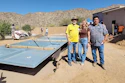
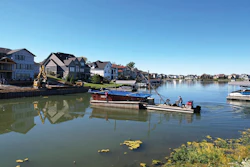
Actually, fiberglass pool installation is nothing but cool. First of all, trucking in a turned-up fiberglass pool shell on a flatbed trailer always draws attention — like, “Look what the Johnsons are up to now!” And then no matter how you get the fiberglass pool shell from the truck into the hole — whether it’s by crane, swung in over the roof and lowered out of the sky like a delivery from aqua-heaven itself; overland by a diesel off-highway loader or telehandler with straps; floated in like a barge across navigable waterways; rappelled in by a CH-47 Chinook heavy-lift helicopter; or some other means of moving a 4,000-pound shell — all of them are much cooler than a truck and a hose and a bunch of guys spraying gunite in a hole. Most neighbors are not even sure what they’re doing down there.
Which is cooler? You decide.
NO. 10: YOU CAN’T HAVE A WIDE FIBERGLASS POOL DUE TO SHIPPING RESTRICTIONS.
It is true that US Department of Transportation (DOT) highway transportation regulations generally limit fiberglass pool shipments to a maximum width of 16 feet. However, some manufacturers make modular designs that can be assembled on site to get around that. For most customers, a 16-foot width (and a length up to 40 feet and beyond) is plenty of pool.
NO. 11: FIBERGLASS POOLS ARE HARDER TO TAKE CARE OF.
That is not a myth because nobody has ever suggested that in the first place. Fiberglass pools are well known to be easier to take care of. The fiberglass surface is not porous like plaster, and that has important implications for longterm care.
Perhaps most importantly, the smooth impermeable fiberglass surface offers no purchase for the probing fingers of algae, always seeking a place to take hold and start growing a colony. This stands in contrast to gunite, which offers a whole irregular mini coastline of inlets where algae spores can settle and begin growing algae civilizations.
The chlorine and chemicals that would be employed to fight algae in a gunite pool, having no such battle in a fiberglass pool, can therefore be mustered against their more traditional enemies such as bather waste and pool debris ingress from natural sources around the pool.
At the same time, as a service tech attempts to keep water in balance, pH, alkalinity and calcium bounce are easier to manage because there’s no interaction between the water and the fiberglass surface as there is in plaster pools.
However, some argue that part is not the best part — which is the long term outlook.
You can’t really determine at a glance a modern fiberglass pool from a concrete pool. The old stigma of the white bathtub is long gone.
With a vinyl pool, the liner has to be replaced regularly. With a plaster surface, you’ll have to acid wash it or resurface it altogether. There is no reliable research on the lifespan of fiberglass pools but anecdotal evidence points to a lifespan of something like 25 years. Some manufacturers offer lifetime warranties on the shells.
This article first appeared in the February 2026 issue of AQUA Magazine — the top resource for retailers, builders and service pros in the pool and spa industry. Subscriptions to the print magazine are free to all industry professionals. Click here to subscribe.