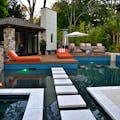
For Denise Canchola de Tournillon, water has always been more than a backdrop. It has been a place of movement, recovery, reflection and renewal.
Her relationship with water began long before her work in mental health. With an undergraduate degree in marine biology, Canchola de Tournillon originally imagined a life spent in shorts and flip-flops, close to the ocean and the natural world. But an early job in a laboratory at a psychiatric hospital led her into patient care, and soon after, she pursued training as a psychiatric and mental health nurse practitioner at Yale University.
Today, Canchola de Tournillon brings those worlds together. Her work blends psychiatry, psychotherapy, wellness and water — specifically, moving water — as a way to help patients think, feel and heal differently. “I’m marine biology. I’m psychiatry. I’m a nurse practitioner,” she says. “I love working out in water.”
Canchola de Tournillon has spent decades working with patients, diagnosing and prescribing medication, but she is also deeply interested in what happens beyond the prescription pad. In her view, medication can be necessary and life-changing, but it should not be the only tool available.
“We weren’t born on meds,” she says. “Many of us don’t need to be on them long term. Some of us do, when genetics or severe stressors are involved. But in other cases, medication can be part of a season of care — and, when appropriate, something patients may eventually taper off with the guidance of their provider.”
That philosophy has led her to explore therapeutic environments that help patients access new ways of thinking — and water, she says, is one of the most powerful.
A DIFFERENT SETTING FOR THERAPY
In traditional therapy, a patient waits in an office, enters a room, sits on a couch and begins talking. That format can be effective, but Canchola de Tournillon believes the physical environment can influence how quickly people relax and engage with difficult emotions.
In water, the ritual changes.
Rather than sitting still, patients are moving. Rather than being confined to a chair, they are supported by water. Rather than focusing only on the conversation, they are also aware of breath, balance, resistance and rhythm.
“There’s a certain ritual that happens within office therapy that’s completely different in the pool,” she says. “You’re working on your physicality, your own feelings and emotions through the water while you’re talking to somebody about problems.”
For some patients, that may mean walking in shallow water while talking through stress, grief, anxiety or relationship issues. For others, it may mean using water as a place to practice breathing, build strength or reframe a difficult situation.
Canchola de Tournillon also uses telehealth in some therapy sessions, allowing patients to connect with a therapist while they are in their own pools. With a small computer, speakers and video, she can see and hear the patient while they move through the water.
“We talk through their issues while they’re in the water,” she says. “They see me on the video, and I see them in the pool.”
SPONTANEOUS FASCINATION
At the center of Canchola de Tournillon’s work is a concept she calls “spontaneous fascination.” In simple terms, it is the moment when the mind becomes gently engaged by the environment, enough to soften rigid thinking and allow a person to see a problem differently.
Moving water, she says, can create that state.
“The idea of using the swimming pool and moving current water — which is different than just the stagnant pool — is to create spontaneous fascination,” she says. “It makes it easier for us to change the way we think about our problems, how we think about our situations.”
That mental shift, she says, can soften the emotional weight of a problem as well. “We can change the way we feel,” she says. “We can have more hardiness, more strength, more courage, more resilience, flexibility.”
For patients who are used to decompressing with alcohol or other unhealthy habits, water can offer another kind of transition, a healthier cue that signals the body and mind to slow down.
She compares it to the way some people feel relief as soon as they pour a glass of wine after work. The relaxation begins before the alcohol has fully taken effect because the brain recognizes what is coming. Water, she believes, can offer a similar transition without the same risks.
“The idea is to take somebody who’s used to decompressing with alcohol at the end of the day and help them decompress with water in a more productive way,” she says. “When they get done, they’re better.”
MOVEMENT, SAFETY AND STRENGTH
Canchola de Tournillon is quick to point out that this kind of work does not require a deep or intimidating pool environment. In fact, she prefers shallow water, gentle movement and a setting where the patient feels physically and emotionally safe.
Clients are not asked to show up in traditional swimwear if that makes them uncomfortable. Instead, she prefers zip-up suits or clothing that allows them to move comfortably without focusing on their bodies. “They’re not there for their body,” she says. “They’re there for the brain.”
Warm, shallow water is also important. A current should not be so strong that it makes a person feel unstable. Instead, it should create enough resistance to engage the body while still allowing the person to feel grounded.
That resistance can be especially useful for older adults or people rebuilding strength. Moving through water requires balance, core engagement and coordination, but in a more forgiving environment than landbased exercise.
“You can work your body really hard in the water, or you can use it for relaxation,” she says. “Helping somebody who needs to build strength through the water is a good thing, especially when they feel safe.”
A NEW WAY TO THINK ABOUT POOLS
For the pool and spa industry, Canchola de Tournillon sees a major opportunity: to talk about pools not only as beautiful backyard centerpieces, but as environments that support health and emotional wellness.
“I think many times we’re about selling beauty,” she says. “And we don’t have to give up beauty to put a current in water.”
In her view, the next step is helping homeowners understand that a pool can be more than a place for children to play or guests to gather on a sunny afternoon. It can also be a personal wellness space — one used early in the morning, after work or in the evening when the rest of the household is quiet.
“We just don’t think about the pool at night,” she says. “All the pools I see are daytime. They’re beautiful to look at in the daytime, and then at night they go to sleep.”
But for many adults, she says, nighttime may be when the pool has the most to offer. With moving water, lighting, music and a quiet environment, the pool can become a place to move, meditate, breathe and reset.
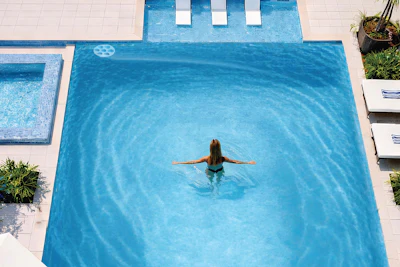
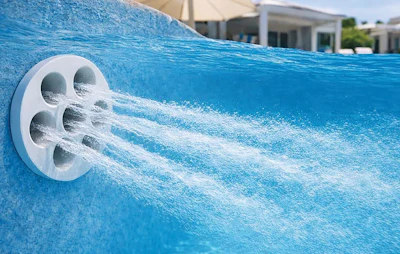
Her own concept, BlueOrbit, is built around that idea (see sidebar). The design uses a current to move water in a circular pattern, creating a gentle, continuous flow. She imagines it paired with lighting and music to create an immersive wellness experience.
“The power of water is understood,” she says. “The power of a current in water to make it come alive is a game changer.”
WELLNESS FOR THE INDUSTRY, TOO
Canchola de Tournillon also believes pool and spa professionals should see themselves in this conversation. Builders, designers, retailers and service professionals spend their days helping clients create spaces for relaxation and connection. But many of them are also high-stress, high-output people who could benefit from those same tools.
“Pool builders are high-energy people,” she says. “They do things quickly. They’re used to the environment. They’re used to working in the dirt and the heat.”
For those professionals, water can be a reminder that wellness is not only something to sell to clients. It is something to practice.
That does not require a million-dollar backyard or an elaborate design. Canchola de Tournillon believes smaller pools, thoughtfully designed with movement and wellness in mind, can still offer meaningful benefits.
“You don’t need a giant swimming pool with everything that your million-dollar pools look like,” she says. “You need to take care of you.”
LIVING WELL
Ultimately, Canchola de Tournillon’s work is about helping people feel less powerless — in their bodies, their minds and their lives. Whether she is working with anxiety, recovery, stress, aging or grief, her goal is to help patients reconnect with their own strength.
She often talks about resilience, hardiness and the mind-body connection. Water, she believes, can help mobilize those qualities faster because it engages the whole person at once.
“There is something to be said about moving your body while you’re working your brain,” she says.
For Canchola de Tournillon, that is the heart of the work. Water gives people a place to breathe, move, think and feel differently. It allows the body to participate in healing instead of simply sitting beside it.
“I’m about living well,” she says. “I want to match my internal exuberance with my external body so they match each other, and that I have a good life to the very end.”
And for her, water is one of the clearest paths to that kind of life.
“Every time,” she says. “Water does that.”
WHAT IS BLUEORBIT?
BlueOrbit is RiverFlow’s whole-pool hydrotherapy concept, designed to bring gentle, continuous movement into the pool environment.
For Denise Canchola de Tournillon, the idea connects directly to her own experience with water. A distance runner, she turned to aquatic exercise after a knee injury made running difficult. At first, she tried swimming in an enclosed current system, but the experience felt loud and confined — more like “swimming inside the washing machine,” she says. What she wanted was a better current in her own pool, one that would allow her to move, swim and rebuild strength without the same impact on her knees and joints.
That search eventually led Denise and her husband, Phil de Tournillon, to current-system technology that helped shape RiverFlow, the company now led by Phil. Since then, the system has been retooled, redesigned and refined for residential and commercial applications.
BlueOrbit takes that current-system technology in a wellness-focused direction. Rather than creating a forceful swim-in-place current, the concept is designed to move water in a gentle circular pattern throughout the pool. RiverFlow describes the result as whole-pool hydrotherapy — a smooth, controlled current that can support walking, stretching, floating, resistance exercise and relaxation.
For builders and designers, BlueOrbit offers another way to talk about pool value. A pool can still be beautiful, but with moving water, it also becomes an active wellness space — one designed not only to be seen, but to be used.