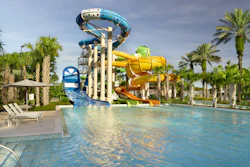













In one of the Indiana Jones films, our hero must take a blind leap onto a well-camouflaged ledge without knowing it's there. Making the leap from residential to commercial pool construction can feel much the same — like a blind leap of faith. The opportunity can bring significant financial rewards, but it also comes with substantial risks and unfamiliar challenges. This article explores a few of the equipment-related considerations contractors should understand before making that leap.
Commercial pools are not simply larger versions of residential pools. Their structures are bigger and are often elevated, built atop a structure or located inside a building. Signage and accessible entry are required, while applicable health, building and safety codes add further layers of complexity. Put simply, the rules are different.
Consider turnover rate: the theoretical amount of time required for the pool's entire volume to pass through the water-treatment system. A residential pool may typically turn over two to four times per day. Depending on the facility type and governing code, commercial pools can require much faster turnover. Wave pools and lazy rivers, for example, may turn over 12 times per day or more, while a 50-meter competition pool may require six turnovers per day. When a pool holds half a million gallons, those requirements create enormous flow rates — and demand correspondingly larger equipment.
Pipe
Start with the hydraulics. A 50-meter pool might have a design flow rate of 2,000 gallons per minute, requiring pipe 12 inches in diameter or larger — or multiple parallel runs. PVC pipe is available in diameters up to 24 inches, but costs and installation challenges increase dramatically with size. A 12-inch tee is not merely twice the cost of a 6-inch tee; a single 12-inch Schedule 80 PVC tee can cost more than $1,400.
Installation methods must scale up as well. This is not the place for rapid-set solvent-welding products, and a single spigot connection may require approximately a quart of solvent cement. Seating pipe into a fitting of that size requires considerable force, often with the help of mechanical come-alongs or hydraulic equipment.
Filters
Handling higher commercial flow rates is not as simple as placing a dozen residential filters in parallel. Hydraulically balancing more than two filters on a single pump can be extremely difficult. If one filter becomes overloaded, the resulting hydraulic or physical failure can cascade from one filter to the next.
Residential filters are generally lighter, with thinner walls and less substantial fittings and internal distribution systems. Commercial applications call for larger, more robust vessels designed for continuous, 24-hour operation. Fiberglass walls may be up to 1/2 inch (12 mm) thick.
To put that scale in perspective, one manufacturer offers a horizontal fiberglass sand filter with more than 80 square feet of filter area. The vessel measures 60 inches (152 cm) in diameter and 204 inches (518 cm) long, with an NSF-rated flow of 1,616 gallons per minute (6,116 liters per minute) and 8-inch face piping.
To conserve floor space, large filters are often stacked on steel frames. They may use a single-lever linkage system to operate four butterfly valves, moving the system from filter mode to backwash mode and back again. Hydraulic and electrically actuated valves are also available, including systems that initiate backwashing automatically based on loss-of-head sensors or timers.
The scale presents logistical challenges as well. The aforementioned filter weighs more than 1,570 pounds (714 kg) empty and more than 32,000 pounds (14,545 kg) in operation. Its sand media alone weighs approximately 15,300 pounds (6,954 kg). Equipment of this size requires careful planning for delivery, placement, structural support and future service access.
Other filtration technologies — including regenerative media, vacuum sand and diatomaceous earth systems — are also available for commercial applications, although a full discussion is beyond the scope of this article.
Pumps
Commercial pool pumps typically begin around 7.5 horsepower (5.5 kW), while large facilities may use pumps in the 40- to 60-horsepower range (29.8 to 44.8 kW). These are generally not the composite-body pumps and plastic strainer baskets familiar to residential contractors. Commercial pumps are often constructed of cast iron, sometimes with bronze impellers and 1-inch stainless-steel shafts. Some manufacturers, however, offer commercial-grade pumps with composite polymer casings in sizes up to 15 or 20 horsepower.
In decades past, engineers often specified an impeller diameter to meet the exact design point — flow versus total dynamic head — of a fixed-speed pump. Variable-frequency drives could cost $15,000 per pump. As the technology became more affordable, variable-speed operation became increasingly common, reducing the need to machine impellers to exact diameters.
Commercial pool pumps also require pressure and compound gauges mounted on or near the pump. Their readings allow the operator to calculate total dynamic head and confirm that the pump is operating within its specified parameters.
Pumps above 7.5 horsepower are typically powered by three-phase current, which is more efficient than single-phase power and generally uses more conductors of a smaller size. Where three-phase utility power is unavailable, contractors may need a phase converter or a variable-frequency drive designed to accept single-phase input and supply three-phase output to the pump.
Commercial pumps may be mounted horizontally, much like residential models, or vertically. Vertical configurations can conserve valuable equipment room space, particularly in facilities with multiple pumps serving water features. Some designs place the pump above the strainer basket to further reduce the equipment footprint.
Strainers
Once contractors move beyond smaller pumps, strainers are usually purchased separately. They may be concentric, with influent and effluent connections of the same size, or reducing strainers that accommodate a change in pipe or pump-suction size without requiring a separate reducing fitting.
Strainer height is an easily overlooked design consideration. More than one contractor has installed a pump only to discover that aligning the strainer centerline with the pump suction would place the bottom of the strainer below floor level. Careful dimensional coordination before installation can prevent an expensive and disruptive correction.
Plan Before You Leap
The good news is that our Indiana Jones hero made the leap and lived to fight another day. Residential contractors can successfully make the move into commercial pool construction, too. The key is recognizing that scale changes far more than equipment size. It affects hydraulics, costs, logistics, structural loads, power requirements, installation methods and service access. Know where the pitfalls lie, plan for them early and make the leap with your eyes open.