








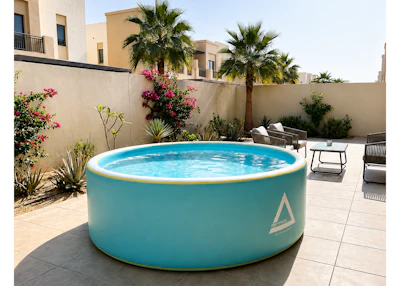
Drop-stitch material is not new. Its use in stand-up paddleboards, inflatable docks, kayaks and other marine products is already well established.
What is less familiar is what happens when the same construction principle is scaled from a board or platform to the wall of a swimming pool.
At that scale, drop stitch stops being simply a convenient way to make an inflatable product feel firm. It becomes part of the structural system holding back a large volume of water.
That distinction is important because a drop stitch pool operates very differently from what most people imagine when they hear the words “inflatable pool.”
Air Pressure Alone Is Not the Technology
A conventional inflatable chamber naturally wants to become round when it is pressurized. Tubes, rings and air chambers take on curved shapes because the internal pressure acts against a flexible membrane.
Drop-stitch construction changes that geometry.
Two opposing coated-fabric surfaces are connected internally by a dense field of yarns. As the chamber is inflated, the two surfaces try to move apart, but the yarns limit that movement and maintain a controlled distance between them.
Instead of expanding into a rounded tube, the chamber can form a comparatively flat panel.
Pressure tensions the skins and the internal yarn system. Together, they create a wall that can resist bending and local deformation far more effectively than a conventional soft inflatable chamber.
It is worth being precise about the word “rigid.” A drop stitch wall is not rigid in the same engineering sense as steel, concrete or a molded composite panel. It remains a flexible, pressure-dependent structure.
But when correctly designed and inflated, the difference in behavior is substantial enough that the wall functions much more like a structural panel than the side of a typical inflatable product.
That is the feature that makes drop stitch particularly interesting for aboveground swimming pools.

A Swimming Pool Changes the Structural Problem
Scaling drop stitch from a paddleboard to a swimming pool is not simply a matter of producing a larger piece of material.
The loads are fundamentally different.
A paddleboard primarily carries people and equipment over a relatively small structure.
A swimming pool wall continuously restrains a large mass of water around its entire perimeter. Water pressure increases with depth, so the lower portion of the wall experiences greater outward loading than the upper portion.
The wall must also preserve its shape while transferring those loads through seams, the floor connection and the rest of the pool structure.
For that reason, a drop stitch pool should be viewed as a complete structural system rather than a pool made from an unusual fabric.
The characteristics of the drop stitch panel matter, but so do wall dimensions, internal pressure, coatings, seams, reinforcement, connection to the floor, valves, fittings and overall pool geometry.
Geometry is especially important.
Circular pools are a natural application because the outward load can be distributed around a continuous perimeter. There are no corners where flat walls must meet and where local load paths become more complicated.
Other shapes can certainly be manufactured, but as the geometry becomes more complex, so does the structural problem.
At swimming pool scale, good drop stitch design is therefore as much about engineering the complete form as it is about selecting the material.
Why It Behaves Differently From a Conventional Inflatable Pool
The fact that both products contain air can make the distinction confusing.
In many conventional inflatable pools, air is used to create soft tubes or chambers, while the water and flexible liner contribute significantly to the final shape of the pool.
A drop stitch pool uses air differently.
The pressure is used to create tension inside a constrained wall structure. Because the inner and outer surfaces are tied together, they can remain nearly parallel instead of ballooning outward.
That produces several practical differences.
The wall can be relatively thin compared with its height. Its surfaces can remain comparatively flat. It can resist local deformation more strongly. And it can support itself without relying on a traditional perimeter of external metal posts to establish its basic shape.
Perhaps the most unusual characteristic is that the same wall can exist in two radically different states.
Deflated, it is flexible and can be folded, boxed, stored and shipped easily.
Inflated, it becomes a high-stiffness structural element.
That combination is difficult to achieve with conventional pool construction.

Where Did the Metal Frame Go?
A drop stitch pool without a traditional external metal frame is sometimes described simply as “frameless.”
That description is understandable, but it can also be misleading.
The structure has not disappeared. Much of it has moved into the wall.
In a conventional frame pool, the flexible liner retains the water while an external system of posts, rails and other components provides structural support and maintains the pool geometry.
In a drop stitch pool, the pressurized wall itself performs much of that structural role.
The coated skins, internal yarns, inflation pressure, seams and pool geometry work together to resist the outward load created by the water.
This can produce a very clean exterior, without the repeated vertical posts and perimeter frame associated with many above-ground pools.
But eliminating the external frame does not eliminate engineering requirements.
In fact, it makes the integrity of the pressure-bearing wall particularly important.
Seams, material transitions and connections are no longer merely details that keep air inside. They are part of the load-bearing system.
This has direct consequences for manufacturing and quality control.
Material consistency, seam construction, pressure testing and inspection become central to the reliability of the finished pool.
The product may look simple once installed, but that visual simplicity is the result of moving structural complexity into the construction itself.
Portability Means More Than Being Lightweight
The second major difference becomes obvious when the swimming season ends.
A rigid-wall or framed pool occupies physical space even when it is not being used. Components may be dismantled, but posts, rails and wall sections still have to be stored somewhere.
A drop stitch wall behaves differently.
Once the air is released, most of the structural volume disappears. A pool that formed a large, stiff structure during operation can be folded into a much smaller volume for transportation or seasonal storage.
That also affects the supply chain.
A large installed pool can travel from factory to warehouse, dealer and customer in a compact state and only acquire its full structural dimensions at the final installation site.
However, “portable” should not be confused with “light.”
A serious pool still contains a considerable amount of reinforced material, along with its floor, valves and fittings. Larger models can be heavy and may require several people to move safely.
The more useful concept is structural portability.
The structure can change from a compact flexible package into a large pressure-stiffened pool and later return to its compact state without permanently installed structural components.
That characteristic can be particularly relevant in seasonal climates, holiday properties and locations where outdoor space has different uses during different parts of the year.
Where Drop Stitch Makes Sense
Drop stitch appears to occupy an interesting space between several existing pool categories.
At one end of the market are inexpensive soft inflatable pools. They are compact and simple, but are generally designed around flexibility rather than wall stiffness.
Further up are conventional framed above-ground pools, which provide substantial capacity and proven construction using external structural components.
Beyond those are rigid-wall and permanent pools, where portability is no longer a primary objective.
Drop stitch can make sense where a customer wants a combination that these categories do not always provide: a high-stiffness wall, no traditional external metal frame, seasonal installation, compact storage and the possibility of relocating the pool.
It may also appeal where appearance matters.
Removing a perimeter of structural posts gives designers a different exterior form to work with and makes the wall itself the dominant visual element.
And in a seasonal installation, the ability to remove almost the entire pool structure can be more important than simply making installation faster.
A patio, garden or recreational area can return to another use when the swimming season ends.

Where It Does Not Make Sense
The technology also has clear limitations, and acknowledging them is important if drop stitch is to mature beyond being treated as a novelty.
It is unlikely to be the right solution at the lowest end of the market.
Drop-stitch material, pressure-bearing construction and the manufacturing controls required to produce a reliable large structure are more involved than those required for a basic soft inflatable product.
It is of course not a replacement for architecturally integrated swimming pools, complex custom-shaped pools or permanent commercial installations. These have little reason to value foldability or seasonal storage.
Other construction methods can be much more logical for those applications.
Drop stitch also creates its own maintenance considerations.
Wall stiffness depends on appropriate internal pressure. Pressure-bearing seams and valves must remain in good condition. Flexible coated materials require protection from unsuitable surfaces, sharp objects, abrasion and poor storage.
Site preparation also remains important.
A pool may be removable, but the water inside it still has considerable mass. A stable and appropriately prepared base matters regardless of whether the wall is made from steel, a liner system or drop stitch.
And none of the normal responsibilities associated with swimming pools disappear simply because the structure can be deflated. Water treatment, circulation, electrical safety, supervision and applicable local safety requirements remain exactly that: pool requirements.
A New Category, or Just Another Inflatable?
This may be the most interesting question for the pool industry.
Existing categories are relatively easy to understand.
There are soft inflatable pools. There are framed above-ground pools. There are rigid-wall pools. And there are permanent constructed pools.
Drop stitch sits awkwardly between them.
Calling it simply an “inflatable pool” describes how the wall receives pressure, but says little about how the wall behaves once pressurized.
Calling it a rigid-wall pool ignores the fact that the structure can be depressurized and folded.
Calling it frameless describes what is absent rather than what is actually carrying the load.
One possible description is a pressure-stiffened above-ground pool.
Whether terminology like that becomes useful will depend on whether the technology develops into a meaningful market segment rather than remaining a niche product.
That will require more than attractive products.
Manufacturers will need consistent approaches to structural design, materials, pressure, seam quality, durability, repairability and quality control.
Dealers and pool professionals will need to understand where the product belongs and, just as importantly, where it does not.
Consumers will ultimately determine whether the combination of wall stiffness, seasonal storage and portability solves a problem worth paying for.
Drop stitch does not need to replace frame pools or permanent pools to become a legitimate category.
That is probably the wrong standard by which to judge it.
New categories often emerge because they occupy the space between existing solutions.
There is a clear gap between the traditional soft inflatable pool and an above-ground pool whose structure depends on a permanent rigid wall or external frame.
Drop stitch offers a technically different way to occupy that gap.
The question now is not whether a swimming pool can be built this way. It can. The more interesting question is how large that space between the existing categories may eventually become.
Alibek Salmenov is the founder of ISKYPOOL, a company focused on the development and commercialization of above-ground swimming pools using drop stitch construction. His work includes product development, manufacturing, quality control and the adaptation of pressure-stiffened textile structures to swimming-pool scale.