










Luxury, once defined by what a backyard displayed, is now defined by how intelligently it performs. Across North America, designers are now creating outdoor living environments that withstand drought and downpour, heatwaves and freeze-thaw cycles, all while delivering a seamless, resort-level experience.
The modern pool is no longer a standalone feature, but part of a carefully composed system of water, shade, sun, materials, and softscape that must work in quiet harmony with its environment.
In this new reality, true luxury is not excess, but foresight: environments that anticipate conditions, reduce demands, and remain as compelling in 20 years as they were the day they were completed.
This shift is reshaping how outdoor environments are planned and built. Rather than relying on static design approaches, today’s projects demand a more responsive mindset — one that considers regional conditions, material performance, and long-term efficiency from the outset. The result is a new standard of outdoor living: spaces that are not only visually refined, but engineered to perform consistently over time.
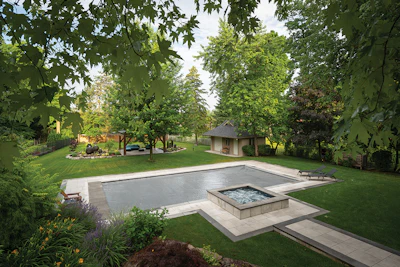
 This outdoor space features two elements designed by John Kenyon: a koi pond that captures rainwater next to the pool, and a shade structure inspired by an Asian tea house.
DESIGNING AND BUILDING FOR REGIONAL CONDITIONS
While the principles of good design remain consistent, their application varies significantly across North America. From arid regions in the Southwest to humid coastal climates and the freeze-thaw conditions of the North, outdoor living environments must be tailored to perform within their specific conditions. A one-size-fits-all approach no longer meets the expectations of today’s client.
Whether designing for heat, humidity, or frost, the goal doesn’t change: It is our job to create environments that feel effortless, perform reliably, and deliver a refined, luxury experience.
HOTTER AND DRIER REGIONS
In hotter, drier regions, water conservation and heat management take center stage. Pool sizing, evaporation control, and the integration of shade all play a critical role in comfort and efficiency.
Automatic safety covers, in particular, have become essential — significantly reducing evaporation while improving thermal retention and overall water efficiency. In more advanced applications, water reservoirs, rain capture systems, and integrated storage vessels can support irrigation demands and manage limited resources. In some regions, swimming pools have also played a role in fire management, both at the residential level and in response to wildfires.
HOT, HUMID CLIMATES
In hot, humid climates, airflow and moisture management take precedence. Covered structures must be designed to breathe, materials must resist mold and deterioration, and drainage strategies become essential to protect both the aesthetic and structural integrity of the space.
Here, thoughtful detailing during construction is just as important as the overall design intent.
NORTHERN CLIMATES
In northern climates, durability defines sustainability. Freeze-thaw cycles, long winters, and deep frost require careful attention to material selection, base preparation, and installation methods.
At the same time, the growing demand for extended seasonal use — even year-round outdoor living — places additional pressure on design-build teams. These environments must not only perform under extreme conditions, but remain visually compelling throughout all seasons. Again, automatic covers play a starting role in these four-season resorts!
Across all regions, the most successful projects are those that respond directly to their environment, balancing aesthetics with performance. The result is outdoor living that feels effortless — but is anything but accidental.
In my own work, I’ve seen firsthand that the most successful outdoor environments are not the ones that chase trends, but the ones that quietly perform year after year. When design decisions are guided by how a space will live, age, and respond to its environment, the result is something far more valuable than visual impact alone. It becomes an investment in longevity, in comfort, and in a way of living that endures.