









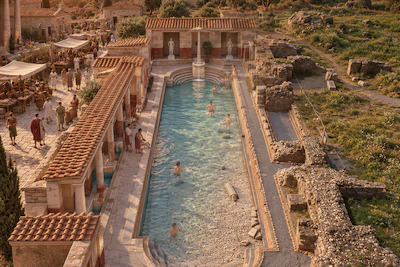
Somewhere in the foothills above the city, a drop of rain fell on the crown of a promontory, joined with another drop that had landed only millimeters away, then they both slid down the side of the outcropping and into a rivulet, then a stream, then a man-made channel.
This was a box channel, 5 feet high, 2 feet wide, but over 100,000 feet long. It was just a long, open box, pitched ever so slightly at one end so water would flow for 20 miles, over hill and dale to a catch basin/distribution point at the other end. There, our two drops of clear, clean rainwater and billions more like them were directed to refresh the luxurious Roman provincial pool at Tralleis.
It was the 1st century AD, in a place about 500 miles northwest of Jerusalem in what is now Turkey. The pool itself, only recently discovered, was about 40 yards long by 40 feet wide, with an area of roughly 4700 square feet, so it could serve as many as 300 bathers at a time.
But wait, 300 bathers and no pumps, no filters, and especially no chlorine?! All that bather waste under the hot Anatolian sun must have turned the pool into a green swamp in a matter of days, right?
Actually, no. The pool was used for many decades, perhaps centuries, and throughout its long service life it provided sparkling clear, chemical-free recreational water.
It used a gravity-fed system. Instead of moving water with pumps, rainfall in the mountains flowed down into the long aqueduct box channel, into the pool and out the main drain, into the sewer and out to sea — continually, 24-7. Contaminated water was simply flushed, and replaced with clean. When pool maintenance was required, you just turned off the valve, the water drained, and you resurfaced or scrubbed the walls, opened the valve, and the pool was back in service.