













The hardest part of developing a future leader may not be teaching that person what you know. It may be resisting the urge to take over.
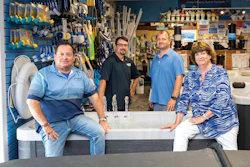
When Mike Panella brought a problem to Dave Thompson, the longtime owner of Swimming Pool Services rarely offered the answer Panella was looking for.
Instead, Thompson would tell him, “I look forward to seeing how you’re going to solve that.”
Panella was young, relatively new to the pool and spa industry and suddenly responsible for running an entire department. He did not always know what to do. Sometimes, the decisions he made worked. Sometimes, he says, he “really screwed things up.”
Thompson gave him room to do both.
Years later, that young retail associate would become CEO and majority owner of the company alongside Justin Lex, who had started one month after Panella as a seasonal maintenance technician.
The transition did not begin when ownership shares changed hands. It began each time Thompson chose not to solve a problem for them.
Across the pool and spa industry, leadership is often built in moments like these: An experienced professional takes time to answer a question, a manager notices an employee’s strength, or a business owner allows someone else to make a consequential decision.
These exchanges are often described as mentorship, but the relationships featured here reveal something more demanding than offering advice. Developing another leader requires trust, honesty and, sometimes, the willingness to give away some of the authority that experience has earned.
It also changes both people.
The mentee gains knowledge, confidence and responsibility. The mentor must learn when to guide, when to challenge and when to step aside. Eventually, the relationship may no longer fit neatly into its original roles. Mentor and mentee become colleagues, business partners or, in Thompson’s case, owner and employee — with the former mentees now serving as his bosses.
Each of the following relationships took a different path. Together, they demonstrate how leaders create room for someone else to rise — and what can happen when that person is trusted to step into it.
 All photos courtesy Stephens, Wachowski and Hanson
A CHAIN OF CONFIDENCE
When Mallory Wachowski first met Alicia Stephens, their relationship was straightforward: Stephens represented a vendor, and Wachowski worked for one of its dealer customers.
Wachowski had questions about water chemistry and the problems she encountered in the retail store. Stephens had the advanced technical knowledge to answer them.
What stood out to Wachowski, however, was not simply that Stephens knew more. It was that she made time to explain.
“I really like to understand,” Wachowski says, “and she would take the time to walk me through the why behind it.”
Stephens meets many people through her work, but she recognized something familiar in Wachowski’s curiosity.
“There was just something about Mal and the way she approached things and her thirst for knowledge that caught my attention in a way that reminded me of me,” she says. “I want to understand. I want to learn.”
What began with water chemistry gradually expanded into career decisions, personal challenges and a friendship that grew alongside their professional relationship.
Wachowski eventually named Stephens as her mentor in an industry recognition — without telling her first.
“I kind of didn’t give her a choice,” Wachowski says, laughing.
Stephens was surprised, but honored.
Now that both women work for BioGuard, their relationship has evolved again. They are coworkers “in every sense of the word,” with strengths that complement one another.
“There’s nothing about me that is better or above Mallory in any way,” Stephens says. “This is not a one-way street as far as mentorship goes because it’s definitely a partnership more than anything.”
When collaborating on projects, they sometimes clarify what kind of support one is seeking from the other. “Do you want my work hat or my friend hat? Tell me which one,” Stephens will ask. “And we’re able to move between the two.”
As Wachowski grew in her career, she began offering that same kind of guidance to someone else.
Allison Hanson entered the pool and spa industry almost on a whim. After returning from studying abroad, she realized she had forgotten to line up a summer job and applied at the pool store that had built her family’s pool.
Wachowski was the retail manager.
Hanson quickly noticed that customers entered the store asking specifically for Wachowski. She seemed to be the person everyone relied on for answers.
But as her manager, Wachowski did not concentrate only on becoming indispensable to customers. She also looked for ways to make the people around her more capable.
“She was really invested in helping us succeed,” Hanson says. “Whether it be giving us different little projects, trying to build on those strengths and genuinely being interested in what we were interested in, what we wanted to do and be good at.”
Wachowski helped Hanson recognize an interest in sales. So after leaving the pool industry to become a teacher, Hanson eventually realized she missed the more outward-facing, people-oriented work she had enjoyed before. As she reconsidered her career, she called Wachowski for advice.
Hanson thought about returning to the retail store, but Wachowski encouraged her to take a different path. She connected Hanson with an industry representative seeking a replacement, helping her reenter the pool and spa field in a role she might not have otherwise found. That introduction ultimately led Hanson to BioGuard, where she now works alongside Wachowski and Stephens.
When Hanson told Wachowski she would not be where she was without her, Wachowski immediately returned the credit.
“She said, ‘That might be true in that you might not be here if you hadn’t worked at the pool store, but you got here all by yourself. I just gave you the knowledge you needed to succeed,’” Hanson recalls.
That response captured what Hanson values most about Wachowski’s leadership: She offered guidance without taking ownership of where it led.
“She wants to build you up and not be like, ‘That’s my girl, Allison. I’m the reason she’s so good,’” Hanson says. “She really focuses on how we can grow with one another.”
Recently, Hanson revealed just how long she had looked up to Wachowski. After a BioGuard event, she remarked that her younger self would have thought she was the coolest person in the world simply for riding in Wachowski’s car.
The comment surprised Wachowski. “I hadn’t realized that she was observing me so closely during her years at the store,” she says. “Sometimes you don’t even realize you are a mentor until they tell you outright — or put it in a magazine.”
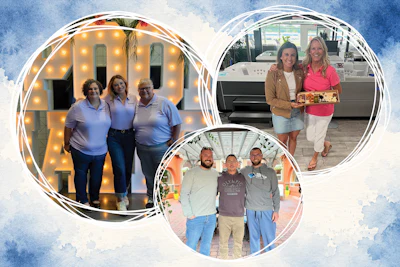
Today, Stephens, Wachowski and Hanson — each separated by roughly 10 years of age — represent three generations of mentorship within the same organization. “You have three generations of mentors within the same group,” Stephens says.
And Hanson is already thinking about who might come next.
“I’m always like, ‘Where’s my gal? Which pool store is she working at?’” Hanson says. “Maybe she isn’t yet, or maybe he isn’t.”
Until then, she approaches each new relationship with greater intention, looking for the same curiosity and willingness to learn that Wachowski once recognized in her.
“If I could help somebody find that confidence and take those leaps in their career — but most of all, remind them that they earned their success — that is what Mallory has done for me.”
 Photo courtesy Swimming Pool Services
LETTING GO OF THE VINE
Mike Panella and Justin Lex did not arrive at Swimming Pool Services with plans to lead it.
Panella was in his early 20s and, by his own description, lacked direction, purpose and ambition. He wanted a customer service job, remembered enjoying his family’s swimming pool and figured pools sounded fun.
“I ended up here the same way as everybody else — by accident,” he says.
Lex started about one month later as a seasonal maintenance technician. From there, he moved through the service office and into positions of increasing responsibility.
Within a few years, both men were placed in charge of major departments.
Lex became service manager despite being younger and less experienced than others on the team. His communication, organization and rapport with customers made him a natural fit for leadership, even if he did not yet have the longest pool industry resume.
Roughly one month later, Panella became retail manager.
Thompson gave each man the outcome he expected, but not a detailed set of instructions for producing it.
“Dave didn’t tell me, ‘This is what I want you to do in that retail store. This is what I want you to sell. This is how much to sell things for,’” Panella says. “He said, ‘These are the results I want. You figure out how to go out and get them.’”
That freedom was not always comfortable.
When Panella brought Thompson a problem, Thompson responded with questions rather than directions. Eventually, Panella stopped approaching him in search of an answer. He learned to examine the problem, develop possible solutions and make a recommendation.
Thompson’s leadership style had developed through his own trial and error.
Earlier in his career, he had experienced a more controlling management structure. When he later became the owner, he initially repeated a version of that pattern. Employees brought him problems, and he solved them.
The approach kept Thompson at the center of every decision. It also denied employees the opportunity to develop judgment of their own.
Through coaching and peer leadership groups, he learned to change the exchange. At one point, he established a rule that anyone bringing him a problem also had to bring three potential solutions.
Employees began anticipating his questions before walking into his office. They no longer considered only what was wrong; they began thinking about what could be done.
“You want people thinking about solutions,” Thompson says. “That’s when you’re getting leaders. But the only way to cultivate that is to not give them the answers.”
Not giving an answer is different from withdrawing support.
Thompson remained available. He asked questions, evaluated outcomes and helped Panella and Lex understand what could be done differently the next time. But he accepted that real responsibility carried the possibility of real mistakes.
Panella remembers decisions that cost the company money and could have affected client relationships. Thompson’s response was generally not to take back control. It was to ask what had been learned and how the company could prevent the same problem in the future.
“Learning always comes at a cost,” Panella says. “The question is, what is your appetite for risk in relation to letting people learn and grow?”
For many business owners, that risk can be difficult to accept. Their companies represent years of work, personal sacrifice and financial security. Allowing another person to make decisions can feel like placing that investment in someone else’s hands.
Yet Panella sees a different risk in refusing to do so.
Owners often complain that employees bring them every minor problem or cannot make decisions independently. But when every choice has always required the owner’s approval, the behavior should not be surprising.
“Those business owners allow themselves to be the bottleneck for any problem-solving and for any decision-making,” Panella says. “They’re simply reaping what they’ve sowed.”
Thompson’s willingness to “let go of the vine,” as Panella describes it, ultimately made a succession plan possible.
The ownership transition began at the end of 2021, when Thompson gave Panella and Lex minority stakes and placed them in the company’s driver’s seat.
Although Thompson remained majority owner and retained the CEO title, Panella began operating as CEO, while Lex took responsibility for operations. They were able to test the new arrangement before becoming majority owners.
By then, the shift was less radical than it might appear. Both men had spent years running departments with significant autonomy. They had already been expected to think and operate like owners within their areas of the company.
Expanding that responsibility across the entire organization was the next step, not a sudden leap.
In January 2024, Panella and Lex purchased majority ownership.
Thompson now makes a point of clarifying their roles. “They’re my bosses now,” he says.
The transition did not eliminate disagreement. Panella and Lex sometimes make decisions Thompson would not make. He offers his opinion and explains his concerns, but he also understands that the authority now belongs to them.
He learned that discipline years earlier through the company’s leadership team. There, Thompson had to support group decisions even when he disagreed with them. Sometimes, he later discovered his concerns had been justified. Other times, the decision worked better than he expected.
Either way, allowing leadership to exist beyond himself required him to accept that the company could not move forward only when everyone chose the option he personally preferred.
Panella and Lex have carried that principle into their own leadership.
Lex created a leadership academy for emerging employees. New hires also meet with all three men: Thompson explains the company’s history and processes, Panella discusses sales and design, and Lex introduces equipment and industry fundamentals.
Panella distinguishes that work from training someone to perform a task. Training can teach a technician to identify a pump, clean a filter or understand water chemistry. Developing a leader requires something broader: self-awareness, communication, empathy and the judgment to act without waiting for instructions.
Panella and Lex also continue to develop one another. They joined the company at nearly the same time, grew into leadership together and now operate as close friends and business partners.
About a year after they started, the two were delivering a hot tub when Panella turned to Lex and said, “Dude, someday you and I are going to be running this place.”
At the time, he meant they might become managers.
Soon, they did. Years later, they became owners.
The outcome might look like a successful ownership transaction. But the transaction was only possible because Thompson had spent years giving them something harder to document: permission to decide, permission to fail and enough room to discover that they could lead without him.
 All photos courtesy Ashley Kampmeier
CHOOSING TO COME HOME
Ashley Kampmeier grew up around Bachmann’s Pools, Spas & Saunas, but her parents and owners, Kiya and Fred Bachmann, never treated the family business as a future she owed them.
She spent childhood afternoons at the office, helping with inventory and filing after her mother picked her up from school. Later, she tested water, stocked shelves and swept floors during high school and college breaks.
Still, when Kampmeier graduated, Kiya and Fred encouraged her to build a life and career of her own.
“I wanted her to be able to go out and make new experiences,” Kiya says. “I didn’t want her to feel like she had to be here.”
That freedom may be part of what eventually allowed Kampmeier to return.
She spent more than a decade developing an identity outside the family company, first in retail leadership at Target and later in training, onboarding, human resources and content development at a large insurance brokerage.
The time away was important. Kampmeier wanted to know who she was apart from the business her parents had built — and what she could contribute beyond being their daughter.
“I wanted to form my own identity,” she says. “I wanted to find out who I was both personally and professionally.”
She did not spend those years preparing to inherit Bachmann’s. In fact, her parents periodically raised the possibility of her joining the company, and for years, she declined.
The opportunity emerged more organically.
As Bachmann’s grew, Kampmeier began helping from the sidelines, including writing job descriptions for positions the company needed to fill. One of those openings was for a customer relations and operations manager.
While on the way to a hockey game with her father, Kampmeier asked whether the role had been filled.
It had not.
“Because I’d like to apply for that,” she told him.
She joined the company in April 2024.
The decision was not driven by obligation. Kampmeier had reached a point in her previous career where she wanted to feel more challenged, appreciated and connected to the meaning behind her work. Bachmann’s offered the opportunity to bring together the skills she had developed elsewhere with the company she had known all her life.
“I really felt a calling to be a part of something bigger than anything I could have ever imagined,” she says. “I feel so lucky and inspired to be here. It took me a long time to feel that again.”
Kiya admits she had mixed emotions about her daughter returning. She understood how demanding the business could be and did not want Kampmeier to feel consumed by the same pressures she and Fred had carried for decades.
But within two years, any uncertainty had been replaced by pride.
“She has turned this business around tremendously,” Kiya says. “I couldn’t be more proud.”
The effect extended beyond daily operations.
Before Kampmeier joined, Kiya and Fred had begun planning their exit. They explored an employee stock ownership plan and considered selling the company outright.
Within approximately six months of their daughter’s return, those conversations changed.
“She reignited both of us,” Kiya says. “It made us realize that, no, we don’t want to just sell what we’ve built for 41 years.”
Kampmeier did not merely give them a possible successor. She gave them renewed energy for the work itself.
“I don’t get the Sunday scaries anymore,” Kampmeier says. “It’s not, ‘We have to come here.’ We get to come here. Another week is continuing to form our next legacy.”
That legacy is not being passed down unchanged.
Kampmeier arrived with experience from a 500-person organization where separate teams handled accounting, human resources, training and other specialized functions. At Bachmann’s, fewer people wear more hats, decisions move differently and new systems must fit the realities of a family-owned company.
She has helped build processes, oversee hiring and onboarding, support marketing, solve operational problems and guide the company’s strategic plan.
At the same time, she is learning an industry and business her parents have spent more than four decades understanding.
When faced with a difficult decision, Kampmeier often asks herself how Kiya or Fred would approach it. Would they gather more facts? Wait until they understood the entire story? Speak to the customer differently?
Their experience gives her a reference point, but not a script.
That distinction is especially important when she makes a mistake.
Kampmeier holds herself to a high standard and admits that mistakes can be painful, particularly when they affect customers, employees or the business her parents built.
Kiya does not use those moments to prove that experience knows best.
“She’s never made me feel like, ‘Why did you do that?’” Kampmeier says. “It’s always been, ‘Hey, you’re learning. Guess what? I ran into this before, too.’”
Kiya then explains how she handled a similar situation, what she learned and what Kampmeier might consider doing next.
“She can coach and teach and train in a way that is extremely beneficial, valuable and motivating, as opposed to raining on my parade,” Kampmeier says.
The lesson is not that mistakes do not matter. It is that correction does not have to diminish the person being corrected.
Kiya’s response allows Kampmeier to remain accountable without treating each misstep as evidence that she is unprepared to lead.
That kind of trust moves in both directions.
Kiya says Kampmeier has taught her that she cannot continue doing everything herself. For years, her instinct was simple: If something needed to be done correctly, it was often easier to handle it personally.
“I was not a good delegator,” Kiya says.
Her daughter’s return has helped her release some of that control and trust other people to carry responsibilities she once considered her own.
Kiya and Fred even took a 21-day cruise for their 25th wedding anniversary — the kind of extended absence that once would have been difficult to imagine.
“I’m able to work on the business now, not so much in it every single day,” Kiya says.
That change illustrates what succession requires before any formal transfer takes place. The next generation must be willing to learn, but the current generation must also be willing to loosen its grip.
Kampmeier and Kiya have learned to give one another direct feedback because the relationship is grounded in mutual respect. They know when a difficult conversation is necessary and when it should wait.
They also work to preserve the relationship that existed before they became colleagues.
Kiya watches Kampmeier’s sons each Friday, and the family usually has dinner together. Work is generally left for Monday.
“In order for our relationship as business partners to continue to be great, we have to reserve that time separately as a family,” Kampmeier says.
Their story does not offer a simple argument that children should return to family businesses or that preserving a company within the family is always the right outcome.
In fact, Kampmeier believes the opposite approach would have undermined everything that now works between them.
The decision had to remain hers.
“If people are ever considering this, don’t let anything force you,” she says. “This happened very naturally and organically. I never felt forced to be here.”
That freedom gave her the space to leave, gain experience and return because she saw meaning in the opportunity — not because she felt responsible for preserving what her parents had created.
Now, Kiya and Fred are teaching her the history, judgement and values behind the business. Kampmeier is helping them imagine what those values might look like in its next chapter.
The legacy continues not because one generation insisted the next take it over, but because they made enough room for her to choose it.
WHEN THE RELATIONSHIP CHANGES
The clearest sign that someone has developed another leader may be the moment the original relationship no longer applies.
The employee becomes an owner. The mentee becomes a colleague. A daughter returns not simply to carry on a family business, but to help reshape its future.
Those changes ask something of both people. The emerging leader must bring curiosity, initiative and a willingness to accept responsibility. The person guiding them must make room — for different ideas, imperfect decisions and outcomes they may not have chosen themselves.
In these relationships, mentorship did not end when the mentee became more capable. It evolved into partnership, succession and a more mutual exchange of knowledge.
That evolution may be the point.
A leader’s influence is not measured only by how much others continue to rely on them, but by whether those people eventually gain the confidence and judgment to move forward on their own — and, in time, make room for someone else.
The next leader does not emerge simply because someone teaches them the work.
They emerge because someone trusts them enough to let the work become theirs.