










“Success is only success if you’re healthy enough to enjoy it.”
You can hear a pin drop. Standing in front of nearly 50 solopreneurs in the pool and spa industry, Christine Pearson of Excalibur Leak Detection in Columbia, Md., closes out her presentation with a sentence that sucks the air out of the room; a quiet but powerful whoosh.
As a solopreneur, you’re the one-stop-shop. The jack-of-all-trades. But if you’re reading this, then you know that already. You’re also probably familiar with the ways that solopreneurship can wear on your physical and mental health, resulting in heavy bouts of burnout.
“You’re doing everything at all times,” Pearson says. “During the pool season, I find myself getting four hours of sleep sometimes. As you get older, it becomes less and less sustainable.”
With care, compassion and by sharing her own personal experiences, Pearson explores ways to identify contributing factors that can lead to burnout, and three of her most effective strategies to prevent it, tailored specifically to the many solopreneurs of our industry.

YOUR FREEDOM MATRIX
Before you decide which strategies work best for your situation, let’s take a look at every aspect of your business. Pearson brings up a visual model she calls the Freedom Matrix and uses it to categorize each one of her tasks to help her manage the next steps.
“You want to balance things that are high joy, high value, low joy and low value,” she explains.
Think of all tasks you do during your typical workday and apply each of them to one of the following four categories:
Low joy, low value: If you hate doing it, and it doesn’t benefit your business, “just cut it out,” Pearson says. No point in keeping it on your workload.
Low joy, high value: Maybe you hate doing it, but it’s important for your business, like replying to emails, sending invoices, calling for collections, etc. Pearson recommends outsourcing these tasks, to get them off your plate but still taken care of (more on this later).
High joy, low value: Do you love it, but it takes too much time? Is it easy, but it keeps you from other, more important tasks? “You can always automate it, so you still have some control over it,” Pearson suggests, “but it gives you back the time it takes to complete it.”
High joy, high value: This is where you’ve hit the jackpot. Anything that you love to do and that adds value to your business day is yours to keep.
“For me, that’s being in the field,” Pearson says. “That’s what I love to do, and why I got into this business. I prefer to be out in the field, talking to my customers, making them happy and taking care of what I can take care of. Somebody or something else can handle all the rest, whether I automate or outsource those things.”
PREVENT BURNOUT IN THREE STEPS
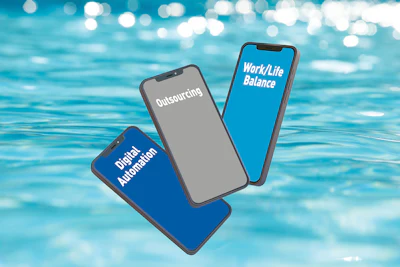
1. DIGITAL AUTOMATION
Remember the tasks you assigned to the aforementioned “high joy, low value” category? These are the tasks you should aim to automate, per Pearson’s recommendation. Things like Zapier, Calendly and TidyCal are just three examples of programs Pearson uses to make her job easier.
“Zapier connects everything,” she explains. “I can have customers fill out a form on my website when they need a service, and I can put that information into QuickBooks for billing. That information can also go into my calendar to prevent me from being double-booked. Zapier ties everything together, it’s wonderful.”
Similarly, programs like Calendly and TidyCal allow customers to “schedule themselves,” so you don’t have to manually schedule your own appointments and manage your schedule as well as executing all of your services.
Your bookkeeping doesn’t have to take you ages to get through. Make the process quicker and clean up any mess through digital automation. Streamline your workflow and leave time for the more important tasks.
2. OUTSOURCING
Outsourcing is perfect for those tasks that are in the “low joy, high value” category of your Freedom Matrix. For Pearson, this manifests in the form of hiring someone to answer questions over the phone when customers call.
“When you’re on the job, you don’t want any distractions,” Pearson says. “Mistakes happen when you’re distracted. If you have someone else that can screen phone calls for you, or at least handle them for the time being while you’re out in the field, that’ll save you.”
“I give this person a prompt,” she continues, “so he can answer general questions, despite not necessarily knowing anything about the industry. I’ll give him a list of certain questions and their corresponding answers so he can take as many phone calls as he can for me. If he can’t answer the question, he won’t try.”
Rest assured, Pearson says, that outsourcing specific tasks like screening phone calls won’t take away any of your control in your business. The company is still yours alone; getting help in order to manage each task will only strengthen your ability to get back to what really matters — your customers at hand.
Some of the apps Pearson recommends to pursue outsourcing tasks include:
Upwork: Best to find freelancers for specialized, long-term projects. “Someone that’s committed to you,” Pearson explains. “Someone that’s going to learn your business.”
Fiverr: Perfect for short-term fixes, Fiverr can help you find someone to perform something specific, “like if you need a specialist in accounting to help you straighten up your books, but you don’t want to have an accountant,” she says.
onlinejobs.ph: Looking for a more permanent addition to your team? Onlinejobs.ph is a platform to find remote workers, specifically tailored to those in the Philippines.
As all of these options are online, you don’t have to worry about training in person, or providing them with anything physical. Any remote workers you hire to help will do the small things — with minimal training — so you can keep your hands in the pot, Pearson emphasizes.
3. WORK/LIFE BALANCE
It wouldn’t be burnout prevention if it didn’t include a little bit of self-care.
“As you get older, it gets harder,” Pearson says. “People always try to figure out how much time we have. Everybody’s energy level is different. Somebody might be able to work 12 hours a day and be perfectly fine, while somebody else may need to do only eight hours. You have to find the balance that works for you.”
Thus is the importance of setting office hours. Even if you don’t have a physical office you go to, it’s crucial that you compartmentalize your time at work versus your time outside of work, to better allow yourself to rest and recoup after each day. Whether or not you have a family to spend time with or take care of, time away from work is an indisputable trick to staving off burnout.
“Say you’re open from nine to five,” Pearson says. “You don’t have to actually work from nine to five, you can keep working as long as you want. But with office hours published, that sets an expectation for your customers. They should only expect to hear from you within that window.”
“I know a lot of people that might say, ‘Well, it’s an emergency.’ It’s a pool,” she laughs. “A pool is almost never an emergency.”
But what if the phone keeps ringing, interrupting your “out of office” time? Another trick that technology has come up with in recent years: silencing all notifications or, in the iPhone’s case, setting up Do Not Disturb.
“I have an iPhone, so I only know how it works with those,” Pearson admits. “But you can set up custom settings for Do Not Disturb, so you’re only getting the notifications that you want.”
From silencing phone calls, to blocking unknown numbers, “locking down” your phone for the night, while you’re driving, or only for when you’re sleeping, can reduce stress a great deal and contribute to lowering your chances of experiencing burnout.
It may feel overwhelming to let yourself rest, to shut off your computer without sending that final email, without working yourself to the bone each day. But taking care of yourself this way will set you up for a stronger future as a solopreneur.
At the very least, Pearson says, ask yourself this: Would you ever work an employee as hard as you work yourself?
If the answer is no (“as it probably should be,” she quips), then you’re already on the right track. You may be the judge, jury and executioner of your company, but that doesn’t mean you have to hold yourself to such a high standard that it becomes debilitating. Protect yourself from burnout; automate where you can, outsource when necessary and find your way back to a more sustainable future.
OUTSOURCING DONE RIGHT
While outsourcing looks a little different than hiring a full-time employee, you should be treating it with the same care, Pearson advises. The business is still under your complete control, but you want to make sure you’re attracting the type of help you need. Consider how you create job postings on sites like Upwork:
The “Burnout” Post: Avoid ambiguity. You may be struggling with burnout, but you don’t want to give that away within the job listing, Pearson says. Vague details and minimal effort won’t make your post stand out to those looking for opportunities, which may result in less applicants and your burnout period lasting longer.
The “CEO” Post: Use specificity wherever possible. List a specific job title and its corresponding requirements. You’re not hoping to hire someone who needs to be trained on every part of the job; you’re looking for someone who already has the appropriate skills to take some of that workload off your shoulders. Training them on the specific ins and outs of your business is one thing, but you want to look for someone with a foundation of helpful skills.
Note: Don’t be afraid to use AI for this as well. “I had AI help me create mine,” Pearson says, “by giving me a job title and job description to make it a solid post.” If you’re stressing about the details, you can always find a way to make it easier.
This article first appeared in the April 2026 issue of AQUA Magazine — the top resource for retailers, builders and service pros in the pool and spa industry. Subscriptions to the print magazine are free to all industry professionals. Click here to subscribe.