










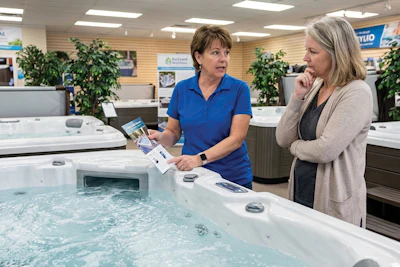
Walk into a modern spa showroom and you can still talk about jets, horsepower, and seating design. Those details matter. But increasingly, they are not what closes the sale. What does prompt buyers to sign on the dotted line is something less immediately tangible and far more powerful. It is the language of wellness.
Across industries and across continents, wellness has evolved from a niche concept into a defining global trend. Consumers are investing in how they feel, how they function, and how long they can maintain quality of life. The Global Wellness Institute has tracked this shift for years, but for retailers on the ground, the evidence is far more direct.
Customers are asking different questions. They are expressing shifting priorities. They are, in a very real sense, speaking a new language.
HEALTHFUL EXPRESSIONS
For the hot tub and pool industry, learning to speak that language is no longer optional.
The rise of wellness is tied directly to demographics. Aging populations are redefining what it means to grow older. Longevity is about more than adding years to life, but adding life to years. That shift is driving demand for products and environments that support mobility, reduce pain, improve sleep, and sustain independence.
Hot tubs sit squarely in that conversation.
As Julie Kazdin of Kazdin Pools and Spas observes, a full-service pool and spa firm located in the Hamptons on Long Island, N.Y., the motivation behind purchases is changing in real time. “There seems to be a line we’re stepping over, from where people view a hot tub as an occasional luxury item to where it’s an appliance for constant health maintenance.” That distinction marks a profound transition. For one generation, the spa was about leisure. For the next, it is about health and longevity.
That evolution is not happening in isolation. It is part of a broader ecosystem that now includes saunas, steam environments, and cold plunges. What was once a stand-alone product category is becoming a coordinated wellness package.
Fred Bachmann of Bachmann’s Pools, Spas and Saunas, based in Madison, Wis., sees this shift accelerating rapidly. “You see the wellness trend in the rise of saunas and cold plunges, which are purely for health-related purposes. Hot tubs are part of that package. It’s huge and those types of sales are rising rapidly. Wellness isn’t a single product, but a broader mindset.”
BEYOND THE TUB
That mindset is reshaping the showroom floor. Retailers are increasingly bundling experiences, combining hot water, cold immersion, and heat therapy into integrated systems designed to support circulation, recovery, and overall vitality.
Bachmann has leaned into that model aggressively. “We are beginning to regularly sell tubs and saunas… you buy two, you get a discount… you buy three… we’re selling quintuplets… building our wellness package items is going to be the thing.” What he describes is not just a pricing strategy, but a reframing of value. The product is no longer singular. It is a system.
Kazdin sees the same pattern emerging in high-end residential markets, where homeowners are blending aesthetics with function. A built-in spa may serve as a visual and experiential extension of the pool, while a portable unit near the bedroom becomes a nightly ritual tied directly to sleep quality. Add a cold plunge, and the environment begins to mirror the offerings of high-end wellness clubs.
Those clubs are themselves part of the story. As Bachmann notes, “There are… establishments, called wellness or pampering spas where you pay a monthly fee to use a hot tub, a cold plunge, a steam suite, and a sauna — people pay $400 to $500 a month for that service.” The implication is clear. What consumers are willing to rent, they will increasingly choose to own, especially when the long-term value becomes apparent.
WORDS THAT WORK
The language used to communicate that value is evolving as well. Retailers are borrowing, consciously or not, from adjacent industries that have already mastered wellness messaging.
The day-spa industry speaks in terms of relaxation, escape, and sensory experience. The sleep industry ties products to measurable outcomes like deeper rest and improved recovery. Fitness brands emphasize routine, consistency, and performance gains. Nutrition companies connect consumption to long-term health and vitality.
Each of these sectors offers a vocabulary that resonates with today’s consumer.
Hot tub retailers who adopt that vocabulary are finding new traction. Instead of describing jet counts, they talk about targeted hydrotherapy for lower back pain. Instead of focusing on temperature ranges, they explain how pre-sleep soaking can help regulate the body’s transition into rest. Instead of positioning the spa as an amenity, they present it as a daily practice.
That shift aligns directly with how customers are using their spas.
Bachmann has observed a striking pattern in usage and product longevity. “We found that people that use their hot tubs more, almost on a daily basis, the hot tubs last much longer largely because they’re taking better care of the water chemistry and other maintenance issues. The ones that are ignored, get destroyed in four to five years.” Regular use enhances the user’s well-being and it preserves the product itself. In a sense, the health of the customer and the health of the spa become intertwined.
That insight reinforces the importance of positioning the hot tub and other aforementioned wellness appliances as a daily tool. When customers use it consistently, they experience the benefits more clearly, from reduced muscle tension to improved mood and sleep.
This is where retailers are reframing the product as part of a daily rhythm. A short soak in the morning to wake up the body. A post-work session to decompress. A nighttime soak to prepare for sleep. When customers begin to imagine those moments in their own lives, the purchase becomes far more tangible.
The benefits themselves span a wide range of wellness concerns.
THERAPY POINTS
For aging customers, hydrotherapy can play a meaningful role in managing arthritis and joint stiffness. Warm water immersion supports circulation and reduces the load on joints, making movement easier and less painful. For those with chronic back pain, targeted jets provide localized relief, a point Kazdin notes is often central to the sales conversation. “More often than not, [we’re] discussing a certain body part or condition — inflammation, pain, maybe a previous injury. We listen to the customer’s concerns and needs and adjust our focus based on what they are telling us about why they’re here.”
Recovery is another major driver. Whether from exercise or medical procedures, the combination of heat, buoyancy, and massage can accelerate the body’s natural healing processes. Cardiovascular benefits, when used appropriately, are also part of the discussion, as warm water immersion can support blood flow and relaxation.
Equally important, and sometimes overlooked, are the cognitive and emotional effects. The calming influence of warm water has been linked to reduced stress and anxiety, improved mood, and better sleep patterns. Emerging research suggests that consistent relaxation and sensory stimulation may also have positive implications for individuals dealing with cognitive decline, including forms of dementia and Alzheimer’s disease. While not a cure, the experience of immersion, warmth, and gentle stimulation can contribute to overall quality of life.
These are powerful ideas, but they must be communicated carefully and authentically. That is where the language of wellness becomes both an opportunity and a responsibility.
Kazdin describes a sales approach that reflects this nuance. “It’s not really selling so much as seeing if you can line up what you can provide with what they want. It’s like a conversation rather than a presentation.” That conversational tone mirrors the broader shift away from transactional selling toward consultative engagement.
Customers are looking to be understood rather than pressured and convinced.
Bachmann echoes that philosophy through both training and experience, emphasizing the importance of delivering on the promise of wellness from the very beginning. Ensuring that water quality is perfect in the first weeks of ownership is not just a technical concern. It is foundational to the customer’s perception of the product. A poor early experience can undermine the entire wellness narrative.
TURNING INTO EXPERIENCE
At its core, the language of wellness is about alignment. It connects what the product does with what the customer feels. It bridges the gap between hardware and human experience.
For the hot tub and pool industry, mastering that language opens the door to a broader identity. No longer confined to recreation or luxury, the category becomes part of a larger movement centered on health, longevity, and daily well-being.
That movement is only gaining momentum. And for those who learn to speak it fluently, the conversation with customers becomes easier and far more meaningful.