







When I sat down to outline the “must-have” retail products for the 2026 season, I started where we’ve all started for decades. I began listing the hardware: high-efficiency heaters, robotic cleaners, automation hubs and LED lighting packages.
But the more I looked at that list, the more I realized I was solving the wrong problem. I was focusing on the inventory rather than the intent.
The more I reflected on the projects currently moving through our shop at Country Leisure in Moore, Okla., the more I realized we have drifted into a completely different paradigm. In 2026, the biggest “must-have” isn’t a product you can find in a catalog. It is the ability to deliver an experience that exceeds what the customer even knew was possible.
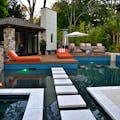
 Mid-size cocktail pool with double-stacked marble coping and a spillover spa. This is the kind of project where material selection and proportion make all the difference.
THE DEMOGRAPHIC PIVOT: FROM ASSET TO ATMOSPHERE
For years, our industry’s focus was on Baby Boomers and Gen X homeowners. For this group, a pool was primarily a property asset — a capital improvement that increased home value and provided family entertainment.
Today, we are in the middle of a generational handoff that most retailers aren’t ready for. Millennials and Gen Z aren’t shopping the way their parents did — and if your showroom still sells the way it did in 2015, you’re already behind. They aren’t buying “a pool.” They are buying the backyard they saw on Instagram — the one that makes them want to stay home on a Friday night.
To this buyer, the backyard isn’t just a place to swim; it’s an extension of their home’s architecture and a critical part of how they decompress. They expect seamless technology, low-friction ownership, and environments that feel intentional. Most importantly, they value atmosphere over square footage. This is the primary driver behind the explosive growth of cocktail pools and high-end semi-inground hybrids. The modern homeowner doesn’t want a 40-foot basin dominating their yard; they want an environment that feels like a resort.
 The "aboveground" category has evolved in parallel with the high-end custom market. Here, we see LED uprights, laminars, and rail waterfalls engineered into the frame. This is what the elevated retail package looks like in practice.
ELEVATING THE “MIDDLE” MARKET
At Country Leisure, we have long been known for aboveground pools and spas. But the “aboveground” category has undergone a sophisticated evolution that mirrors the high-end custom market. We are no longer selling entry-level pools.
The packages we deliver today feature LED lighting engineered directly into the uprights, creating a structural glow that isn’t bolted on after the fact — it’s part of the frame. Molded laminars purpose-built for the pool structure provide architectural water movement that integrates seamlessly. And backlit rail waterfalls — water features built into the top rail itself — transform the vessel into a light-and-water sculpture after dark. These aren’t aftermarket accessories dropped into a box. They’re engineered into the pool from the ground up, and that’s what separates a modern retail package from what this category looked like even five years ago.
A decade ago, these features didn’t exist in this category. Today, they are the baseline expectation. Whether it’s a semi-inground hybrid or a compact cocktail pool for a tight urban lot, these products are designed to create an emotional response. When the sun sets in Oklahoma and the lights come on, the customer shouldn’t see a “retail pool.” They should see a sanctuary.
THE BACKYARD AS A WELLNESS UTILITY
The pandemic permanently changed how people relate to their homes. The backyard became a vacation replacement, a social hub, and a decompression zone. But what started as a necessity has become an intentional design philosophy — and it isn’t going backward.
For the modern buyer, the transition from indoor living space to the outdoor environment needs to be seamless — not because they saw it in a magazine, but because that transition is what keeps them sane. The heated cocktail pool isn’t a party feature; it’s their version of a spa membership they actually use. The laminars and water features aren’t just decorative; they provide the sound that replaces the noise in their head after a 10-hour screen day. And with cold plunge demand exploding, the backyard is becoming a full wellness circuit: hot water for recovery, cold water for reset, and a designed environment that ties it all together.
The pool isn’t just recreation anymore. It’s where they decompress. When we sell a heater that extends the season, lighting that sets the mood, or a cold plunge that rounds out the experience, we aren’t selling luxury add-ons. We are selling a utility for mental wellness.
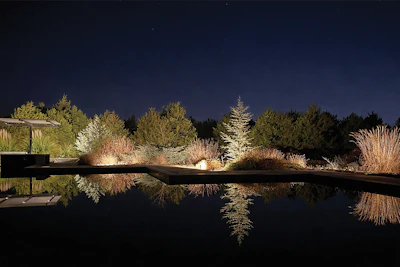
 Compact cocktail pool featuring a 360-degree perimeter overflow spa. A great example of what a small footprint can deliver when the design is intentional.
THE TRUE 2026 RETAIL CHECKLIST
When viewed through that experiential lens, the actual “must-haves” for 2026 come into focus.
Automation is the floor, not the ceiling. If a pool doesn’t respond like a smartphone, this generation sees it as a chore, not a retreat. Efficient, targeted heating has become a design tool — compact vessels heat fast, which means a cocktail pool positioned as a “social spa” can deliver year-round usability that a traditional 20,000-gallon pool simply can’t match. Visual planning through 3D rendering is no longer a nice-to-have; it’s a requirement. This buyer will not commit to a five- or six- figure backyard transformation based on a brochure and a handshake — they want to see the finished environment, complete with native landscaping and hardscape, before they sign. And simplified water care isn’t optional. Every layer of complexity we leave in the ownership experience is a reason for the next generation to walk away from the category entirely. Streamlined sanitation that reduces the “chemistry homework” is what makes the lifestyle promise actually deliverable.
EDUCATION AS THE COMPETITIVE MOAT
With big-box retailers and online marketplaces pushing price to the floor, competing on cost is a race no professional builder should want to run. Our advantage has always been knowledge — and in a market where buyers have already done hours of research before they walk into a showroom, the ability to teach is what separates us from a website with a shopping cart.
But the education that matters in 2026 goes beyond installation specs. The customer buying a cocktail pool or a semi-inground hybrid isn’t just asking, “Will it fit?” They’re asking, “Will it feel right?” They want to know how the LED color temperature interacts with their hardscape palette. How the water feature placement creates visual depth from the back door. How to tune a laminar or waterfall so it doesn’t just look right but sounds right — because the difference between a water feature that creates mood and one that creates noise is in the adjustment, not the installation. How the hydraulic design keeps the system whisper-quiet so the atmosphere they’re paying for isn’t ruined by equipment drone. This is architectural thinking, not just technical knowledge.
The GENESIS curriculum delivered by the Pool & Hot Tub Alliance (PHTA) and the Certified Master Pool Builder & Design Professional (Master CBP) designation gave me the foundation to think this way — to approach every project not just as an installation, but as a designed environment. When you can walk a customer through the “why” behind every element, from color choices to flow rates to spatial proportion, you’re not competing with the internet anymore. You’re offering something it can’t.
THE FUTURE IS COMPACT AND SOPHISTICATED
As we head into the 2026 season, the greatest opportunity in our industry sits squarely in the middle: between the entry-level commodity pool and the six- or seven-figure custom build.
The future belongs to refined, compact, and highly engineered environments that blend retail accessibility with master-level design. Cocktail pools and high-end semi-inground hybrids aren’t a niche. They are the natural evolution of a market that has decided experience matters more than size.
Here’s what I’ve learned after years in this business: The customer can’t want what they’ve never been shown. They walk in thinking about a pool. It’s our job to show them a sanctuary — a backyard they couldn’t have imagined on their own. And when we do that, when we put the right environment in front of them and back it up with the expertise to deliver it, the sale isn’t a negotiation. It’s a partnership.
That’s the real must-have for 2026. Not a SKU. Not a product line. The ability to show someone something they didn’t know they wanted — and the knowledge to make it real.
This article first appeared in the April 2026 issue of AQUA Magazine — the top resource for retailers, builders and service pros in the pool and spa industry. Subscriptions to the print magazine are free to all industry professionals. Click here to subscribe.