









Early in my career, I observed a new ORP controller take a school pool to 18 mg/L in front of me.
The sensor was clean. The controller was calibrated. The installation was textbook. By every measure, the system was working correctly.
The pool, however, disagreed.
Chlorine was spiking past 30 mg/L before I switched it off. The pH was swinging. The controller was hunting, dosing, overcorrecting, dosing again. The inevitable conclusion from everyone on site was the same: ORP control doesn't work.
It took me years and a great deal of accumulated experience to understand what was actually happening that day. The system wasn't malfunctioning. It was behaving exactly as it should. We were simply reading it wrong.
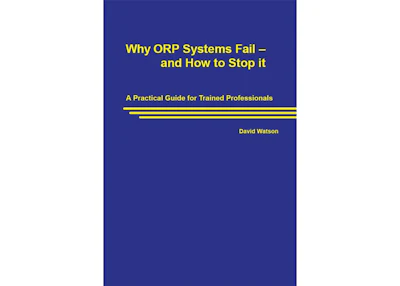
That realization is what eventually became ORP Control in Real Pools: Why it Works, Why it Fails, and How to Use it Properly.
What ORP Is — and Isn't
The foundational mistake most operators make with ORP is treating it as a chlorine meter.
It isn't.
ORP (oxidation-reduction potential) is a measure of the overall electrochemical state of the water at the sensor, at that moment. Chlorine contributes to that reading. So does pH. So does cyanuric acid, temperature, dissolved gases, and the physical condition of the probe itself.
Here's a simple way to see why this matters.
Imagine two identical pools, same volume, same free chlorine reading of 2.0 mg/L on your test kit.
- Pool A has a pH of 7.2
- Pool B has a pH of 7.8
Test kit readings: identical. ORP readings: potentially 60 mV apart. A difference large enough to cause a controller to dose aggressively in one pool while leaving the other alone.
The chlorine hasn't changed. The ORP has. The controller is not confused. It is responding accurately to real electrochemical conditions that the test kit can't see.
This is not a flaw in ORP. It is how ORP works. Understanding the difference between those two things changes everything about how you use the technology.
Why Controllers Hunt, Overshoot and "Fail"
Once you understand that ORP is a multi-factor signal rather than a chlorine proxy, the behaviors that look like malfunctions start to make sense.
Hydraulic lag. A controller doses based on water that left the pool several minutes ago. By the time that water reaches the sensor, the chemistry has changed, and further dosing has often occurred. The controller isn't malfunctioning. It is reacting accurately to information that is no longer current. This is a system design and installation consideration, not an equipment fault.
Cyanuric acid suppression. CYA progressively suppresses ORP. A pool that has accumulated stabilizer over a season may be sitting at what appears to be a dangerously low ORP reading, while maintaining adequate sanitation. Operators who don't account for this relationship will chase setpoints that cannot be reached without excessive dosing. Drawing exactly the wrong conclusions from the result.
pH interaction. A pH shift of 0.3 units can move ORP by 20 to 30 mV without any change in chlorine concentration. In a pool where pH and ORP are both controlled automatically, the two systems interact. Understanding which is driving which, and in what sequence, is not optional. It is the job.
Probe condition. Probes don't only fail outright. They foul gradually, and fouling changes response characteristics in ways that look like drift or instability. A probe that reads correctly at calibration may behave quite differently after several weeks of service. Knowing how to evaluate probe condition and what "calibration" can and cannot tell you matters more than most operators realize.
None of these behaviors is a mystery. Each one is predictable, once you know what you're looking at.
The Question That Changes the Answer
Most ORP troubleshooting starts with the wrong question.
When a reading looks unexpected, the instinct is to ask: Is the equipment working?
A more useful question is: What conditions in this water, right now, would produce this reading?
That shift from instrument-focused to chemistry-focused thinking is not just philosophical. It changes what you look for, what you measure, and what you do next. It is the difference between operators who get reliable, consistent results from ORP systems and those who replace sensors on a rotation and never quite solve the underlying problem.
The technology is sound. The gap is in the interpretation.
What the Book Covers
ORP Control in Real Pools works through all this systematically. Not as theory, but as applied knowledge for working professionals.
It covers how ORP is generated and what it reflects. It covers the relationship between ORP, pH, and cyanuric acid in enough depth to be genuinely useful in the field. It covers controller behavior, setpoint selection, installation considerations, probe maintenance, and the specific failure modes that generate the most service calls.
It also covers when ORP control is the right tool and when it isn't. A question that deserves an honest answer.
The book is written for technicians, facility operators, and anyone responsible for water quality outcomes in any aquatic environment. It does not assume prior knowledge of electrochemistry. It does assume the reader wants to understand what they are working with, not just follow a procedure.
If you have ever looked at an ORP reading and genuinely not known what to do with it, this book was written for you.
Acknowledgment: The author would like to thank Richard A. Falk for his technical review of the manuscript and for his characteristically rigorous commentary on the electrochemistry and its practical implications.
About the Author: David Watson is an independent pool and water treatment researcher and consultant with four decades of international experience across pool and spa water chemistry, treatment systems, and facility management. He operates under David Watson Pool Consulting.
ORP Control in Real Pools: Why it Works, Why it Fails, and How to Use it Properly is available this month, July 2026. It is the second in a series of practical guides for pool professionals. The first — Pool and Spa Leak Investigation: A Practical Guide for Trained Professionals — is also available.
Both titles can be found at: amazon.com/stores/David-Watson/author/B0GZJDFTBB