








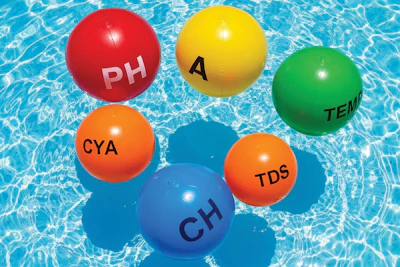
Most pros can tune PH, alkalinity, calcium hardness, and sanitizer in their sleep. But when water still looks dull, algae keeps creeping back, or a saltwater chlorine generator underperforms despite “perfect” numbers, the missing pieces are often Total Dissolved Solids (TDS) and the effect that cyanuric acid (CYA) has on total alkalinity. Neither of these are primary water balance parameters, but their importance increases in pools that have high concentrations of either one or both parameters. Ignore them and you can unknowingly create corrosive water while believing everything is in range.
WHAT IS TDS AND HOW IS IT MEASURED IN THE FIELD?
TDS is a measurement of all of the substances dissolved in pool water, including salts, minerals, metals, and organic material. In the field, TDS is measured indirectly from electrical conductivity (EC), and most poolspecific handheld TDS meters convert EC to “ppm TDS” using a calculation that best mimics the conditions found in pool water. These meters typically offer modes for EC (uS), TDS (ppm), and salinity (ppm). They require only occasional calibration using a saltwater solution. It is important that technicians are trained in ensuring that the meter is set correctly, as most technicians use the same meter for both salinity and TDS measurement.
THE LSI CONNECTION: TWO CORRECTIONS MOST TECHS MISS
The Langelier Saturation Index (LSI) is the real guide for protecting surfaces and equipment. To get it right, two adjustments are essential:
- TDS factor: The ANSI/PHTA standard (updated in 2021) uses a five-tier TDS adjustment — more granular than older two-tier charts.
- CYA correction to alkalinity: The general rule of thumb is to subtract ⅓ of a pool’s cyanuric acid level from a total alkalinity reading. This is then used in substitution of the measured total alkalinity in the LSI equation.
When combined together in both a high TDS and a high CYA environment, the water can be quite corrosive even if the water looks to be within “ideal ranges.”
THE “IDEAL RANGE” TRAP: A TALE OF TWO POOLS
Same temperature (80°F), same “perfect” basic readings: pH 7.5, Total Alkalinity (TA) 100 ppm, Calcium Hardness (CH) 300 ppm.
- Pool A (No salt, no CYA): TDS 1,000 ppm. LSI ≈ 0.0. Balanced.
- Pool B (Salt and high CYA): CYA 70 ppm, TDS 4,600 ppm (3,600 from salt + ~1,000 other). After proper TDS and CYA corrections: LSI ≈ -0.33. That’s corrosive.
Now push Pool B to the low end of old-school ranges (pH 7.4, TA 80, CH 200) and LSI plunges to about -0.72 — very aggressive water that many would conclude is in range.
BALANCING FOR REALITY
For that same corrosive salt pool (TDS 4,600; CYA 70):
- Allow pH to settle slightly higher: 7.6
- Target TA around 100 ppm (after CYA correction).
- Intentionally raise calcium hardness to 500 ppm.
Result: LSI ≈ +0.03 — right on target. Yes, CH 500 ppm looks “high” compared to 200-400 ppm. In high TDS/CYA environments, it isn’t a scale risk; it’s the mineral buffering the water needs to protect the shell and equipment. You could also keep the calcium hardness at 400 ppm and raise the total alkalinity to 120 ppm and obtain nearly the same result.
The takeaway is: Balance your pools to the LSI, not to a one-size-fits-all approach.
FIELD-TESTED WORKFLOW FOR CONTRACTORS
- Test the full picture: pH, TA, CH, CYA, TDS, and temperature.
- Understand the corrosive effect high levels of TDS and CYA have on pool water.
- Use updated TDS factors (ANSI/ PHTA 2021 five-tier).
- Balance to the LSI, not static ranges.
- When TDS climbs: Plan dilution. As a practical rule, when TDS rises to about 1,500-2,000 ppm above the salt level, it’s time to partially drain and refill.
PRO CONTEXT: REGION AND BATHER LOAD CHANGE THE GAME
- Arid climates (Phoenix): Aggressive evaporation concentrates minerals fast — TDS and CH climb even when you don’t add anything.
- Humid/rainy (Florida): Rain dilutes and adds organics; big storms can overwhelm systems and can throw a pool out of balance overnight.
- High-use/commercial pools: Organics (sweat, lotions, oils) and hygiene variability drive sanitizer demand and impact clarity. Kids’ play patterns and long dwell times add load you won’t see in most residential accounts.
TOOLS THAT SHORTEN THE LEARNING CURVE
Encourage your technicians to use a good chemistry calculator that accounts for TDS, CYA-corrected alkalinity, calcium, pH, and temperature vs. balancing to the “ideal ranges.”
- Saves troubleshooting time and chemical waste
- Reduces risk to surfaces/equipment
- Helps seasonal techs get LSI right from day one
- Delivers consistent, clear, comfortable water
COMMON PITFALLS TO AVOID
- Trusting “ideal ranges” without running LSI
- Ignoring the CYA correction to alkalinity
- Using outdated two-tier TDS factors
- Skipping dilution when TDS or CYA creeps up
QUICK CONTRACTOR CHEAT SHEET
- TDS is not necessarily “bad”; it just changes the math.
- Always correct alkalinity for CYA before computing LSI.
- Use updated TDS factors (ANSI/ PHTA 2021).
- In salt pools with higher CYA, it’s normal to run CH higher (around 500 ppm), TA higher (around 120 ppm), and pH ~7.6 — or a combination of all three — to hit the protective zone on the LSI.
- Plan partial drain/refill when TDS rises ~1,500 ppm above the salt level or when CYA rises above 100 ppm.
THE BOTTOM LINE
Modern pools demand modern balance. When you factor TDS and CYA correctly and target LSI, you stop corrosion, avoid scale, keep SWGs happy, and deliver the sparkling clarity everyone notices. That’s the difference between a “service tech” and a true water chemistry professional.
APPENDIX: THE CASE STUDY, READY TO REUSE ON ROUTE
- Conditions: 80°F, saltwater pool, CYA 70 ppm, TDS 4,600 ppm (3,600 salt + ~1,000 other)
- “Ideal range” numbers: pH 7.5, TA 100, CH 300 ➝ LSI ≈ -0.33 (corrosive)
- Worse with low-end ranges: pH 7.4, TA 80, CH 200 ➝ LSI ≈ -0.72 (very corrosive)
- Balanced reality: pH 7.6, TA 100 (CYA-corrected), CH 500 ➝ LSI ≈ +0.03 (protective)
Use this example to explain to clients why your targets may differ from a generic chart — and why their surfaces and equipment will last longer because of it.
This article first appeared in the November 2025 issue of AQUA Magazine — the top resource for retailers, builders and service pros in the pool and spa industry. Subscriptions to the print magazine are free to all industry professionals. Click here to subscribe.