








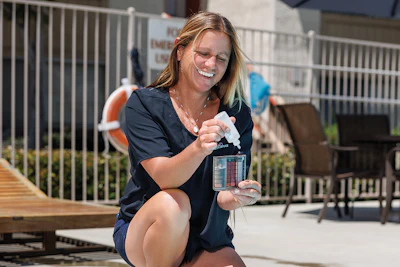
Michelle Watson found the perfect metaphor for running her own business. It occurred to her when she was doing plumbing work for Shell’s Pool and Spa Services, the business she’s owned and operated in a coastal region of Southern California for the past 16 years. She’s also spent the vast majority of that time as the sole employee.
“Plumbing is kind of like Tetris or something where you have to focus and put all these pieces together,” Watson says. “And that’s kind of like running a business. There are all these little pieces to assemble and rearrange, and you have to put it together precisely in order for the water to flow.”
Watson is one of the hardy souls in the pool and spa industry who runs their business as a solopreneur. Although Watson has recently brought her husband onboard to help with some of her business’s approximately 150 accounts, she still essentially operates Shell’s Pool and Spa Services as the same one-woman shop it’s been since its inception.
There are definitely mighty challenges in keeping a pool and spa business running with only the most limited support. For people like Watson, the positive attributes of such an arrangement outweigh the negatives.

GETTING STARTED
Joe Catricks is another person who decided to become a solopreneur in the pool and spa field.
Catricks spent more than a decade working for petroleum companies In that capacity, he often assisted in clean-up efforts for any spills. Among those assignments was a lengthy stint on the Deepwater Horizon.
It was grueling work which often called for time away from home for extended periods. When Catricks and his wife, who had a similarly demanding corporate job, decided the time had come to start a family, he needed a career change that would allow him to stay closer to home.
Partially because he had a strong background in water chemistry, Catricks found his way to the pool and spa industry. He spent years working with an old hand who had a well-established business. After plans to purchase that business fell through, Catricks realized that all his planning and ideas needn’t go to waste. He started his own outfit, Poolside Services, in Pennsylvania.
“As a younger guy with a little more of a corporate background and a little higher technology aptitude, I was thinking about how to change things,” Catricks remembers. “You know, when you sit next to somebody every day and you see the shortcomings, you want to improve on that. So, I sat with him and I was like, ‘Man, I could do this. I could do this better.’”
For her part, Watson also ventured into the world of pools and spas after the household expanded with a child. She’d worked an array of jobs out on the water, a commercial crab fisherman, chef on a dive boat, and deckhand on a fishing boat among them. It felt like a natural step to tend to water that was on land.
As she worked for an acquaintance with a pool and spa company, Watson picked up extra pools on her own during the weekends. That collection of side accounts grew until Watson had enough clients to strike out on her own. It helped her confidence that one of those early clients was a large commercial pool. Starting with a commercial pool in need of major mending made the residential pools seem easy by comparison.
“I had to do many repairs right off the bat,” says Watson. “Once I succeeded at that, within a few months I felt like ‘I got this.’”

DOING IT ALL
Both Catricks and Watson started their small businesses with solid experience in the pool and spa field. They’d also worked in a variety of outside businesses that gave them insight into different approaches to managing tasks. Even so, they’d only ever done their own small part as employees. In the new reality, absolutely everything was their responsibility.
Soon enough, it was time for a crash course in the areas of the business that were outside their initial skill sets.
“The most challenging part for me is managing the financial aspect of it,” Catricks says. “Am I charging enough? Am I not charging enough? That’s the hard part because you don’t have other people to help nail down the correct price. Not selling yourself short is the key. And I think when I started out, probably during the first year or two, I sold myself short.”
For Watson, being in the field was always the part of the job that held the highest appeal. Watson has a good head for business, so she adjusted quickly to the office work required to keep her operation going. The sheer amount of that office work is the main stressor.
“Staying on top of different fees and getting the certificates of insurance,” Watson answers when asked about the toughest part of the job, adding that the commercial pools often require more paperwork. “You have to make sure all of your different insurances are in line and specifically worded and get those to different vendor-credentialing people and then bookkeeping. I mean, the list goes on and on.”

ONE ON ONE
If operating solo has its own unique pressures, it also offers a strong selling point.
“All my customers that are new come to me because they want a single point of contact,” explains Catricks. “They want to talk to the person that’s doing the work. They want to see the person that’s in their backyard.”
When a client seeks an answer to a question, they are confident that they’re not going to get passed around to people who aren’t familiar with them, their property, or their pool. Their phone call is going to go straight to the person they know.
That personal connection is also beneficial when it comes to getting customers to commit to expenses that they might otherwise find painful. Working with them on an individual basis helps in the critical task of developing trust.
“You build that rapport with your customer by being honest and truthful with them every time,” says Catricks. “When you make a recommendation, 95% of the time they respond, ‘Let’s get it done. I don’t want to miss a day swimming.’”
DEMANDING BUT FLEXIBLE
Catricks and Watson agree that the solo approach to their businesses makes for a grueling schedule. The work needs to get done, and there’s no fallback.
“When you have a company, someone can fill in for you,” Catricks notes. “But when you’re by yourself, and you have five customers with needs, you have to effectively manage that. You have to relay that to your customer and let them know why they are where they are on the list.”
Even if there’s some strain in being the only one to solve a problem, there’s also some fundamental pleasure in not answering to a boss in the process.
“It’s a 24-hour, 365-day-a-year job,” says Watson. “There really are no days off. But just the feeling of no one telling me how to do the job, you know? I may work 12-plus hour days, but I can still take my lunch break when I want.”
Fortunately for Watson, she knows exactly how to take advantage of that freedom. Her longstanding love of water includes a sideline as a championship surfer. She keeps her board right on the truck.
“Most of my accounts are at the beach,” Watson says. “So, I’m not going to lie: I can service an account and then jump out in the water for 30 minutes or so and come back. And to me, surfing is my passion and what makes me happy. Just having the time to be able to jump in the ocean is huge.”