













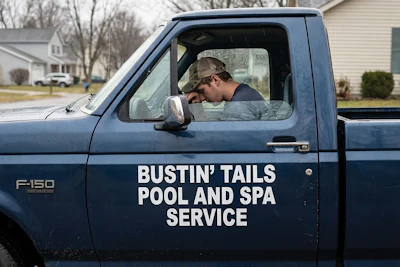
A pool tech sits in his truck at the edge of an HOA. The engine is off. His phone is face down on the passenger seat. He has four more stops for the day and has not spoken to anyone since he first turned the key that morning.
The work is not the problem. The pools have not been particularly stressful. No surprise algae problems. No cloudy water. No emergencies. No Karens. From the outside, this is a cake walk.
However, inside the cab, the silence weighs in. It grows heavier over the following days, weeks, months. He tells himself to buck up and bear down, but the silent words only echo in the empty cab. One day, he quietly turns in his notice. As he walks past, a few of the veterans in the company raise their eyebrows, but only slightly, and mutter, “This job is not for everybody.”
This pattern is not a pool service problem. It is a large- scale, field-based work problem that includes lifeguarding, HVAC, pest control, and a range of other mobile trades. Workers in these jobs leave without warning, often without complaint, and usually without explanation.
Why is this happening?
I’m going to refer to the cause as burnout, but it’s a special kind of burnout. Normally, we think of burnout as a function of time — someone has been doing something for too long and has worn down and “burned out.”
But for many young people, the monotonous repetition and isolation of service work — which is the job itself, which is normal operation of a pool service route — is like normal operation of a car engine, only without oil. After a short period, smoke starts coming out from under the hood.
It’s that phenomenon that I’m referring to in this column.
It’s the long hours of solitary, unvarying, in mindless labor with minimal human interaction.
ODDLY DISSATISFYING
What is it about this work?
A 60-second, “Oddly Satisfying” video clip of a pool vacuum on TikTok set to “Weightless” by Marconi Uni with hundreds of thousands of views would seem to prove this activity is oddly rewarding, but in fact, for many young workers, it is not. For them, sustained responsibility in low-stimulation environments, such as brushing walls and netting leaves, exact a cumulative toll.
I know many old service hands reading this are shouting, “WTF are you talking about?! I’ve been doing this for years! This is a great job for those exact reasons — its isolation and consistency!”
To that legitimate and indignant remark, I can only say that the fact that previous generations tolerated those conditions is irrelevant. You’re right, the structure of the work you have done for many years, perhaps quite happily, has remained unchanged, but the workforce has not.
It’s a problem for younger workers, many of whom have grown up with near-constant communication; texting, social platforms, and instant feedback woven into daily life from an early age. They received no preparation for mindless repetition the way that older generations did. They have never been unstimulated.
The shift is not a cultural preference so much as an environmental mismatch: The world has changed, and the work has not, and that employee can nowadays check all of those boxes and often at a higher rate of pay flipping burgers at McDonald’s. But the problem is not pay. It is not seasonality. It is not that “Damned Gen Z work ethic.” Their work ethic is as strong as Gen X’s, but their lives differ in fundamental ways, and that means their work-world differs.
(Quick aside: At this point in the article, if you are calling BS, you will struggle with HR issues. However, if you are engaged, you are likely to experience fewer vacancies in positions in the years to come. You know why — because you sense there is a problem, and you’re searching for answers, even in a bombastic Rudy Stankowitz column. You may not find them here, but at least you’re looking.)
THE TOLL
In a prior life, I would have been skeptical of everything I just said. I was out there in my truck driving pool to pool, doing the same thing over and over, one pool at a time. Rarely would I see a pool owner during the day. I never had a lifeline, no option to call a friend (they were all at work, too). I was alone. It was quiet, to the extent that long stretches of silence became the norm. Heck, they were even welcome. So, I did not get it. When technicians left, I assumed turnover was simply the nature of the business and could be chalked up to the costs of physical, seasonal work. People came. People went. But that’s just me, not Gen Z.
For many of them, that same service route I found to be a normal mix of blessing and curse is an unmitigated grind. Drive. Stop. Test. Adjust. Rinse. Repeat. Usually alone, often in silence. It does not take long for the brain to switch to autopilot, and when that happens, it becomes harder to spot minor issues. Early detection of a leak or filter problem is easy to miss. It is not because they do not care. It is because routine narrows focus. It is not a personal flaw; it is how people work. The bigger problem is not overlooked details; it is losing engagement. The days drag. The work loses meaning. Burnout sneaks in quietly.
That is why telling people to “embrace the suck” is so damaging. It does not motivate; it signals surrender. It screams to workers that the reality is ‘nothing will change,’ so they will eventually move on. Burnout does not always look dramatic. People keep coming in, keep doing their jobs. However, long before they walk out the door, they have already checked out emotionally, often as soon as they sense their concerns will not be heard. By the time you notice they have disengaged, it is usually too late. That is how you lose good people without ever realizing it is happening.
WATCHERS’ FATIGUE
The same thing is happening in another, oddly similar branch of our aquatic industry we don’t usually talk about in AQUA: the lifeguard chair. You might think the two jobs are wildly different, but there are some interesting intersections.
As you may know, there is an acute lifeguard shortage affecting public facilities across the United States. Pools operating with only one guard have become more common, necessitating a change in guidelines from organizations, such as the MAHC, to include provisions for one- guard facilities; in these situations, break coverage is typically handled through rotation plans, temporary closures, or reduced operations. However, during hours of operation, a single guard is responsible for patron surveillance. Think about that. In both lifeguarding and pool service, sustained vigilance is expected, though the consequences for a lifeguarding lapse are much more serious.
TOUGHEN UP, BUTTERCUP
Brains do not get tougher; they get tired. They get fatigued. This is not my opinion; it is a well-established fact from cognitive psychology. There are decades of research and observation supporting this. The longer we ask people to focus, the more their attention slips. Their ability to catch problems drops. They call it vigilance decrement, I call it ‘Pool Route Brain.” Pretending it is not real or ignoring it only makes it worse.
When a lifeguard loses focus, it is not a sign of bad character or poor training. It is what happens when people are expected to be alert nonstop. Unfortunately, their jobs are built around budgets and schedules, not around how the human brain actually works. Not always. We know people’s attention wears out. We know routine dulls our senses. We know Lifeguard Blindness is NOT a personal flaw. This is now considered common knowledge. Anyone who has ever been fishing, top water with a bobber, knows precisely what I mean. You watch that red-and-white orb intently, and then it suddenly disappears. It is not a fish. It is not glare. It is not even choppy water. You cannot find it. Until suddenly, there it is.
This is a real thing that anglers suffer from. It is called inattentional blindness, and it is layered with a little of what is called attentional tunneling. Your brain locks onto where it expects the cork to be and builds a picture of the scene in your mind. When the bobber drifts, dips, or subtly breaks the pattern, your eyes continue to search the predicted spot instead of rescanning the water. Nothing disappeared. Your brain filtered it out because it no longer met expectations. This is the same cognitive wiring behind lifeguard blindness and pool route brain.
THE SCALES OF DECISION
The work itself is not the problem; it is the environment around it. Route work is repetitive. Lifeguarding is lonely. Both ask people to carry a heavy load on their own for long stretches. Being alone is part of the job, but feeling isolated is a systems issue. Simply checking in can make a difference. A quick call, a friendly “atta boy” or “atta girl,” does not fix everything, but it helps slow the slide. Some have even implemented an ‘open chat’ where the entire team can communicate with each other on the drive between pools to foster interaction and build morale.
Saying “thank you” does not pay the rent, but appreciation matters. Smart service company owners know that flexibility, fair treatment, and real investment are what keep people committed. This is not rocket science. However, it is uncomfortable for business owners who cling to outdated habits with a death grip. Too many organizations still rely on outdated tools (there are still a few bristles left on that brush!), impossible workloads, and an endless cycle of being surprised when people burn out and leave.
Here is the deal: If you are losing people, and you want them to stay, give them a reason. We all make the decision every day, every month, every year. We weigh up the pros and cons, and decide.
When a new service tech leaves, he or she puts everything on the scale, and the pan marked “downside” is heavier. If you want a different result, you have to figure out a way to make it lighter.
Real training and real support can help. Jobs designed with human limits in mind. The kind of investment that says, “You are important, and your work matters.” When people feel that, it lightens the downside pan, and they tend to stay. When they do not, they quit. Keep in mind this is not a character flaw; it is a rational response to the situation we created.
Gunter, Gleiben, Glauchen, Globen only work in a Def Leppard song: We do not want good people to burn out, or fade away...
This article first appeared in the March 2026 issue of AQUA Magazine — the top resource for retailers, builders and service pros in the pool and spa industry. Subscriptions to the print magazine are free to all industry professionals. Click here to subscribe.