









When I first started studying pools — back when enthusiasm was strong and experience was thin — one of the "facts" I picked up was international TDS limit. Something around 1,100 or 1,500 mg/L, depending on who you read.
This seemed verified on the ground locally where I was at the time.
In that environment, pools above the ‘limit’ were often green and unresponsive to treatment with chlorine, filtration, nothing seemed to recover them. (Please note, I have never used floc on a pool and was trained not to use it.)
Based on that experience, I treated TDS as a hard limit. Once exceeded, draining was the only solution.
Then…I moved countries.
Suddenly, this fact, which was seared into my bones, was thrown out the window. Pools of all shapes and sizes came in with TDS sometimes 2000, sometimes 3000 or more, and crystal-clear water with no issues.
So what changed?
BUCKETS, WATER, AND A SIMPLE THOUGHT EXPERIMENT
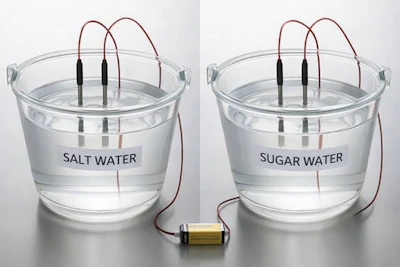
To make sense of it, imagine two buckets and some deionized water.
In each bucket, measure out one litre.
- To the first bucket, add 10 g of table salt
- To the second, 10 g of sugar
Stir each bucket until everything is fully dissolved.
Now measure the TDS in each. What do we observe?
- The salt bucket reads very high
- The sugar bucket… barely moves the needle
Yet chemically, both buckets contain 10,000 mg/L of dissolved material.
So, what’s going on?
WHAT TDS ACTUALLY IS
TDS in pool testing is not a direct measurement of dissolved solids. It is an estimate derived from electrical conductivity, using a conversion factor that assumes the dissolved material behaves roughly like sodium chloride.
In other words, the meter isn’t weighing what’s in the water. It’s listening to how well electricity moves through it.
Because different meters use different factors, readings can vary between instruments, and absolute values are less meaningful than often assumed.
In practice, TDS reflects the concentration of dissolved ionic species that contribute to conductivity, not the total mass of all dissolved substances.
WHY SALT READS HIGH
When sodium chloride dissolves in water, it doesn’t stay together.
It splits:
- Sodium becomes Na+
- Chloride becomes Cl-
These ions are free and mobile, carrying a charge and significantly increasing conductivity.
A lot of the chemicals we use behave similarly to salt. They split into individual charged ions. This is termed dissociation in chemistry.
The table below lays out the dissociation of more common pool chemicals.
DISSOCIATION OF COMMON POOL CHEMICALS IN WATER
For chlorine compounds, dissociation is shown in simplified operational form to reflect net species introduced into pool water rather than step-by-step reaction mechanisms.

As can be seen, nearly every chemical we add splits into individual ions and, as such, carries a charge, thereby increasing conductivity.
WHY SUGAR BARELY REGISTERS
Sugar dissolves, but it does not dissociate. This is termed dissolution in chemistry and looks like this:
C12H22O11(s) becomes C12H22O11(aq)
(Dissolution is the process by which a substance dissolves in water and becomes evenly dispersed as intact molecules, without breaking apart into charged ions.)
Sugar dissolves but does not dissociate into ions. It remains as neutral molecules in solution, contributing to dissolved mass but negligibly to conductivity.
So, the low reading isn’t because there are fewer total dissolved solids. It’s simply that there are fewer charged ions and, consequently, less conductivity.
That distinction matters more than most people realize.
THE MISSING PIECE: WHAT THE TDS IS MADE OF
Why in one country were pools above a nominal TDS amount green and impossible to recover, yet in a different place, the pools were running well outside this limit without issue?
The answer isn’t the number.
It’s the composition.
In the “green soup” environment, the water sources included bush runoff, agricultural contamination, dust, and organic loading. The dissolved solids weren’t mostly benign salts. They were likely dominated by:
- Phosphates
- Nitrates
- Dissolved organics
- Bioavailable nutrients that actively feed algae
These substances often coincide with elevated TDS, but are not caused by it, and are not distinguished by the measurement.
TDS acted as an indicator of contamination, and the consistent association made it appear causal.
In the second country, there were a few differences. The water was more commonly sourced from groundwater. This water came out of the tap at about 600 mg/L TDS, a long way up from the dam water 50 mg/L I saw previously.

Groundwater in this new country tended to be higher in chlorides and bicarbonates. Both of these naturally increase the TDS content.
In a warmer climate, evaporation concentrates dissolved salts over time, increasing TDS without introducing biologically active contaminants.
As a result, the TDS was dominated by:
- Chloride accumulation
- Bicarbonate buffering
- An absence of biologically active contaminants.
This composition was chemically stable and largely biologically inert.
It is worth noting that different substances impact TDS differently. The actual electrochemistry behind this is beyond the scope of this article. However, for understanding, this graph shows indicative, system-level differences in how major anions tend to dominate conductivity readings in treated pool water.
ANION CONTRIBUTION TO ELECTRICAL CONDUCTIVITY

This is why TDS meters mostly respond to chloride, even when other substances are causing the real problems.
For completeness, the same conductivity dominance is seen on the cation side, where sodium overwhelmingly contributes to the measured signal in most swimming pools.
CATION CONTRIBUTION TO ELECTRICAL CONDUCTIVITY

Together, sodium and chloride explain why TDS rises steadily even in otherwise stable, healthy pools.
WHY SIMPLE RULES BREAK DOWN
Rules of thumb, such as ‘high TDS kills chlorine’ or ‘above X mg/L the pool is dead’, fail because TDS aggregates all dissolved material. Nutrients, salts, metals, and organics — into a single value. Two pools with identical TDS can behave entirely differently depending on the actual composition.
WHAT TDS IS ACTUALLY USEFUL FOR
Used properly, TDS can indicate:
- Accumulation of by-products.
- Dilution.
- Unexpected source of dissolved ions.
- Salt is becoming a potential
- corrosion risk (in aboveground pools, for example).
It is not a diagnostic tool on its own.
A high-TDS pool does not fail because the number is high. Saltwater pools are a common proof of this.
TDS only becomes important when it indicates that other dissolved substances are in excess.
THE REAL LESSON
TDS isn’t misleading — it’s simply often misinterpreted.
Many guidelines express TDS as a limit relative to source water, which can be useful operationally, but this does not change the underlying chemistry. Composition, not total value, determines impact.
Historically, TDS served as a crude proxy for accumulated contamination, assuming higher dissolved solids reflected higher chlorine demand. This relationship only holds when the accumulating material actually drives demand.
In some settings, a high TDS is a symptom of nutrient overload and likely a high presence of phosphates and nitrates.
Yet in others, it can simply be reporting the amount of sodium chloride in the sample and be completely benign.
TDS is not a pass/fail metric. It is an indicator that requires interpretation, not blind following. A newly filled salt pool with a TDS of 4,000 mg/L may be perfectly fine, yet a school pool running calcium hypochlorite with the same reading may indicate it is time to consider increasing water loss and dilution.
Next time a TDS reading looks elevated, the right question isn’t ‘how high is it?’ It’s ‘what’s it made of?’
ACKNOWLEDGMENT: The author would like to thank Richard A. Falk for reviewing the technical aspects of this article and for his constructive comments on the interpretation and limitations of TDS measurements.
David Watson is a pool industry researcher and technical writer with four decades of hands-on international experience in pool and water treatment systems. He is the author of several industry publications, including ORP Control in Real Pools: Why it Works, Why it Fails, and How to Use it Properly. Find your copy here.