










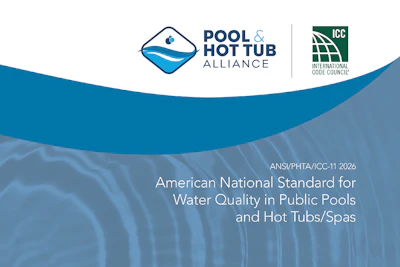
This month, the Pool & Hot Tub Alliance (PHTA) is publishing the newly revised ANSI/PHTA/ICC-11 2026 American National Standard for Water Quality in Public Pools and Spas, which provides recommended guidelines for water quality parameters in public swimming pools, spas and hot tubs. These parameters are based on scientific research, verifiable data and best practices. This standard is unique amongst PHTA's dozen-plus industry standards for a number of reasons.
“The entire document is important,” says Kevin Post, chairman and CEO of Counsilman-Hunsaker, who serves as vice chair of the PHTA-11 Standard Writing Committee (SWC). “Not only is this the standard that impacts the direct safety of the user — it’s also the standard referenced within other standards, so ensuring that it's updated with current trends, science and technology is key.”
When asked who benefits from this standard, Post and PHTA-11 SWC Chair Dr. Roy Vore, senior consultant at Vore & Associates LLC, simultaneously and emphatically answers, “Everyone!”
More specifically, Vore highlights three key audiences whose work is directly impacted by the information provided in this standard. Pool and spa operators “will be able to better understand which parameters are critical to operation and which can be deferred and addressed later;” facility managers “will better understand why operators may insist that certain conditions must result in closure while others do not;” and inspectors “will be able to better emphasize which parameters are key and which violations may result in a minor citation but not an immediate closure,” he explains.
“In this new version, we identified the parameters that impact health and safety, and the parameters that impact the physical venue itself,” Vore says. “We made that separation so it’s clear that when certain parameters are out of range, the facility must be closed immediately, but when other parameters are out of range, they can be addressed later.”
Vore highlights that the materials produced by PHTA all work in tandem. “Part one is the standard, which tells us the what. Part two is the resource guide, which tells us the why. And part three is the CPO Handbook, which tells us the how,” he says. “They’re all critical to understand as you become a well-rounded pool and spa operator.”
CONTINUOUS MAINTENANCE
One aspect that sets PHTA-11 apart from other PHTA standards is that it's the first and currently only standard that is undergoing continuous maintenance. While most standards are reviewed and revised on a five-year cycle, PHTA staff and the PHTA-11 SWC are constantly accepting change requests for PHTA-11.
The formatting of this document is the biggest change between the 2026 version and the previous 2019 edition. “This isn’t a version that will be staying on your bookshelf for five years,” Post says. “It’s already being worked on again. The formatting of this new publication allows for the SWC to more quickly and easily identify where changes will be made and how to address those changes.”
“We did not change any values from the previous edition — rather, we prioritized the components,” Vore explains. “We adopted a new format for this standard, and now we’re already deep into working on the first revision, where we are reexamining and revalidating every aspect,” such as alkalinity, calcium, water balance, clarity, pH and testing.
“Other standards, such as PHTA-1 for Public Swimming Pools and PHTA- 2 for Public Pool and Spa Operations and Maintenance, don’t change as rapidly. That’s why it’s important that PHTA-11 exists, because recreational water quality is such an important part of pool operations,” says Post.
“This version of PHTA-11 will lay the groundwork for other standards,” he continues. “We see new technologies advancing and changing. Having the PHTA-11 under continuous maintenance means that we can include these advancements and constantly improve the end result for the user.”
THE ROLE OF INDUSTRY STANDARDS
“National standards lay the groundwork for having a national code,” Post says. “A key part of the ANSI process is that it opens
a dialogue where we try to build consensus across the industry. When a national standard is adopted into a national code, we can get to a point where we don’t have multiple conflicting codes overseeing one project.”
He mentions that in Colorado, Counsilman-Hunsaker runs into this very issue when designing, permitting, and constructing projects because the state of Colorado has one (outdated) code, the health department refers
to the Model Aquatic Health Code (MAHC), and the local building department has adopted the International Code Council (ICC) code. “It’s impossible to comply with all three codes simultaneously,” he says.
“The ANSI process makes sure that as we develop this absolute baseline, we do so in an open format,” Vore says. “The standard development process is not done in the proverbial smoke-filled room in the back
office. It is done in daylight, where anyone who wants to comment has the opportunity. We are absolutely transparent.”
GETTING INVOLVED
Every time a PHTA standard is ready to undergo a review and revision, PHTA issues calls for participation on multiple levels: SWC membership, change requests, public comments on draft revisions, and meeting observations.
“Anyone can submit a change request, and every change request
is reviewed and considered by the SWC,” Post explains. “Every person who submits a request gets a personal response.”
Vore agrees, saying, “Every concern by anybody involved is fully addressed during the process.”
The schedules for all PHTA technical committee meetings are posted on the PHTA website, with a form for observers to complete in order to receive the virtual meeting invitations. “Even if you aren’t serving on a PHTA committee, you can join a meeting and have a chance to talk,” Post says. “It’s very open. Half of our meeting attendees are committee members and half are the general public.”
“Those extra pairs of eyes are critical,” Vore says. “Sometimes
we as the committee members get myopic and overthink things. It’s so easy to get into circular logic. Having outside observers and commenters strengthens the process and produces better product for all of us.”
For those who want to be even more involved in the standard development process, Vore and Post agree that serving on an SWC is a huge learning opportunity. “I learn so much about the why of a standard,” Post says. “It also gives me a lot of confidence in the process, because PHTA’s technical committees are made up of some of the smartest people in our industry who are all discussing these topics and coming to a consensus.”
The newly published PHTA-11 will be available for purchase at PHTA.org in March 2026.
This article first appeared in the March 2026 issue of AQUA Magazine — the top resource for retailers, builders and service pros in the pool and spa industry. Subscriptions to the print magazine are free to all industry professionals. Click here to subscribe.