








Putting a cover on a pool is no more controversial than putting the Tupperware lid back on the leftovers before you put them back in the fridge. You know you should. You’re just being lazy if you don’t. Yet roughly 90% of pool owners have failed to do just that.
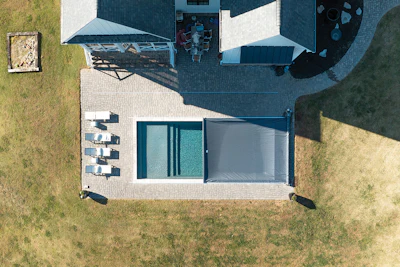
Automatic pool covers are simply a practical, convenient lid for the vessel that sits in the backyard, keeping its contents fresh and intruders out.
At some level, all pool owners know this. It is the job of a pool professional committed to the customer’s best interests (and his own, by happy coincidence) to remind them and bring the intuitive, undeniable benefits of automatic pool covers to their attention.
 An automatic cover conveniently provides all the benefits of a covered pool without marring the aesthetic charm of a truly dazzling installation.
THINGS KEPT IN AND OUT
Mainly, auto pool covers retain four valuable assets. These are:
1. Water. Fresh, clean water is expensive and growing more so. In the measured view of the PHTA Government Relations Advisory Committee writing in June AQUA, “Water scarcity is no longer a future prediction — it is an accelerating national crisis with direct implications for the aquatics industry. More than 40 states expect water shortages in the next decade."
How much water does an auto pool cover save? About 90 gallons a day in the American Southwest. That’s a typical daily evaporation loss in Phoenix summer heat, and pool covers decrease evaporation by up to 97% (U.S. Department of Energy).
2. Heat. Many people are not fully aware of how much heat is lost by an uncovered pool by evaporation — the breaking of every single intermolecular bond holding departing water molecules together. It sucks a surprisingly massive amount of heat from the pool, same as it does from your body when you climb out of the pool on a windy day. In fact, most of an uncovered pool’s heat loss is due to evaporation — about 75% — instead of the commonly held heat-transfer culprits of convection and radiation.
That’s the science of it.
In more practical terms, a common rule of thumb is that an auto cover adds 7 to 10 degrees to pool temperature, and that extends the swim season. Trying to heat a pool without a cover, as Wes Mathis, founder of Pool Cover Specialists, West Jordan, Utah, once said, “is just as much an exercise in futility as heating a house with no roof.”
As one can imagine, heating a house without a roof would be expensive. Heating a pool without a cover is surprisingly expensive, too. In terms of dollars, the analysis of industry veteran Joe Keyes, inside sales manager at Coverstar, is illustrative. Keyes worked in the Chicago market for years, where he analyzed the cost of heating a pool with and without a cover. “My data actually comes from 2010 heating fuel costs, which are low, but in one season, a Chicago homeowner is going to spend roughly $3,400 on heating a pool to a nice comfortable temperature. Now, when you add in an auto cover, that cost drops down to $523 — a substantial savings.”
3. Chemicals. According to the U.S. Department of Energy, swimming pool covers reduce chemical consumption by 35% to 60%, which is a lot. How do they do it?
- Shade: Covers block UV degradation of chlorine. As we all know, sunlight is hell on Cl. By shielding the water, covers can reduce chlorine loss by up to 60%.
- Evaporation reduction: When water evaporates, the chemicals dissolved in it are lost to the air. Covers prevent up to 95% of evaporation, keeping sanitizers and balancing agents in the pool.
- Algistat: A pool cover doesn’t kill algae, but it blocks the sunlight it needs to grow. By stopping photosynthesis, covers help prevent algae from taking hold and blooming, so your sanitizer isn’t consumed fighting outbreaks.
- Block out debris: Leaves, pollen, and dust carry bacteria, and their breakdown and eventual oxidization consumes chlorine. If organic waste never reaches the water, the use of shock treatments, clarifiers and maintenance chlorine is reduced.
- pH stabilization: Uncovered pools lose carbon dioxide (CO2) to the air, which causes pH levels to rise continuously, and may necessitate the use of an acid to lower pH. A pool cover traps CO2 at the water’s surface, slowing down pH drift.
4. Time. The time required to clean pool — skimming, vaccing, etc. as well as all the time needed to to up water and replace lost chemical is also saved through the use of pool covers.
 An auto cover's most important function.
A FENCELESS BARRIER
Even as auto covers keep precious assets in the pool, they keep precious bodies — like infants and non-swimmers in general — out. That imperative needs no explanation, but the laws governing it do. Every jurisdiction in the United States requires barriers between pool water and humans, but these authorities differ on what constitutes a code-compliant barrier. In some places, a fence is required. In others, an automatic pool cover replaces the need for a fence. That is, an automatic pool cover can be installed to both satisfy the barrier code — thereby obviating the five-figure cost of a fence — and to provide all the cost savings in water, chemicals, and heat detailed earlier. Taken together, all these benefits far outweigh the cost of an auto cover.
Indiana, where Keyes lives, has passed a law that allows auto pool covers to replace fences in the pool code. It’s had a powerful impact. “In 2024, we looked at data and noticed there were roughly 120,000 inground pools built nationwide, but only about 10% got an auto cover. Now the crazy thing is, if you looked at the state of Indiana, 95% of inground pools have an auto cover.”
That 95% acceptance rate speaks to the overwhelming financial benefit of installing an automatic pool cover in a place where it obviates a fence.
However, Indiana is the only place that has adopted the code state-wide. Outside Indiana, codes are changing to allow auto covers to replace fences, mainly through the ISPSC (International Swimming Pool and Spa Code), which allows ASTM F1346-compliant automatic or manual safety covers to serve as a substitute for traditional 48-inch pool fencing.
“Right now, we have 16 states that have adopted ISPSC, 21 optional states, 558 local adaptations, and then the one state law, which is Indiana. So, if your state has adopted the ISPSC, including states such as Georgia, Louisiana, Michigan, New Jersey, Virginia, to name a few, or cities like Houston, Dallas, Austin, and San Antonio that have adopted the code, you can use an auto cover instead of a fence,” Keys says, noting that sometimes code inspectors themselves may need an update on the relatively recent changes.
 Keeping an auto cover clean and pristine is a sensible service add-on.
SERVICE
These code changes are good news for a variety of reasons. Yes, they create an overwhelming value proposition for homeowners, but for pool professionals, they create a valuable opportunity. The installation and service of automatic pool covers can snowball into a good revenue stream.
“There’s not only money on the front side of this when you build your pool and you add the auto cover to it, but there’s service revenue on the backside of it because this is a moving, working device,” Keys says. As well as manufacturing automatic pool covers, Coverstar has a service division in the Midwest that offers everything from cleaning and tuneups on up. He invites other companies to join this rewarding service market.
“Cleaning the cover is a nice, billable service item. And what you’re doing is you’re cleaning the top of the cover with a non-petroleum-based protectant, you’re cleaning the pit, you’re checking the wearable parts — sliders, pulleys, ropes and leading-edge bar inserts. To do a tuneup, our service department charges $355 plus travel. We inspect the tracks, the ropes, the pulleys, and we lubricate the mechanism. We verify that the motor and switch are working, and we make sure the water level is correct.
“I had a dealer recently reach out to me and she said, ‘You know what? I finally listened to what you were suggesting to me, and I sent out an email blast to 40 customers that said, “Hey, get your cover cleaned for wintertime.”’ Forty emails went out, and she had 30 homeowners respond. She charged $500 apiece to go out and clean their cover in November.”
Service revenue streams such as this one are part of a growth pattern, as companies continue to find new customers on the aftermarket side of the pool business.
In the wider view, given all the factors involved — resource conservation and a barrier code picture brightening with every year — automatic pool covers are on a trajectory to reach higher levels of acceptance as a standard part of the backyard swimming pool package. For pool companies in the trade, success is mostly a matter of reminding customers of these factors.