






Automatic pool covers are becoming an easier sell, because — in the words of Charlie Claffey, owner and general manager of Claffey Pools in Southlake, Texas — “it’s all about the features people are willing to spend money on.”
And, increasingly, a large segment of the pool-owning population is willing to pay for enhanced peace of mind.
“You can have water sensors, you can have door alarms, you can have fencing — but you still do not get the same safety that you get with a cover,” says Jay Taylor, who installs a “ton of covers” as owner of Custom Pools of Lubbock in northwest Texas. “Any other safety feature you put out there [reacts] after something has already happened. Water sensors are going to go off and tell you that somebody’s in your pool, but somebody’s not getting in the water if that cover’s closed.”
And neither are leaves, twigs and other debris, because a cover also makes it easier to keep the pool clean, as well as extend the season with its thermal heating capabilities. The ultimate key to locking in more pool cover sales, according to Claffey and Taylor, is understanding how a customer intends to use (or not use) the pool.
“For a lot of people, the use of a pool is secondary to the design,” says Claffey, who sometimes combines an automatic pool cover and in-floor cleaning system in a safety and easeof-maintenance features package. “Our job, as designers and builders, is to ask the right questions so you can come up with the best solution. We have a very unique product, in a higher price point, and there’s not many other things you can buy where every one of them is completely different. You can build the same pool, but that doesn’t necessarily mean that it’s going to act the same in the yard from the perspective of drainage or topography, for example. You’ve got to know the options available so that you can produce for every client you serve.”
Such thorough builder-client discussions anchored the Gold and Silver projects in the “Pools with Automatic Covers” category of PHTA’s 2025 Awards of Excellence. One required balancing multiple functional and safety requirements while working with a challenging sloped site. The other relied on unconventional placement of the cover in order to accommodate elaborate water features at the deep end of the pool.
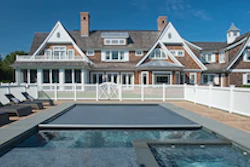
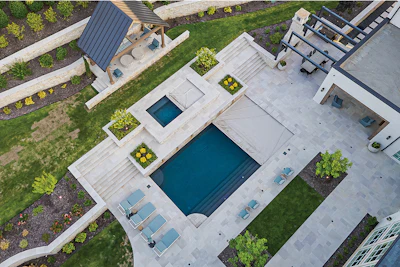
 Designing a pool-spa combination with two bodies of water sharing the same equipment required independently operating automatic covers, each with walk-on lids — a solution driven by both safety needs and site constraints.Photo courtesy Serrato Photography
 Photo courtesy Serrato Photography
MULTIPLE LEVELS OF SAFETY
When the owner of a massive home in West Lake, Texas, with a generous backyard (punctuated by an 8-foot elevation change) came to Claffey Pools, an automatic cover was already a given. After all, this was a family with three children under the age of 10 that also intended to keep the pool heated during the winter months.
The challenge — or rather, challenges — was designing and building a pool-spa combination using two bodies of water that shared the same equipment and incorporated independently operating covers, each with walk-on lids. Claffey designed a finger ledge accented with scuppers to separate the elevated spa deck from the pool and serve as a safe space for the kids to jump into the deep end of the pool, which spans 38 feet across and runs parallel to the elevated spa deck.
The pool owner insisted on having the entire length of the 8-foot deep end run parallel to the finger ledge to ensure safe entry from any jumping-off point. The shallow end, on the opposite side, features pool-length entrance steps. The pool also includes clipped corners to create a Grecian-design effect, with resting ledges recessed just below the water level. The pool cover extends from one short end (19 feet in length) and rides over the top of the recessed ledges, covering the deep and the shallow areas at the same time.
The automatic covers for both the pool and spa function the same, with stainless steel brackets supporting the walk-on lids. The tracks for each also were set at the same time, and the covers were installed at the same time.
“With this particular client, the use of the pool was just as important as the design itself, and that’s pretty rare,” Claffey says. “We’ve done projects with two auto covers before, but never in a pool-spa combination like this one. I think the specific safety concerns with this particular project were unique to the client. I don’t necessarily think we’ll do anything like this again with both the safety of the cover itself and then the safety of the way the pool needed to be designed.”
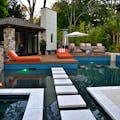
Above the spa, a cabana integrates into the slope, which is supported by retaining walls and surrounded by landscaping that tames the terrain. The project carried a $600,000 price tag — including $75,000 for both automatic pool covers and their installation, according to Claffey.
“We are able to serve a client base that is not afraid of the cost of two covers; it’s a fairly healthy investment,” he says, adding that the stone on top of the walk-on lids significantly hikes up the cost. “A more economical way to do coverage would be some kind of aluminum lid. But here in Texas, it’s gonna get smoking hot. You’ll get burns if you touch it, and it makes one side of the pool, in terms of function, completely useless. That’s why 95% of the covers we do have walk-on lids.”
Claffey Pools subcontracts with Dallas-based Pool Cover Resource for all of its cover installations. “We have always made the decision that leaning on someone that [does cover installations] all day and every day for a living is giving the client the best bang for the buck,” Claffey says.
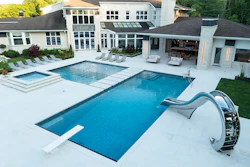
 While the deep end typically houses the cover box, this project reverses the standard layout, relocating the automatic cover to accommodate a slide and water features without sacrificing access to the cover mechanism.Photo courtesy Jay Taylor
 Photo courtesy Jimi Smith Photography
FLIPPING THE SCRIPT
The owner of a home in Lubbock wanted to make the backyard a fun place for the family’s small children while also an inviting space to host church-related events and other social gatherings. That meant a water slide was a must, and so were compelling water features. The catch: All of those elements needed to be combined at the deep end of the pool, which is typically the end that houses the pool cover box. “So we had to flip it on this project,” Taylor says, noting that no elements could be built on top of a cover box. “It required a little more thought as far as in-floor cleaning goes. We had to use fixed heads versus rotating heads, because you can’t shoot the water back into the cover pit; you’ll just always end up with it flooded.”
At the shallow end of the 22-by48-foot pool (which also includes an 8-by-8 spillover spa with adjacent barstools), the coping sits on brackets and is removable to access the cover mechanism.
“That’s why you can’t put the cover on the same side as the water feature,” Taylor adds. “If you had it on that end, then your water feature would have to be recessed 18 inches back from your cover box, because you have to have access to that cover box.”
 A custom slide structure clad in red brick integrates multiple jump platforms and a weir wall, demonstrating how automatic cover placement can expand, rather than limit, design possibilities.Photo courtesy Jimi Smith Photography
 Photo courtesy Jimi Smith Photography
A custom slide structure at the deep end, clad in red brick, features multiple jump platforms and a weir wall bookended by large fire bowls. Other key features include an outdoor kitchen — complete with a grill, trash center, storage and bar-style seating — plus a sunken fire pit and decking with an inlaid turf grid.
“Slide structures all tend to the look the same, and this one is just completely different than any we’ve done,” Taylor says. “We’ve never done a weir wall in one. We have done a lot of shears and scuppers, and we had done a weir wall for another project in a different design. So we decided, ‘Hey, let’s incorporate all that and just change it up.’”
The entire project cost $250,000, according to Taylor, including $15,000 for the cover, and was complicated by the fact that the original house on the property was torn down and rebuilt at the same time the pool was under construction.
Custom Pools of Lubbock does its own cover installations, but Taylor relied on a cover specialist for about a decade before he felt comfortable taking on the process himself.
“Covers come with their own issues,” he says. “If your beam walls aren’t plumb, and you’re setting that cover track and it’s got some wave to it, that cover is never going to operate [properly]. You’re going to always have issues down the road. Rope systems are definitely more forgiving in that type of situation than a cable system. But the number one obstacle is getting that track flush, because if you don’t get that right, nothing else is going to be right.”
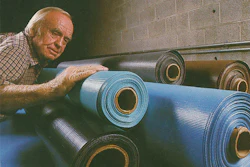
The success of a cover also relies on educating the pool owner about how to maintain it by keeping the tracks and cover pit clean, removing excess debris from a closed cover and washing the cover tarp itself on a regular basis.
Taylor acknowledges that concerns about aesthetics or cost can deter buyers without children. But, as with all customers, “we’re here to educate and try to guide them to make the best decision,” he says. “With a cover, you get the peace of mind knowing that the pool is protected, as long as that cover’s closed. That’s the cool thing about covers, truly.”
This article first appeared in the February 2026 issue of AQUA Magazine — the top resource for retailers, builders and service pros in the pool and spa industry. Subscriptions to the print magazine are free to all industry professionals. Click here to subscribe.