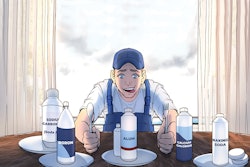













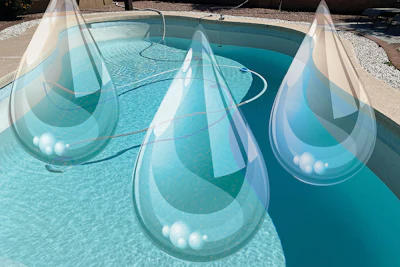
Water's ability to dissolve a wide range of substances, including salts, sugars, and acids, has earned it the colloquial title of “the universal solvent.” Speaking in general chemistry terms, water is a polar molecule and follows the principle that “like dissolves like.” This means that water readily dissolves other polar molecules. These molecules may also be described as hydrophilic due to their ability to mix with and dissolve in water. Nonpolar substances, oils and fats, for example, are described as hydrophobic because they do not dissolve in water and remain separate. This property is the reason you shake the bottle when you prepare a flavorful vinaigrette, to spruce up your lunchtime salad, as oil and water-based ingredients will not mix without assistance.
Understanding these fundamental properties of water helps explain what happens during everyday chemical processes occurring in aquatic venues. Consider the case of adding a calcium hypochlorite (Cal Hypo; Ca(OCl)2 ) shock product to the water. Looking at the listed ingredients, one finds Cal Hypo with a weight percent as well as the term “other ingredients” with the remaining weight percent. But what are the other ingredients and why are they there? To answer this question, one simply needs to look at the Safety Data Sheet (SDS) for that product. Section 3, Composition/ information on ingredients, identifies the other ingredient(s) contained in the product indicated on the SDS. For this product, we see that sodium chloride (NaCl) and water (H2 O) are the secondand third most abundant components, respectively. Additionally, salts such as calcium chlorate (Ca(ClO3 )2 ), calcium chloride (CaCl2 ), calcium hydroxide (Ca(OH)2 ), and calcium carbonate (CaCO3 ) are present only in small amounts. Similarly, the SDS for sodium hypochlorite (NaOCl) lists it as the primary ingredient with caustic soda (sodium hydroxide; NaOH), being the minor ingredient. Oddly, sodium chloride (NaCl), a 1:1 byproduct of the synthetic process, sodium chlorate (NaClO3 ) a decomposition product, as well as water are not listed as being ingredients, even though they are present in the solution. Investigate the SDSs of the other chemicals that you readily use to see what else you might be adding to the water.
In the above examples, with the exception of water, the chemicals added are salts. Building on your general chemistry knowledge, the chemical makeup of a salt, i.e., the individual ions, dictates the degree of solubility in a particular solvent and is denoted as the solubility product constant (Ksp). For instance, sodium chloride is highly soluble in water, the reason being is that the attraction between the sodium (Na+ ) and chloride (Cl- ) is weak and easily overcome by the neutralizing force of water molecules. Once the sodium chloride ions break apart, they are hindered from reuniting by water molecules surrounding them and keeping them further apart. Water molecules orient themselves by turning the positive hydrogen ions towards the negative chloride and the negative oxygen towards the positive sodium. Through a process of hydration, the individual sodium and chloride ions are surrounded by the water molecules and kept in solution. This can also help explain why calcium carbonate is only slightly soluble in water. The attraction between the calcium (Ca2+) atoms and the carbonate (CO3 2-) molecules is very strong, making it difficult for water to separate the ions.
While we have talked about the other chemicals that accompany a hypochlorite sanitizer, let’s now focus on the action of hypochlorite on an organic molecule that frequently enters bodies of water. Urea (CO(NH2 )2 ) is a colorless, odorless water-soluble organic compound in urine that enters the water when a person decides to pee in the pool. Once in the pool, the urea disperses and waits to interact with a chlorine sanitizer. According to work done by Blatchley, et. al. (Environ. Sci. Technol. 2010, 44, 8529–8534), the chlorination of urea proceeds slowly. The urea molecules can accumulate, just like the inert salts discussed above. When the chlorination of urea proceeds, the proposed mechanism requires five hypochlorous acid molecules to reach the final products. To try to put this into perspective, let’s assume that 5 grams of urea entered the pool when an adult decided to pee. If the pool water is maintained at 1 ppm free available chlorine (FAC), it will take the chlorine contained in approximately 5,765 gallons of water to completely neutralize all of the urea from that one person.
Now that we have painted the picture that salts and waste are introduced into the pool water by treatment chemicals and from bathers, let’s discuss the strategy of water replacement to remediate the water. By replacing the water, you are going to be removing these dissolved salts, as well as unreacted organic contaminants, disinfection by-products (DBPs) and other compounds contributing to chlorine demand, thereby preserving FAC to act as a sanitizer. In the ANSI/ APSP/ICC-11 2019 American National Standard for Water Quality in Public Pools and Spas (APSP-11), Section 8.8 Water replacement states specific language on the Water Replacement Interval (WRI) for hot tubs and spas. The standard states that the water shall be replaced when either: (1) Total Dissolved Solids (TDS) has increased to 1500 ppm greater than TDS at start-up; or (2) the WRI is calculated as
WRI (Days) = (1/3) x (Spa Volume in U.S. Gallons) / (Number of Bathers per Day)
For swimming pools, WRI has not traditionally been regulated in the United States. APSP-11 recommends that regular water replacement should be applied to pools, although certain circumstances may prohibit this practice (e.g., drought conditions) or make it unnecessary (e.g., reverse osmosis to extract contaminants from the water). One approach for swimming pools is to replace 7 gallons of water per bather entering the water each day. The Appendix section of APSP-11 provides more details on the reasoning for the WRI. Supplementary systems, such as ozone or UV, can destroy organics and DBPs which may help reduce the frequency of water replacement.
Maintaining water quality in pools, hot tubs, and spas goes beyond simply adding sanitizing and balancing chemicals. Every added chemical brings with it other ingredients that inevitably accumulate as TDS. This buildup, coupled with organic waste from bathers, can make sanitizers less effective over time. By adopting a strategy of regular water replacement to lower the TDS to recommended levels, the aquatic environment can be refreshed. This ensures sanitizers can work both efficiently and effectively, preserving water quality for everyone to enjoy.
This article first appeared in the February 2026 issue of AQUA Magazine — the top resource for retailers, builders and service pros in the pool and spa industry. Subscriptions to the print magazine are free to all industry professionals. Click here to subscribe.