












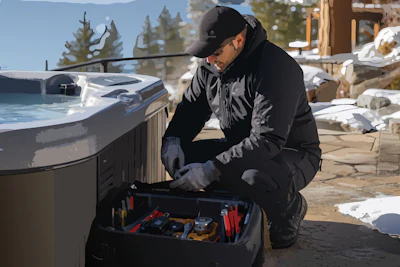
The old stereotype remains stubbornly intact. Hot tubs can be viewed as troublesome luxuries, expensive to maintain and perpetually on the verge of turning into cloudy microbial soup after a few enthusiastic weekends of use — literally a hot mess.
In that view, service departments exist mainly to respond to complaints, repair breakdowns and soothe frustrated customers. Yet the companies that survive, and increasingly those that thrive, see service through an entirely different lens.
For them, service is not an afterthought attached to product sales. It is a recurring revenue stream, a customer retention strategy and perhaps most importantly, a business built on trust. Hitting those high marks is a multifaceted process. The economics, inventory control, insurance costs, employee retention — it all matters.
Yet, after speaking with two seasoned operators serving mountain communities where hot tubs are essential to local lifestyle, culture and economy, one message surfaced repeatedly: profitability begins with water.
“I think the biggest message I would like to convey,” says Kurtis Wyllie, president of Sun Peaks Aquatics in British Columbia, “is that hot tubs have such a negative reputation of always being dirty. That’s not true at all. I know that from my personal and business experience that a hot tub can and should be the best water you’ve ever experienced. That’s the key to service profits.”
For Wyllie, whose company maintains approximately 170 hot tubs in a British Columbia ski resort community dominated by Airbnb rentals and vacation properties, water chemistry translates to competitive differentiation.
“For us, it’s 100% doing water care,” he explains. “I know nobody really loves water care, because it’s a constant challenge, especially in high-use properties, but it’s our key to success when it comes to service. That’s what sets us apart.”
Foundations of Profitability
As he explains, water quality may sound mundane compared to sales or repair work in terms of immediate profitability, but it has a way of infiltrating every corner of a service business.
Improper water maintenance leads to complaints, emergency calls, damaged equipment and unhappy customers. Conversely, crystal clear water creates something far more valuable: confidence. “Our goal is crystal clear water,” Wyllie says. “And we get comments all the time from people who’ve never seen hot tubs that have been so clean.”
Achieving that standard requires relentless oversight. In Wyllie’s market, many customers are short-term rental owners whose tubs experience extraordinary use. “The biggest part of our program is with an Airbnb guest,” he says. “We check it daily if needed. Some of our properties get 200 checks a year.”
During peak holiday periods, the demands become staggering. “There’s times where we’re checking all 175 tubs every day through Christmas.”
The stakes are high because many of these vacation properties command premium nightly rates. “People expect those hot tubs to be up and running,” Wyllie explains. “Some of our units get anywhere up to two or three thousand bucks a night in the peak season.”
In a mountain environment, where winter temperatures can become brutal, a malfunctioning pump is not merely inconvenient. “If something happens, a pump stops working or it’s having some kind of error code, we have to have someone that can look at it that day, or else it could be a popsicle by the morning. That downtime becomes expensive quickly.”
Selling Peace of Mind
Customers rarely purchase service plans because they enjoy paying for maintenance. More often, they are buying freedom from worry. “Our main selling pitch is peace of mind,” Wyllie says. “You don’t have to worry if something goes wrong.”
That philosophy requires proactive intervention before owners are even aware of problems. “We just proactively fix a lot of things,” he explains. “Most of our customers are happy because they don’t have to think about it.”
The approach can become remarkably hands-on. “If a hot tub has a catastrophic leak, we will put a hot water recirculating heater in it overnight,” Wyllie says. “We’re very, very proactive.” At that point, maintenance has evolved into a form of insurance. Customers are paying not simply for chemical balancing or repairs, but for assurance that someone is constantly watching over an important amenity.
Setting Expectations Early
Profitable service divisions become highly skilled at one discipline that often receives too little attention: managing customer expectations.
Juliet Phelps of Ajax Pool & Spa in Basalt, Colo., approaches communication systematically. “I have an outline of service,” Phelps says. “When we do their routes, we have a detailed outline of what we’re going to do for them.”
Customers receive upfront information detailing recurring services, expected maintenance intervals and pricing. “If I need to do a drain and clean — and then, in parentheses, ‘every four to six months’ — you’re going to expect to be asked to do that. This is the price.”
Repairs fall into a separate category. “A repair is everything that’s not on the list above.”
Wyllie agrees that clearly defining policies and exclusions is essential. “One hundred percent, yeah,” he says of the importance of documenting what is and is not included. “I send them an email saying all of our policies and procedures are listed on our invoice.”
Ambiguity destroys margins. Clear expectations preserve them.
Hiring for Attitude
Technical aptitude matters, but perhaps not as much as many employers assume.
“I honestly prefer someone who knows nothing about hot tubs than someone who thinks they know everything,” Wyllie says.
Instead, he prioritizes qualities that cannot be easily taught.
“A willingness to learn, and a good work ethic.”
Employees progress through structured competency levels.
“We scale our job description and pay based on what they eventually are capable of doing.”
Phelps shares a similar philosophy, though she expresses it more bluntly. “I like a heartbeat,” she jokes. “A driver’s license that’s clean.” Then she clarifies. “I like to really hire guys that need a job and are willing to learn. Motivated people.”
Training receives substantial investment. “I just got done sending eight guys in a minivan to Denver to do training,” Phelps says. The financial investment communicates something important. “They know in their minds that I value them because I am paying to train them.”
The training itself matters, but so does the message behind it.
Revenue Generators
Phelps describes employees in unusually direct terms. “Our employees are our profit centers. “Every service vehicle leaving the shop each morning represents income potential. “They get in our little profit truck and go off and do what they need to do to generate income.”
Protecting those employees therefore becomes both a human and financial priority.
Phelps has reduced insurance costs through safety programs and tracking systems. “I got a big discount on my insurance,” she says. “I think it was about ten grand a year.”
The savings came through GPS tracking systems, safety meetings and documented protocols. “I get breaks for doing safety classes, safety meetings, safety contracts.”
Every incident becomes part of a formal record. “If they have too many incidents, you need to fire the guy.”
Documentation removes ambiguity and creates accountability. “It makes it a little bit more cut and dry.”
Inventory Management
Chemical losses, misplaced tools and untracked inventory quietly erode profitability. Phelps learned that lesson firsthand.
“A company came in and said that I was losing about $35,000 a year on chemicals alone that weren’t getting charged for.” Her solution involved adopting barcode inventory systems. “The truck is literally an inventory location,” she explains.
Technicians become accountable for products loaded onto their vehicles.
“You take out a bottle of $22 algaecide, you forget to bill it out…”
Consequences follow, and the principle is simple. “You go to the hospital and they scan every Band-Aid. The point is, every item matters.” One small item might not matter by itself, but when you add it up, those small costs accumulate over time, almost like compound interest.”
Inventory extends beyond chemicals. Phelps hired an asset manager specifically to oversee equipment and supplies. “He oversees all of my trucks, all of my tools.”
Even mundane items require oversight. “He’s got my jumper cables under two locks because they disappear the fastest.”
Wealthy Clients & Complex Billing
High-end markets create unusual customer service challenges. Second homes, absentee owners and property managers introduce multiple layers between service providers and actual decision-makers.
“You have property managers who don’t pay,” Phelps says. “Then you have homeowners... and then you have other people who have a secretary writing checks.”
The service company may ultimately deal with several intermediaries before receiving payment. The complexity requires flexibility, patience and disciplined billing systems.
By the same token, not every customer relationship should be preserved. “We’ve certainly fired a few customers,” Wyllie says.
His approach to conflict begins with honesty. “I try to get to the root of the problem,” he explains. “I’m not afraid to say when we’re wrong or when we’re not wrong.”
Refunding money may solve some problems, but not all. Frequently, the better solution lies in establishing expectations from the outset.
Pricing for Economic Reality
Fuel costs rise. Labor costs rise. Equipment and shipping costs rise. Service businesses eventually face difficult pricing decisions. “I won’t raise and say gas surcharge,” Phelps says. “I’m going to just raise my prices.”
Her reasoning is direct. “We have no option.” Pricing should reflect local economic realities, she adds. “You look around and charge what you know is appropriate.”
To determine labor rates, she benchmarks against luxury automobile repair shops. “My guys are highly skilled, just like a mechanic.” The comparison resonates because spa technicians require expertise across multiple brands, systems and technologies.
“I’m charging less than the Audi guy, and my technicians come to you.”
The Real Product Is Trust
Ultimately, profitable service businesses sell something much larger than chemicals, repairs or maintenance visits.
They sell certainty. Vacation rental owners want confidence that guests will encounter clean water and functioning equipment. Property managers want fewer emergencies. Wealthy homeowners want convenience.
The operators who succeed build systems supporting those outcomes through training, inventory controls, proactive maintenance and obsessive attention to water quality. Wyllie summarizes the formula succinctly. “Water care leads to service, which leads to sales.”
The relationship forms a pyramid with crystal clear water at the base and profitability at the top. Perhaps the most revealing comment came when Wyllie described customers staring into perfectly maintained tubs. “We’ve even had people say, ‘I don’t think there’s water in our hot tub.’” His answer captures both pride and philosophy. “No, trust me. There’s water in the hot tub. It’s just so clear, you can’t tell.”
For successful service businesses, invisibility may represent the highest compliment. When everything functions perfectly, nobody notices. Until they experience anything less.