











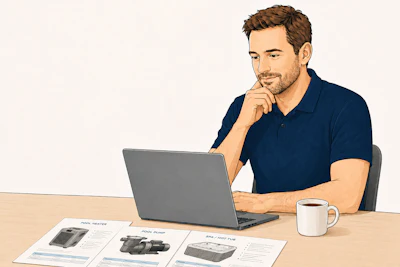
A homeowner has three competing bids on his table for a new pool heater. Three brands, three spec sheets, each insisting theirs is the best. He wants his local pool pro Drew Coppolino’s read before he signs anything.
Not long ago, Drew, owner of Pools Etc. Maintenance & Repairs in California, would have lost an afternoon to spec sheets, cross-referencing BTU output against thermal efficiency against pad footprint. Today, he opens ChatGPT.
He prompts it for a head-to-head “battle test” of the three units. Round 1, raw heating muscle. Round 2, efficiency and emissions. Round 3, footprint and retrofit ease. Round 4, hydraulics. Round 5, controls. Through Round 7, ecosystem compatibility.
In the time it takes to drink a coffee, Drew has a seven-round breakdown his client can actually read, a recommendation backed by reasoning he can defend, and a clear path to a signed proposal.
THIS IS THE POOL INDUSTRY’S QUIETEST REVOLUTION.
The trade is still the trade. Water is still wet. Service trucks still pull out before sunrise, loaded with chemicals, vacuums, and the muscle memory of a thousand pump rebuilds. None of that is going anywhere.
And yet the gear itself is getting smarter. Floating dispensers are reading chlorine, pH, and ORP in real time and dosing only when the water actually calls for it. Heater boards ship with predictive maintenance baked in. The hardware is evolving. But the hands turning the wrenches are still human.
However, the back office is changing much faster. Proposals. Equipment comparisons. SOP documents. Customer follow-ups. Marketing copy. Route optimization. P&L reviews. Even the first drafts of public-health standards. The work that used to require a second hire, an outside consultant, or a 60-hour week is now happening in the leftover margins of the day, prompted from a phone between service stops.
Call it “bionic, not replaced.” It’s not a robot in the truck. It’s a second brain in the back office. The craft doesn’t change. The business around it does.
ONE BUILDER’S BEHIND-THE-SCENES BENCH OF SPECIALISTS
Remember Drew? He runs a lean operation. There’s no analyst on staff, no marketing department, no operations manager writing his SOPs. What he has instead is a set of tools that fill those seats on demand.
The role he leans on most is business analyst. The heater battle test wasn’t a parlor trick. It was Drew turning a tedious, error-prone research task into a structured, client-ready document in the time he used to spend just hunting down the spec sheets. The same approach works on his books. Feed a profit-and-loss statement into an AI model, ask where the margin is leaking, and it catches the dollars quietly going down a drain you forgot was open. The AI doesn’t make the decision. It makes the decision visible.
From there, it spreads into the rest of the business: tightening customer communication, drafting and refining proposals, building out the standard operating procedures a growing service company lives or dies by. None of it replaces Drew’s judgment. All of it removes the friction between his judgment and the finished work.
The common thread is leverage: getting the output of a bigger team without the cost of one. Drew hasn’t added headcount. He’s added capability. Each of these use-cases would once have meant a hire, a contractor, or an evening lost to a task outside his day-to-day expertise. Now they happen between service calls, on a phone, for the comparatively low cost of a subscription. He’s the same pro he was five years ago, with a bench of specialists now riding shotgun.
UP AND DOWN THE INDUSTRY
Drew isn’t an outlier. Across the industry, pros in every lane are quietly doing the same thing.
Emily Swett, founder of Swimming with Confidence in Montana, built her e-commerce brand as essentially a team of two: herself and an AI assistant she nicknamed “Janet.” An MBA and current PhD student, she uses it to turn rough ideas into polished posts, write product copy, draft SOPs, and, most tellingly, as a sounding board. “I use it to pressure-test decisions, simplify complex problems, and identify gaps or opportunities I might be missing,” she says. “It acts like a second brain.” Her verdict on a year of full-time growth: “I could not have built what I built without AI.”
Rob Breault, owner of Greyshark Pools in North Carolina, points his AI at building things. His latest website was built and optimized with AI assistance, and he has a pool equipment parts scanner and a service business-intelligence reporting tool in development. For a service company, AI isn’t just answering emails. It’s the R&D department.
Some of that capability is being baked directly into the software pool pros already use. Pool Brain, founded by former Phoenix pool company operator Adam Beech, uses AI to automatically predict the number of chlorine tabs needed for any body of water. The AI model analyzes weather data, schedule frequency, and chemical history to automatically provide the dosing amount.
On the manufacturing side, Sean McDermott, Executive Vice President at H2Flow Controls in Ohio, uses AI to write display-control code, translate technical documents, and sharpen marketing copy. Three very different jobs, all with one very powerful tool.
And then the quiet surprise. Sarah Cheshire, an environmental health scientist at the Utah Department of Health and Human Services, uses AI to run first-pass research and draft the early language of public pool standards, which her team then edits for accuracy. The people writing the rules are using the same tools as the people following them.
SO WHY ISN’T EVERYONE DOING IT?
Ask pool pros what’s holding them back and the answer, over and over, isn’t fear of robots. It’s the clock. The most common refrain in our conversations wasn’t “I don’t trust it.” It was “I don’t have time to learn it.” The irony writes itself: the tool that gives you time back demands a little time up front, and a booked-solid operator in the middle of pool season has absolutely zero to spare.
But this way of thinking is a silent trap.
The first several hours with AI aren’t overhead. They’re an apprenticeship, and they pay for themselves the first time you turn a half-day research grind into something you finish before your coffee goes cold. The pros pulling ahead didn’t find more hours. They treated learning the tool as billable work and put it on the calendar.
But thankfully, becoming a self-taught AI activator isn’t the only path. Many pros are better off doing what they already do with bookkeeping or payroll: hand it to someone who’s good at it. A growing number of reps and consultants now help pool businesses set the systems up, write the prompts, build the SOPs, and wire up the automations, so the owner gets the payoff without spending a season becoming an AI expert. Knowing when to outsource is its own kind of leverage.
No matter which path you take, the goal is the same: don’t get caught treading water while the rest of the pool swims past.
Think of AI like a power drill. You can still reach for a manual screwdriver if you want to, and spend all day turning your wrist until it aches. But the pro with the drill finishes 10 jobs in the time it takes you to finish one.
THE DOUBLE-EDGED SWORD
AI cuts both ways, and the pros feel it. “We already see unqualified or unreputable people using [AI] to increase their brand in spite of having little real-world experience,” says Mike Bowers, president of Pool Pros in Wisconsin. “It’s leveling the playing field marketing-wise.” His worry is real: a six-month-old company can now generate a polished website, fluent proposals, and a presence that makes it look like a 30-year veteran. Well-executed AI can bring instant credibility to anyone, deserved or not.
Here’s the part both sides can agree on. The veteran’s frustration is fair: real expertise takes years, and watching someone skip the line with a slick, AI-built front can make you feel a certain kind of way. But the newcomer’s hustle is fair too, using every tool available to compete isn’t cheating, it’s exactly what this article is encouraging you to do for yourself. The one line every pro with integrity should agree to though: don’t let the marketing claim experience the work can’t back up.
So this isn’t a craft problem, it’s a marketing one, and it points both sides somewhere useful. For the veteran: your years in the field are the one thing AI can’t fake, so put them on display, show the diagnostics, the before-and-afters, the reasoning behind the call, and let real experience speak louder than any brochure. For the newcomer: let AI open the door, then let the work keep it open, because the tool can start the conversation, but only results build a reputation.
THE AI LEVERAGE MAP
If you take one thing from this article, take this: not every task is worth handing to AI, and knowing which is which is the whole game. Here’s a rough map of where the leverage actually is in a pool business.

The pattern is simple. AI is strongest where the work is language, research, and repetition. It’s weakest where the work is judgment, trust, and touch. Spend your first hours at the top of that list. Or connect with other pros who can help do it for you.
THE BOTTOM LINE
Back to that homeowner with three heater bids.
He didn’t choose Drew because Drew uses AI. Plenty of his competitors have the same chatbot open in another tab. He chose Drew because Drew used it to do something a busy expert rarely has time to do: lay out the full picture, clearly, fast, and back the recommendation with reasoning a homeowner could trust. And Drew knew what to ask the bot for based on his time tested experience and knowing what was really valuable to the end-user.
That’s the whole story. AI isn’t coming for your job. But the professional who learns to wield it might be coming for your market share. Or, as Neva Fairfield of Georgia Swim School put it: ignore it, and you’re the one still using a typewriter while everybody else has moved on to the computer.
Laci Davis is the co-founder and CEO of The Grit Game, an international rep firm that aims to empower potential within the pool and spa and backyard leisure industries.