












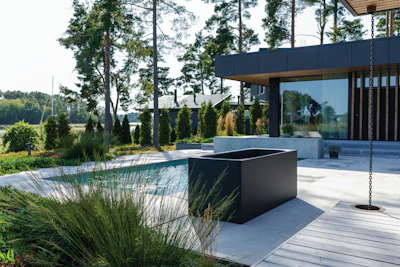
If you have spent any time scrolling through social media, touring luxury home expos, or talking to high-end clients lately, you already know that contrast therapy has officially gone mainstream. What was once a niche biohacking trend or a specialized recovery ritual reserved for elite athletes is now a standard requirement for luxury residential backyard design.
Homeowners are no longer satisfied with just a pool and a hot tub. They want the full “Fire and Ice” experience. And while the industry has made great strides in understanding the “Fire” side of the equation with authentic, high-design saunas, the “Ice” side is where many pool and spa contractors are currently struggling to keep pace.
The cold plunge boom is here, and it represents one of the fastest-growing, highest-margin add-on opportunities our industry has seen in a generation. However, because this market has evolved so rapidly, it has become a bit of a Wild West. To capitalize on this demand successfully, builders and dealers need to look past the internet hype and understand how to engineer, plumb, and maintain cold water correctly.
THE SHIFT FROM “APPLIANCE” TO “INTEGRATION”
When the cold plunge trend first hit North America a few years ago, it was defined by standalone, plug-and-play appliances. Clients were buying stock tanks or cheap imported plastic tubs, hooking up small, noisy chillers on their decks, and calling it a day.
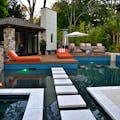
For a high-end custom backyard, that approach no longer cuts it. Luxury clients do not want a makeshift, industrial-looking plastic box sitting next to a beautiful $150,000 gunite pool. They want their cold plunge to look like an intentional, architectural component of the overall landscape.
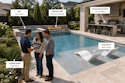
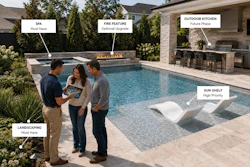
As a builder, this means you need to shift your sales focus from selling an isolated vessel to creating a unified wellness zone. A properly designed contrast space positions the cold plunge in perfect proximity to the sauna exit, with a direct, seamless path to a dedicated outdoor shower and, crucially, an aesthetically pleasing rest area where the body can recover.

THE TECHNICAL CROSSROADS: BUILT-IN VS STANDALONE LUXURY
When a client requests a cold plunge, pool contractors generally face a critical engineering crossroads: do you build a dedicated cold zone directly into the custom pool structure, or do you install a high-end, dedicated standalone unit? Both paths have distinct mechanical and operational realities.
1. THE INTEGRATED POOL PLUNGE
Building a small, deep, separate well directly into a concrete pool shell looks incredibly sleek. It shares the same gunite structure, matching tile, and coping, blending flawlessly into the deep-end architecture.
However, engineering this setup requires careful planning. To achieve true contrast therapy, the water needs to sit consistently between 55 degrees Fahrenheit (10 degrees Celsius) and 65 degrees Fahrenheit (15 degrees Celsius), but perhaps as low as 40 degrees Fahrenheit (5 degrees Celsius), depending on the client. If it is sharing a wall with an unheated pool in July, thermal transfer is working against you. You must heavily insulate the plunge well walls from the main pool shell during the pour. Furthermore, cooling water takes significantly more energy than heating it; you will need a massive, dedicated commercial-grade chiller connected to a separate equipment pad with its own dedicated plumbing loops and automation.
2. THE STANDALONE LUXURY VESSEL
The alternative is utilizing premium, self-contained standalone plunges designed specifically for high-end landscape integration. These are a far cry from the entry-level tubs found online. High-end units feature custom cedar, thermowood, stone, or other high-quality cladding that can be matched exactly to the exterior of your sauna build.
The benefit here is mechanical efficiency. These units are engineered with internal insulation, matched chillers, and proprietary filtration systems optimized for that exact volume of water. They reduce your on-site engineering liability and provide a clean “plug-and-play” installation, while still delivering the high-end aesthetic luxury clients demand.

THE WATER QUALITY NIGHTMARE: MANAGING THE ORGANIC SHOCK
The single biggest mistake pool and spa professionals make with cold plunges is underestimating the sanitation requirements.
Think about the physical ritual of contrast therapy: A bather sits in a 195 degrees Fahrenheit (90 degrees Celsius) sauna for 15 to 20 minutes, sweating profusely. Their pores are wide open, shedding skin cells, body oils, and sweat. They open the sauna door and immediately submerge themselves directly into a tiny, 80- to 100-gallon (300- to 400-litre) body of cold water.
When that heavy organic load hits a standard residential pool, the volume dilutes it. When it hits a small cold plunge, it creates an instant water quality nightmare.
To make matters worse, traditional chlorine and bromine do not sanitize effectively in water below 55 degrees Fahrenheit (10 degrees Celsius); the chemical reaction rates slow down dramatically. If you rely on a standard spa floating chlorinator, the water will quickly become cloudy, biologically unsafe, and unappealing.
To keep a cold plunge crystal clear and available to the wellness experience, the sanitation system must be robust and multi-layered:
- High-Turnover Filtration: The water needs to cycle through micro-filtration multiple times an hour.
- Ozone and UV-C Sanitation: Because traditional chemicals struggle in the cold, a combination of ozone and UV-C sterilization is mandatory to destroy pathogens and break down organic compounds instantly on contact.
- Educational Client Staging: Builders should design a quick-rinse outdoor shower directly between the sauna and the plunge. Teaching clients to rinse off the heavy sweat before they plunge protects the water and elevates the ritual.
THE ULTIMATE UPSELL
The cold plunge boom isn’t a passing fad; it is the maturation of the North American wellness lifestyle. For pool and spa professionals, mastering this segment is the key to transforming standard backyard builds into complete, year-round wellness destinations.
When you can confidently talk to your clients about thermal transfer, water sanitation in low temperatures, and proper contrast layout flow, you cease to be just a contractor selling water and lumber. You become a wellness architect, and that is a space where margins are high and competition is thin.