










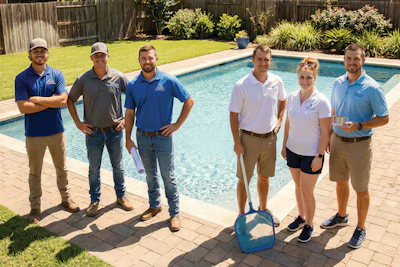
On July 13, 2026, leaders from the Pool & Hot Tub Alliance Builders Council and Service Council came together for a joint roundtable titled "Elevating the Customer Experience Through Collaboration." I had the privilege of leading the discussion as a member of the Builders Council.
The objective was straightforward but long overdue: create a productive, non-adversarial dialogue about recurring field problems, warranty friction, equipment serviceability, maintenance expectations and the ways both groups can improve long-term outcomes for pool owners.
For years, builders and service professionals have sometimes behaved as though they occupy opposing sides of the industry. When a pool develops a problem, a builder may point to maintenance or water chemistry. A service professional may point to design, construction, equipment installation or material selection. The homeowner hears conflicting explanations and is left wondering whom to trust.
That finger-pointing damages more than the relationship between two professionals. It undermines confidence in the entire pool and spa industry. Builders and service professionals ultimately want the same result: safe, reliable and beautiful pools that perform well over time. The purpose of the roundtable was not to decide which side was right. It was to identify recurring friction points and find practical ways to reduce them.
What Service Professionals Need From Builders
Service professionals spend years working with equipment pads after the builder has completed the project. They quickly learn which installations are easy to operate and maintain — and which create avoidable problems. Their clearest request was also the simplest: label everything.
Pipes, valves, electrical panels, automation controls and accessory equipment should be clearly and permanently identified. A technician should not have to experiment with valves or trace plumbing lines to understand how a newly constructed pool operates.
Service professionals also asked builders to leave complete plans and operating information at the equipment area. The information might be stored in a waterproof container, provided electronically or maintained in a digital project record accessible to the homeowner and service company. At a minimum, it should include builder and warranty contacts, equipment specifications, automation settings, plumbing diagrams and a record of materials used on the project.
Details matter. Tile, coping, interior finish, grout, sealant, lighting and water — feature selections should be identified by manufacturer, vendor, product name and color whenever possible. That documentation becomes invaluable years later when a product must be repaired or replaced.
Equipment accessibility was another major concern. Pumps, filters, heaters, chemical systems and automation equipment are sometimes installed so tightly that an average-sized technician cannot work safely between them. Builders must allow room not only for installation, but also for cleaning, repair and eventual replacement. Vanishing-edge basins, surge tanks, equipment vaults and other difficult-to-reach areas also need safe, intentional access rather than improvised solutions after construction.
The equipment pad itself deserves more consideration. Filter cleaning, leaking fittings, servicing and rainfall routinely make these areas wet. A better installation provides a level mounting surface for equipment while directing surrounding water toward a drain, gravel area or other approved discharge location. A nearby hose connection also makes it easier to clean filters, equipment and the pad.
Small provisions can also preserve future options. A dedicated plumbing line for a future suction-side or pressure-side cleaner can prevent an expensive modification later. Specialized systems — including ultraviolet units, ozonators, salt chlorine generators and chemical controllers — should be accompanied by written inspection, cleaning and replacement schedules.
The message from service professionals was clear: Build with future serviceability in mind.
What Builders Need From Service Professionals
Builders raised equally legitimate concerns about what happens after the pool is turned over. Premium projects may include glass tile, natural stone, dark interior finishes, metal accents, fire-and-water combinations, complex water features and specialty sanitation equipment. These materials and systems require care beyond basic brushing and chemical testing.
The service community can help establish more consistent maintenance expectations, including appropriate inspection and cleaning intervals for waterline tile and specialty finishes. Mineral buildup, scale and neglected tile can become difficult — and sometimes impossible — to correct if they are not addressed early.
The equipment pad should also be treated as part of the maintained property. Too often, the pool looks pristine while the equipment area contains half-used chemicals, old test kits, broken brushes, discarded parts, soil buildup or leaking fittings. Routine service should include keeping the equipment and slab reasonably clean, reporting leaks and removing abandoned service materials. The condition of the equipment area often provides an early warning of a developing problem.
Autofill devices deserve particular attention. A stuck or malfunctioning autofill can conceal water loss, continuously introduce fresh water and make a leak more difficult to identify. Periodic leak checks might include temporarily shutting off the autofill, monitoring the water level, performing a bucket test or checking the vessel while the circulation system is off. These practices support the water-conservation principles addressed by ANSI/APSP/ICC-13 2017, Standard for Water Conservation Efficiency.
Water chemistry can provide additional clues. If cyanuric acid, salt or calcium levels are unusually difficult to maintain, the pool may be losing treated water and replacing it with fresh source water. Service professionals are often in the best position to recognize those trends and alert the builder or homeowner before a small leak becomes a major problem.
Accurate maintenance records are just as important. When plaster discoloration, scaling, corrosion, staining or equipment failure occurs, builders and manufacturers need reliable service records to evaluate the condition. Incomplete chemistry histories make it difficult to determine whether a problem stems from construction, equipment failure, source water or maintenance practices. Clear minimum service and recordkeeping expectations would help preserve both construction and equipment warranties.
The message from builders was equally clear: Maintain the pool with its original design, materials and warranty requirements in mind.
The Handoff Is Where Collaboration Begins
One of the most important questions raised during the meeting was where builder responsibility ends and service responsibility begins. The answer cannot be left to assumption.
A formal handoff meeting among the builder, homeowner and service provider could prevent many common misunderstandings. The meeting should cover plumbing and valve operation, automation programming, filtration schedules, chemical systems, plaster startup, brushing requirements, water balance, warranty limitations, specialty-material care and recommended service intervals. At a minimum, it creates a direct introduction and shows the client that the professionals involved are willing to work together for the long-term success of the project.
The builder can explain the design intent, while the service professional can ask questions before assuming responsibility for the pool. This is also the right time to provide a permanent "pool owner's record" containing plans, equipment lists, automation settings, plumbing labels, finish selections, warranty information, startup records, maintenance schedules and contact information.
The record could be physical or digital; the format matters less than its accessibility and durability. It should remain with the property so essential information is not lost when a home is sold, the service company changes or equipment requires repair years later.
Presenting a Unified Message to the Customer
Both councils agreed that disagreements should not be argued in front of the homeowner. Before a service professional criticizes a construction decision, the builder should be contacted and given an opportunity to explain the design or inspect the condition. Before a builder attributes a problem to water chemistry or maintenance, the service professional should be contacted and the service history reviewed.
That professional courtesy does not prevent either party from identifying defective work or improper service. It simply encourages everyone to gather facts before reaching conclusions. Consumers should not be placed in the middle of an industry dispute. Even when professionals disagree, they can communicate respectfully, investigate methodically and present the homeowner with clear recommendations.
Turning One Conversation Into Lasting Progress
Everyone who participated agreed that the roundtable was productive and should not be a one-time event. One proposed next step is a PHTA online discussion forum where builders and service professionals can share field observations, identify recurring problems and discuss solutions involving materials, equipment, finishes and construction practices.
If service companies in several markets begin observing the same staining problem with a particular stone, recurring equipment failures or maintenance challenges associated with a specific finish, a structured industry forum could identify those trends much earlier.
Joint webinars, recorded panel discussions and educational seminars can extend the conversation to the broader PHTA membership through the PHTA Center of Excellence. Future sessions are expected to produce practical resources addressing equipment pad construction, project turnover, startup procedures, service documentation, specialty-material maintenance, leak detection and warranty communication.
My greatest takeaway from the meeting was that builders and service professionals are not competing interests. We are consecutive participants in the same customer experience. Builders create the pool; service professionals preserve it. When we communicate, document our work and respect one another's expertise, we reduce callbacks, avoid disputes, protect warranties and strengthen consumer confidence.
The July 13 roundtable was an important first step toward resolving years of friction. The next step is turning what we learned into repeatable practices that elevate professionalism throughout the pool and spa industry.