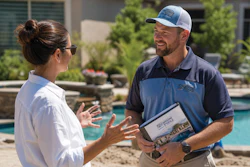








Kevin Holleran, CEO of Hayward, sat down to answer a few questions from AQUA and global forum Pool Horizons on our industry’s mission to bring water into people’s lives, and the benefits to health and community that flow from it.
For more details on Pool Horizons and its visionary role in the aquatic industry, see the sidebar on the following page.
AQUA/Pool Horizons: From your perspective, why is there sometimes a disconnect between the value the swimming pool industry delivers for health, well-being and social connection and how it’s perceived?
Kevin Holleran: I don’t see it as a disconnect as much as an opportunity. The value our industry delivers is real, measurable and already resonates with pool owners and users.
Images of blue water and active families aren’t just marketing, they reflect real outcomes. Pools support physical activity, reduce stress and create space for meaningful time together.
Consumers recognize that, and there’s strong validation behind it. The medical community has long supported aquatic exercise as a low-impact, highly effective option, and regular swimming has been linked to a more than 50% advantage in long-term health and longevity.
Swimming engages nearly every major muscle group while remaining easy on the body. It supports cardiovascular health, improves mobility and flexibility, and plays a role in rehabilitation and therapy. There’s also growing evidence around mental health benefits, including reduced anxiety and improved overall well-being. From a social standpoint, pools create spaces where families and communities connect.
Where perception can fall short is when that full story isn’t consistently told. If we don’t tell it, someone else will fill that vacuum, often focused on perceived negatives. Every industry has critics, but without a clear, fact-based narrative, those perspectives can disproportionately shape perception.
That’s beginning to change as the industry invests in stronger data and more effective ways to communicate it. It’s also important to broaden how people think about pools. They are not just symbols of luxury. Community aquatic centers, therapeutic applications and residential pools all point to a more inclusive role centered on health, wellbeing and human connection.
AQ/PH: Historically, the industry’s marketing has focused on product features and lifestyle. How can the industry evolve towards communicating health, well-being and community outcomes? Are there companies or initiatives you think are leading this shift effectively?
KH: The evolution starts by focusing on people rather than products, and more importantly, on aspiration. The most powerful positioning our industry can embrace is access to water and what it represents: health, well-being, human connection and lifelong memories.
That’s personal for me. I didn’t grow up with a pool in my backyard, but I spent a lot of time at community pools and rec centers. Some of my best childhood memories were simple moments like playing Marco Polo in a friend’s aboveground pool. That’s the emotional connection our industry delivers.
You saw that play out in a very real way during COVID. As families paused travel and traditional vacations, many prioritized investing in a pool. In many cases, the backyard pool became the vacation. Unlike a trip where you come home with a few pictures, a pool creates new experiences and memories every day. That surge in demand was a clear signal of the aspirational and emotional value pools provide.
At Hayward, we’re making a deliberate shift to highlight those outcomes. Campaigns like “Power of US” focus on the people behind the industry and the real impact pools have on healthier lives and stronger communities.
Equally important is backing that message with action. Step Into Swim is a strong example. The industry, led by the Pool and Hot Tub Association (PHTA), has rallied around expanding access to swim lessons, particularly in underserved communities. Formal lessons can reduce drowning risk by up to 88% for young children.
The path forward is clear: lead with aspiration, reinforce it with facts and expand access so more people can benefit from time in the water.
AQ/PH: How do you see digital technologies, especially AI, helping the industry enhance and demonstrate the health and well-being benefits of its products?
KH: Technology has already made pool ownership easier and more accessible.
Automation platforms such as Hayward’s OmniLogic and OmniX allow owners to manage water quality and system performance through a single interface, simplifying ownership. When pools are easier to manage, they’re used more often, and that’s where the real health and wellness benefits are realized.
What’s evolving now is how technology can reposition the pool as part of a broader wellness routine. We’re seeing increased interest in turning the backyard into a workout and recovery space, with features like swim jets and resistance systems supporting fitness, and cold plunge and infrared saunas adding to a more complete wellness environment.
At the same time, wearables and health trackers are changing how people think about activity and performance. There’s a natural opportunity to connect aquatic activity into that ecosystem so people can better understand how time in the water contributes to overall health.
The next step is data and insight. Connected pools can provide a clearer view of usage, while AI continues to improve water quality management, anticipate needs and reduce complexity.
All of that reinforces a simple idea: When technology makes pools easier to use and more integrated into everyday life, it strengthens their role in supporting long-term well-being.
AQ/PH: There’s long been discussion about a coordinated effort to elevate the industry’s value proposition. Is there a path towards that? What would be needed to make it successful?
KH: It begins with alignment around the industry’s measurable impact and a commitment to sustained, collective action.
We’re at an important moment where initiatives like Pool Horizons represent a real opportunity to create a more unified, global narrative. The foundation is already there through credible data that clearly articulates the health, safety and community benefits pools provide. The next step is broader adoption and activation across the industry.
Efforts like the PHTA Day on the Hill in Washington, D.C. show what’s possible when stakeholders come together with a common voice to advocate for the industry’s value, particularly around safety, access and public policy.
To truly elevate the value proposition, it will take a broader coalition. This is not something a small group can carry alone. It will require a “village” approach, with more participants across the ecosystem contributing their time, talent and resources, and actively using the data and insights that have already been developed.
Hayward’s “Power of US” campaign plays an important supporting role by highlighting the professionals behind the industry and humanizing the story. Their impact is strongest when connected to a broader, coordinated effort centered on health, well-being and community outcomes.
Ultimately, success comes down to consistency and commitment. Aligning on the data, amplifying it across channels and speaking with a unified voice. The opportunity is there, now it’s about collective action at scale.
AQ/PH: How do you see aquatic spaces contributing to healthy, resilient communities in the years ahead?
KH: Pools have always been more than amenities. They are places where children learn water safety, families connect and older adults maintain mobility in ways other activities may not support. For decades, aquatic spaces have quietly contributed to community well-being.
What’s different now is the context we’re operating in. We’re only a few years removed from a period of separation and sheltering in place, and it reinforced how critical social connection really is. Community spaces, including pools, play an important role in bringing people back together. They’re places where conversations happen, perspectives are shared and a sense of community is rebuilt in a very real way.
That also means we need to think differently about how these spaces are prioritized. Too often, community and public pools become areas where budgets are reduced to fund other initiatives. If we truly recognize the role they play in health, safety and connection, they need to be viewed as essential infrastructure and prioritized accordingly.
Looking ahead, I expect a stronger link between aquatic infrastructure and community health. Pools provide safe environments for physical activity, opportunities for connection and a setting that supports both individual well-being and broader social resilience.
The industry will continue to make pools more accessible, efficient and easier to maintain, helping reduce barriers to regular use. Each new and actively used aquatic space represents more than an investment in infrastructure. It’s an investment in healthier, more connected and more resilient communities.