









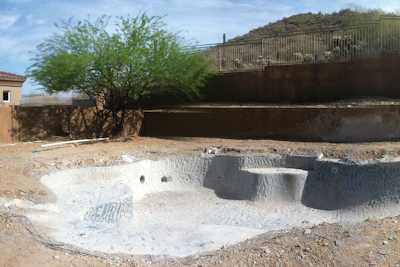
You walk out into the backyard for what you hope is your next pool remodel project only to find the pool shell has structural issues. Perhaps it is out of level. Or maybe the dimensions of the pool are just all wrong and need to be modified to fit the new backyard plan. The owner wants to salvage everything. Of course he does. After all, demolition and new construction are expensive. It is human nature to try to salvage, to try to repurpose, rather than demolish and haul off. That’s why antique dealers outnumber pool builders.
We have here opposing points of view. Do we salvage and save money? If so, will we be forced to hold our nose at the final outcome? Or do we bite the bullet, spend money, and deliver a better product? Do we go along with the owner and force-fit the new design with less-than-optimal results, or do we take the nuclear option and start with a clean slate?
Similarly, do we polish up what we have by replastering, changing out the tile and coping, and adding an outdoor kitchen? Or do we start all over? We need to ask our clients and ourselves some strategic questions before we ever launch into a sales pitch with our wonderful photo- realistic renderings produced without any regard to the issues the owner has with his or her pool.
Question one: What is it your clients hate about their backyard? Perhaps they can’t really put their finger on the problem, but there is some angst that makes them want to spend even more money than the cost of the original pool. Unfortunately, we want to start fixing things without finding out their issues, but we can’t fix a problem we have not identified. If we try without listening to the client, the client stares at the final product and still hates it even if they cannot put their finger on why, and now they have wasted even more money. You won’t be getting a referral from this client! Some 60,000 residential swimming pools will be filled in the United States this year alone. Pool professionals need to address the problems that make people want to do this!
Question two: Have your clients seen a pool, a spa, or some other feature that set their soul on fire, something somewhere that grabbed them and now they want to repeat that feeling in their own backyard? Have you ever had a client go on vacation in the middle of a pool project and then come home with a new checklist for you? It’s okay to borrow good ideas while always remembering to give credit when it’s due. It’s not okay to try to blend every idea they saw in three different resorts into their own backyard.
 If something is in the wrong place, oriented in the wrong direction, or the wrong shape, it probably should go.
Question three: Is the old pool in the right location? Are we sacrificing good design on the altar of saving money? If it’s in the wrong place, oriented in the wrong direction, or the wrong shape, it probably should go. On the other hand, it is often feasible to lengthen or reshape a concrete pool. Or, we could raise or lower pool walls to change the view and emphasize
the best assets of the property such as vistas, terrain, or landscapes while hiding the neighbor’s garage. Adding new features like fire pits or bowls, waterfalls, negative edges, laminar jets, bubblers, or other nifty ideas doesn’t alter the fact that the existing pool does nothing for the backyard setting. It’s analogous to lipstick on swine. Sometimes, less is more.
Assuming the location of the pool is satisfactory but maybe the shape is slightly off, you can modify a concrete shell by cutting the shell edges back properly at a 45-degree angle, exposing the reinforcing steel, and shooting shotcrete to the new shape. The same cannot be said for fiberglass and vinyl shells, however.
A common question is, “How much concrete shell can I take out before it becomes just too expensive, and I must totally demolish?” There are no hard and fast rules in this case. Some experts feel if you are removing more than 30% of an otherwise sound pool shell, it likely would be more economical, and probably less financially risky, to rip it all out and start with a clean slate. This would apply to a sound concrete shell and not one that is severely damaged and in need of extensive repairs. Before you commit to saving a shell, take core samples of the concrete and have them tested for compressive strength and look carefully at the core cross section for problems like rebound and thin sections. Compressive strength for any shell should be at least 4,000 PSI. Striations in the core sample indicate poor shooting practices and commend tear out.
Some other words of advice:
Don’t try too hard to save the plumbing. Underground piping hides a myriad of problems, from corroded pipe to leaks to poor-performing circulation. Pipe is one of the least expensive building materials on the site. Rather than losing sleep at night, replace it and feel confident.
Replace the pumps. If you are called out to revamp the circulation system, plan on replacing the pumps with new, more efficient, multi-speed models rather than repairing and reusing a pump and motor which have seen better days. Any pump more than six years old should be considered suspect.
Sell remote control and telephone apps. Even your older clients will appreciate a bit more automation in their lives. The joy of “hands-on” operation and cleaning is greatly exaggerated.
Don’t trust the electrical. On any sizable equipment replacement deal, check the electrical service entry size and materials, and plan on replacing the panels, breakers, and equipment wiring. Change to low-voltage lighting.
Finally, give the client options and price each option as fairly as possible. Let the owner make the difficult decisions to spend money or save money. It is not your site, nor is it your old pool and equipment, so make sure the liability for accepting things the way they are remains with the owner. Your first priority has to be safety, not money. Be sure the owner is aware that the suction outlet main drain is non-compliant with current standards or any other code violation you see. You are, after all, the pool expert, and would be remiss — and possibly even negligent — to let code issues slide without pointing out the problem to the owner.
Over 400,000 pool remodels of some type take place in the United States every year. It is a good market to be in and can be very profitable, but don’t stumble blindly into the backyard, and never accept existing work on faith alone. As Ronald Reagan once said, “Trust. But then verify.”
This article first appeared in the January 2026 issue of AQUA Magazine — the top resource for retailers, builders and service pros in the pool and spa industry. Subscriptions to the print magazine are free to all industry professionals. Click here to subscribe.