













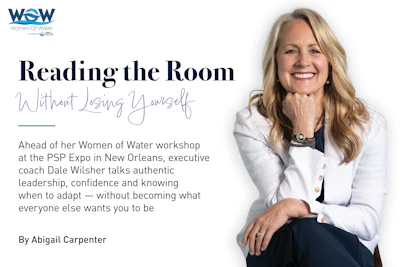
For years, Dale Wilsher thought being "a lot" was something she needed to fix.
She had spent years hearing that certain parts of her personality needed to be toned down. And like many people who become skilled at sensing what others expect of them, Wilsher learned to adjust.
"I was always over-reading the room because I knew very early on what other people needed me to be," she says.
Wilsher now calls herself a "recovering people pleaser." Growing up, she paid close attention to what the people around her praised and criticized. If she heard disapproval of a trait she recognized in herself, she tried to rein it in. If someone valued something she did not naturally possess, she thought she ought to develop it.
Eventually, all that attention to other people's expectations came at the expense of her own sense of self.
"In spending so much time trying to figure out what other people wanted me to be, I had completely neglected what I wanted and who I was," she says.
That experience now informs much of Wilsher's work as an executive life and leadership coach. It also shapes the half-day workshop she will lead this November for Women of Water at the International Pool Spa Patio Expo in New Orleans, La.
Women of Water, a Pool & Hot Tub Alliance initiative, brings together women across the pool and spa industry for professional development and connection.
"Reading the Room: The Intelligence That Elevates Every Interaction" will focus on better understanding yourself and the people around you, and communicating more effectively across differences — without becoming what the room seems to want.

FINDING HER WAY
Leadership coaching was not Wilsher's original career plan. She began in science, earning an undergraduate degree in invertebrate zoology with an emphasis in marine biology and pursuing doctoral studies before her path changed.
While raising four daughters, Wilsher was also building a speaking career, much of it with faith-based audiences. After a difficult divorce left her with full custody of her children, she began thinking more seriously about how to build a sustainable career around the work she most enjoyed.
Looking back, she could see a through line: growth.
She had long been drawn to teaching and mentoring, often sitting down with people to help them recognize their strengths or think through what they wanted next. When others began suggesting coaching, though, Wilsher was skeptical.
"I thought it was a little hokey, to be very honest," she says. "'What is that? Like, a drill sergeant and a tarot card reader?' I thought, 'I'm not really sure that's a real job.'"
What changed her mind was realizing that coaching was not about telling people who they should become, but helping them build from the strengths and values they already had.
Wilsher began as a life coach before gradually moving into career coaching, often working with people who knew something no longer fit but weren't sure what needed to change. As she spoke at more professional conferences, leaders increasingly sought her out, and leadership coaching grew naturally from there.
Today, about 70% of Wilsher's coaching clients are women. "I really like working with women who are developing themselves and empowering others," she says.
WHAT'S RIGHT WITH YOU?
For much of her life, Wilsher says, she heard her personality described in negative terms. "'You're rude. You're aggressive. You're too bossy. You're all those things,'" she says.
"I'd worked very hard to tone myself down. But there was always this ache in me like, 'Gosh, I want to be me, but is it possible to be me and even be likable?'"
Her perspective began to shift during a group study where participants took a personality assessment. Wilsher had taken similar assessments before, but for the first time, the woman leading the group described her personality type in positive terms.
"She's the only person I've ever heard describe my type positively," Wilsher says. "And I thought, 'Wow, is there actually something good about me?'"
Years later, another moment reinforced that shift in perspective. Wilsher saw many of her own qualities in her oldest daughter, Savannah. When she walked into a parent-teacher conference expecting to hear Savannah was bright and doing well, but perhaps a little bossy with the other children, Wilsher was surprised to hear the teacher praise her daughter for voicing her dissent and describe her as a role model for other girls.
The contrast stayed with Wilsher. "The world will tell her what's wrong with her," Wilsher remembers thinking, "but I should be the one to tell her what's right."
That lesson still shapes how Wilsher works with leaders. People can become so accustomed to hearing where their personalities create friction that they lose sight of what those same qualities allow them to do well.
"There's a lot of identity work in becoming a leader and embracing our strengths," she says.
But embracing those strengths does not mean ignoring their impact on other people. Wilsher rejects the idea that authenticity gives someone permission to behave badly and shrug it off with, "Well, that's just who I am." She calls that excused authenticity.
"I'm not talking about that," Wilsher says. "I'm talking about elevated authenticity where you truly rise into the best of who you are."
That means knowing what comes naturally to you while also recognizing what may be missing. "Authentic leadership to me is knowing who you are, but also then knowing what you're missing and strategically supplementing," she says. "That doesn't mean you become everything to everyone."
One way she thinks about that balance is through warmth and strength. "Two questions: Do you care and can you deliver?" she asks.
Most people communicate one more easily than the other. Some naturally project competence and authority; others are quicker to make people feel understood. Effective leaders communicate both.
For women, Wilsher says, that balance can be especially complicated. They can be penalized for appearing too soft, yet also receive pushback for being too forceful.
Wilsher knows how easy it is to respond by making yourself smaller. When she was told she was bossy or "too much," she could lose confidence not only in how she was communicating, but in the strength behind it.
"It's not about subtracting," she says.
A leader who naturally projects warmth may need to be more intentional about showing authority, while someone who leads with strength may need to make sure people can also see that they care. Neither requires becoming someone else.
The goal is to understand what the moment calls for without losing yourself in the process.

'THEN MUCH MUST BE NEEDED'
Confidence is another piece of that equation. Wilsher defines it as "the deep belief that the world needs what you have to offer."
For women, she says, developing that belief often means being willing to take up space rather than waiting for permission. "We have to own the space that our strengths gave us," she says.
Wilsher had to learn to do that herself. For years, hearing you're a lot could shut her down. "That one used to crush me," she says. "And then I would shrink myself, my voice, all of it."
She hears it differently now.
"Wow, then much must be needed," she says. "If I have been called in and I'm a lot, then this must call for a lot."
That shift does not mean dismissing feedback, but no longer treating every criticism as an instruction to become smaller.
For Wilsher, taking up space can also be literal. She pays close attention to posture and the signals people send before they ever speak. Hunched shoulders or the instinct to hold something in front of the body, like a notebook or purse, can diminish a person's presence, while even the amount of physical space someone is comfortable occupying can say something about confidence.
Wilsher catches herself studying those signals everywhere. "Who looks confident and who doesn't and why?" she says.
READING MORE THAN WORDS
During "Reading the Room," Wilsher will introduce Women of Water attendees to three forms of intelligence: Personality Intelligence, Social Intelligence and Values Intelligence. Together, they offer a way to think about how people naturally operate, what they communicate beyond their words and what matters most to them when pressure rises.
Wilsher's goal is not to turn attendees into experts at sizing someone up in a matter of minutes, but to help them become more attentive to what is already happening in front of them. "There are things we see in less than a second that we are not trusting," she says.
A customer may hesitate before voicing an objection. In a meeting, the tone can shift before anyone acknowledges that something has changed.
People often pick up on those signals, Wilsher says, but then talk themselves out of what they noticed. She wants attendees to become more comfortable trusting that instinct. In a sales conversation, that might be as simple as saying, "I'm getting a sense that there's some hesitation."
The point is not to assume what someone is thinking, but to notice when there may be more to ask. That skill reaches well beyond sales. Anyone trying to lead effectively needs to recognize when people are engaged — and when something may be holding them back.
Wilsher also asks attendees to consider how their own preferences shape what they see in others. "We will naturally be biased toward our own personality type," she says.
Later in the workshop, Wilsher will move into values — the principles people rely on when circumstances get harder and decisions carry more weight. For her, that is where reading the room becomes something more than observation. "That's when people really rise," she says, "when they stand on their principles."

MORE THAN FOUR HOURS
When Wilsher thinks about what she wants women to carry away from the workshop, she comes back to clarity. "I want them to be clearer on the impact they have to offer," she says, "on what is truly unique about them and how that can make them more courageous."
Part of that means giving attendees better language for what they recognize in themselves and in others. "I want people to have language for what is great about them," she says. "I want them to have language for what is great about others so they can encourage and empower them as well."
Wilsher also sees value in the four hours women will spend together. The conversations around the workshop may lead to relationships that continue well beyond New Orleans, particularly when attendees are willing to move past surface-level networking. "When you talk about real things, you are more likely to have real connections," she says. "I'm not for shallow."
For women working in the pool and spa industry, those connections can carry additional weight. Many still spend much of their careers in workplaces and professional settings where women are outnumbered.
"I love the women who are in male-dominated places because they're usually badass to begin with," Wilsher says.
She sees those women as having already demonstrated a willingness to make their own way. The challenge is making sure that, over time, fitting into the surrounding culture does not require women to leave parts of themselves behind.
"If we believe the bias, we will never serve the rest of the women coming behind us," she says.
The conversation will continue after the Expo through three Women of Water webinars with Wilsher in December, February and April. The follow-up sessions are designed to give participants a chance to revisit the work as they encounter it in their own careers.
"You don't go to one class on it and then you're good to go," Wilsher says. "You have to practice it, and you have to bring it back to what is going on in your world."
The webinars will look more closely at the pressures that can make that difficult, from navigating uncertainty and constant urgency to staying authentic when an environment seems to reward something else.
For Wilsher, the larger goal is not to teach women how to conform to every room they enter but to help them understand the room while remaining confident in what they bring to it.
"I don't want women to go hostile," Wilsher says. "But I also don't want them to go silent."

Questions or comments on this article?
Please email [email protected]