







In 1989, sociologist Ray Oldenburg coined the term Third Place to describe the essential environments where community happens, spaces that are neither work (the second place) nor home (the first place). For decades, these were our coffee shops, local pubs, and town squares. They were the neutral grounds where conversation was the primary activity and everyone was equal.
But in 2026, the traditional Third Place is in crisis. Coffee shops have become drive-thrus and pubs are dominated by screens (not to mention alcohol). We have lost the physical sanctuary of belonging. However, from this vacuum, a movement is emerging. We are entering a Third Space Renaissance as society comes to understand the value of these shared, communal spaces, and the authentic sauna is one of the focal points around which they can be built.
THE SOCIAL BATHING REVIVAL
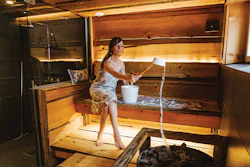
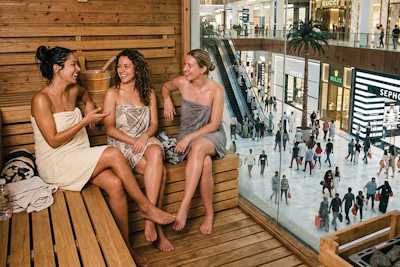
Unlike a gym that is focused on performance or a high-end spa where people are often separated by private rooms, the authentic sauna experience is inherently social. In Finland, the sauna has always been the ultimate Third Space, a sacred spot where titles, technology, and tensions are left at the door.
We are seeing a global hunger for this Analog Wellness. People aren’t just looking for a sweat, they are looking for a sanctuary from digital noise. For the aquatics professional, this shift from Solo Recovery to Social Renaissance completely changes the math of a sale.
THE ARCHITECTURE OF CONVERSATION: SOCIAL GEOMETRY
To sell the Third Space, we must design for it. In a traditional solo or family sauna, we often see stadium seating, two straight benches facing a wall. This is a design for isolation. To facilitate the Renaissance, the design must shift to Face-to-Face Geometry.
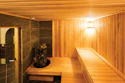
When benches are configured in a U-shape or an L-shape, the heater becomes the hearth around which the group gathers, much like at a campfire. This configuration lowers the social barrier and encourages eye contact. Furthermore, we must consider the depth of the bench, a 24-inch depth allows for the Finnish tuck (sitting with knees up), a relaxed, informal posture that facilitates longer, more meaningful dialogue.
THE PSYCHOLOGY OF THE WELLNESS HOST
A critical expansion in the Third Space movement is the emergence of the Home Wellness Host. Retailers are no longer just selling to an end-user, they are selling to an entertainer. When a client invests in a large-scale sauna, they are often motivated by the desire to provide a unique social experience for their inner circle.
This is a powerful sales pivot. Instead of asking a customer how they feel after a sauna, ask them how they want their guests to feel. By framing the sauna as a social anchor, much like a luxury outdoor kitchen, the retailer moves the product from a personal luxury to a communal necessity. This psychological shift justifies the jump from a standard sized sauna to a custom, high-volume Social Suite.
CAPTURING THE QUENCH REVENUE
The Third Space isn’t just the 15 minutes or so spent in the heat, it is the 30 minutes spent recovering. This is the Fourth Place, the lounge area, and it is where the Wellness Suite upsell truly happens.
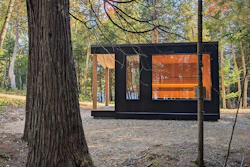
This is exactly how I have designed my personal backyard sauna. I viewed the entire layout as a journey of deliberate transitions rather than a collection of separate products. In my own space, the sauna sits in immediate intuitive proximity to the pool, allowing for a seamless transition into the Ice phase of the cycle. The journey then leads naturally into a dedicated lounge area designed specifically for rest. Here, the focus is on hospitality. I’ve integrated a hydration station that allows for personalized refreshments for each guest or group that I host, ensuring the social conversation is never interrupted by a trip back to the house.
If a retailer only sells the sauna room, they are leaving 40% of the project’s potential revenue on the table. A Third Space sale must include a transition zone. By designing a Cool-Down Lounge, complete with ergonomic loungers, hydration stations, and textured flooring, you are selling a destination rather than an appliance.
In the current market, the most successful dealers are those selling the “Fire, Ice, and Air” package as a single, integrated social unit.
THE COMMERCIAL-TO-RESIDENTIAL BRIDGE
We are seeing a halo effect from the rise of public social bathing clubs in cities across North America. Consumers are visiting high-end thermal wellness centers and experiencing the Third Space firsthand. They are returning to their local Aqua retailers asking for that same communal magic in their own backyards.
Retailers should capitalize on this by staying informed on local commercial wellness projects. When a new Nordic-style spa opens in your region, it isn’t competition; it is a lead-generation engine for residential sales. Use the commercial vocabulary, “Social Bathing,” “Thermal Cycles,” and “Regenerative Design,” to show your customers that you can bring that world-class hospitality experience into their homes.
THE RETAIL GOLDMINE: FROM BOOTHS TO SUITES
When you sell a two-person sauna, you are selling gym equipment. When you sell a six-person Third Space suite, you are selling a hosting venue. This justifies larger footprints and significantly higher price points.
Customers who view their sauna as a social hub are more likely to invest in the full ritual, adding high-end lighting, stone backdrops, and raw textiles that age with character.
Using materials that feel alive creates a space that demands presence. The social magic happens when the environment feels as permanent and authentic as the conversations held within it.
THE NEW STANDARD
We are no longer just in the business of selling heaters and cedar. We are the architects of the new public square. By positioning the sauna as a Third Space, we provide the infrastructure for a more connected, human way of living, one that starts just steps from the back door.