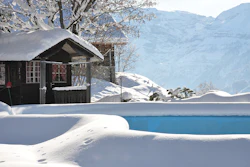














Those of us who work in the pool industry in a cold weather climate get used to hearing the same question over and over: “What do you do all winter?”
I used to say, “We sit around and try to figure out a good response to that question.”
Many swimming pool business operators have good reasons to try to continue working throughout the coldweather months. Seasonal layoffs of key employees always come with the risk that they don’t return the next spring.
Maybe that employee finds another construction job that keeps them on all year, or maybe they go to a competitor that promises them year-round work with an ancillary business such as snow plowing or outdoor holiday display setup.
Whatever the case, there are many benefits to trying to keep building swimming pools throughout the colder months.
 Temporary enclosures create a controlled environment for cold-weather pool construction.
FOUND MONEY
In addition to employee retention, the thought of revenue coming in during January and February — even if it is at lower profit margins — seems like found money for a business owner or manager.
But I have lost count of the number of times in my career that I have priced out a renovation job in February on an indoor pool at a bargain-basement price — only to have them come back to me three months later in the height of spring, wanting to know when it can be started. (Maybe this should be in the anonymous third person?)
And jobsites that are easy to navigate on frozen ground in the morning become slick, muddy messes as the sun comes up and the temperature hovers above freezing.
But cold-climate winter pool work can be done with proper planning!
EYE ON THE FORECAST
Once a pool is formed, it is extremely important to watch the weather forecast for the next week to 10 days. Because once the steel reinforcement is in, that is the point of no return. Freeze-thaws can cause cave-ins of the excavation. That is a nightmare of a job to fix, trying to work around steel. A snowstorm that dumps a foot or two of snow followed by subfreezing temperatures will degrade the steel, making for a poor installation and weakened concrete.
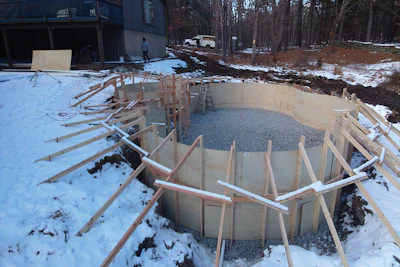
It is a good idea to always fully form the pool and possibly add more crushed stone to the bottom of the excavation to ensure that you are not shooting against frozen earth. And while it is always good practice to take core samples, it is even more important in cold weather.
If the finished shot freezes before proper curing takes place, you will not achieve the American Concrete Institute (ACI) recommended standard of 4,000 PSI. Covering your shot after it is complete with “concrete blankets” is of paramount importance.
Another option is a blow-up construction tent. Once the site is excavated, this structure is put into place and heated, creating a controlled environment in which to work in any weather. These tents come with a pretty hefty price tag, ranging from $10,000- $40,000, and the price of heating it during the job is not insignificant. But keep in mind that the capital expenditure cost of the tent itself goes down with every job you use it on.
All of these steps can create added costs into a job. Again, the lure of extra revenue may be enough to lower your margins slightly to cover these costs, or the client may want to move up the installation schedule and be willing to pay the extra costs. But, in terms of monetary and reputational damages, these cold-weather extras are nothing compared to a completed pool that fails.

SERVICE SIDE
The service and maintenance side also has options to keep working during the cold months. “Winter Watch” is becoming more and more common in the northern states. Technicians will visit clients’ homes to check various things, such as if the pool cover is still sitting on the pool properly, the water levels are correct, and all the winter plugs are still intact. Many companies have expanded these pool services to include checking on the property for their clients who are out of town for extended periods, or even the whole winter. Those that have the space at their physical location will also bring back clients’ filters and other equipment to store for the winter, where they can be cleaned and repaired in a controlled environment, generating revenue and pushing sales to replace outdated or damaged pieces.
While cold-weather pool construction comes with its own set of challenges and costs, the payoff seen by those who undertake it — from securing a yearround revenue stream and improving employee retention — can be well worth it for many pool businesses.
This article first appeared in the February 2026 issue of AQUA Magazine — the top resource for retailers, builders and service pros in the pool and spa industry. Subscriptions to the print magazine are free to all industry professionals. Click here to subscribe.