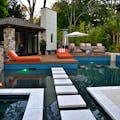











When it comes to swimming pool and spa integration, my instincts always lead to one thing: great filtration and circulation. The best way, in my opinion, to achieve this is to have all the bodies of water work together during the filtration and sanitization process.
Let’s start from the beginning. There are two basic forms of spillover, “reverse” and “forward” edge. Each has its own distinct characteristics and adds or detracts from the harmony of the outdoor living space. When I first approach a new client’s home and throughout our initial meeting, I am searching for clues. Do I hear highway or interstate noise, or is the site peaceful and serene? Is there elevation change that will allow for spillover visibility, or is the goal for the water to disappear? Is the design inward facing or outward facing? These inferences can help lead the design, but much more information gathering is often needed before we can implement a spillover style.
When speaking to a client for the first time, they may or may not know their style. There are a few signs to look for when this happens. What does their home décor look like? Which style of home do they reside in? These very questions may also muddy the water when it comes to style in the outdoor living space, since they may be asking for something different altogether — but the outdoor living and swimming pool design should usually not be a complete departure from the home’s architectural style or decorative style. More traditional settings may call for a traditional tile and coping pool and spa with a 3-foot spillway, while more contemporary and modern settings can lead to more intricate water features and edge details.
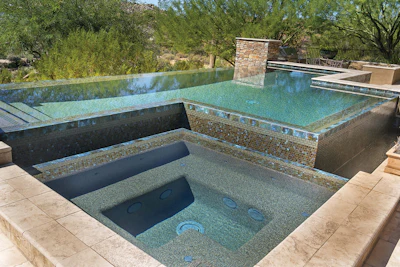
One of my favorite details (when style permits) is to have the pool body of water completely surrounding the spa. It creates a clean, contemporary look. With a minimal area of water surrounding the spa (possibly 6 to 8 inches), a reverse edge or “wet-wall” design would be used. Several neat benefits come from this, including minimal spillover water flow requirement and a shimmering tile veneer that can really make a project stand out from others.
If I get to the project location and hear interstate noise and have an inward facing design, perhaps we will opt for a spa that faces the main sightlines and utilizes a forward edge (with water trajectory). This detail can often mask unwanted noise while creating a visual feature that draws attention to both the spa and the pool.
One of my greatest concerns in a gunite or shotcrete spa is how I may design it with additional benefits that outweigh the pros of a prefabricated acrylic spa. Let’s face it: purchasing a standalone spa with 150+ jets, contoured seats, and simple controls sounds like a no-brainer. However, adding this to a $300,000+ backyard and placing it next to a brandnew concrete pool does not look right. My goal is to turn the situation around, design something nice for the client, and offer the product that will not make them immediately slip into buyer’s remorse.
EQUIPPING YOUR POOL + SPA COMBO
Let’s talk equipment. Regardless of the style of spillover edge, we can remain confident that this will surely add to the integrity of the filtration and sanitization systems that we, as builders and designers, are specifying. Efficiency is a broad term, but let’s just take one example of this when it comes to pumps and hydraulics. If you have taken any GENESIS courses, such as E211: Fluid Hydraulics for Pools & Spas, you have already learned how we should be moving water. In simple terms, large quantities of water moving at a slow velocity. With all of the technology surrounding filtration and feature pumps in our industry, we can tackle just about any situation handed to us. The key is to implement the correct combination of items that will a) pass the test of time, b) make for a clean pool or spa, and c) allow it to be easily operable by a homeowner.
My go-to is a shared equipment system for the pool and spa, especially when the spa has a spillover. Depending on the amount of water that is necessary to make the spillover function properly, we may have to supplement water flow with an additional pump. Just the opposite way that a traditional pool works by returning filtered water to the surface and circulating back to the main drains, I prefer to return my filtered and sanitized pool water near the bottom of the spa and allow it to flush the existing spa water up and over — back into the pool. To do this, we can utilize either wall returns in the footwell, floor returns (main drains or in-floor heads), or, in a more simplified setup, spa jets may be used.
The debate amongst builders and designers has always been whether or not to use separate systems for each of these. Some of the builders I frequently work with are very set in their ways and see no need to have a spa jet (or booster) pump. It’s generally my most common practice to not overutilize a pump — sometimes it is all right to allow that pump to have two functions, but I never place more than that on one pump system. If a pool/spa combo has only one pump, that pump should not be responsible for pool filtration, spa filtration, therapy jets, and also a spillover.
The same applies to an approach of using one pump for different features; for example, “you can either turn on the bubblers or the scuppers, but not both.” This is always going to be a sore subject during pool school when the client asks if they can use different features at the same time and your reluctant answer is “no.” My inclination is always to add an additional pump if it will make the client have a better experience with their investment.
CONTINUOUS LEARNING
My company, H2 Outdoor Living, is always learning and evolving in design and application of intricate details and unique situations. Have you ever had an uncommon situation with, say, the friction coefficient on a tile spillover that you had to overcome in the field after installation? Have you had a lack of water flow that just didn’t meet the expectations of your designer or client and could have been resolved with better hydraulics? These are all situations that I would love to hear about from you and allow my experience to be broadened. We have certainly run into this situation and there is always more to learn in our industry.
Keep pushing the envelope on design and construction, continue taking advantage of education events, and broaden your network of industry peers. Each of these daily tasks allows us to become better designers for our clients.
This article first appeared in the November 2025 issue of AQUA Magazine — the top resource for retailers, builders and service pros in the pool and spa industry. Subscriptions to the print magazine are free to all industry professionals. Click here to subscribe.