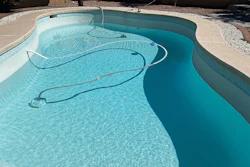










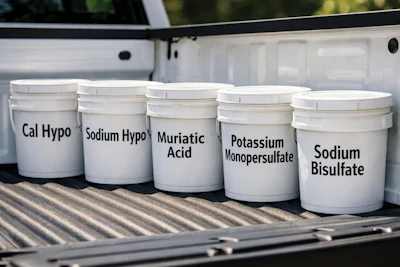
Being a pool and hot tub/spa professional often means hauling chemicals from one job to the next. Whether it is buckets of granular calcium hypochlorite, buckets of trichlor tabs, jugs of sodium hypochlorite or muriatic acid, these substances are essential to maintaining water quality. They are also regulated as hazardous materials (hazmat). The U.S. Department of Transportation (DOT) recognizes that many service businesses, including pool and hot tub/spa operators, need to carry such materials in relatively small quantities. To reduce the regulatory burden while keeping safety at the forefront, the Hazardous Materials Regulations (HMR) include a provision called the Materials of Trade (MOTs) exception (49 CFR § 173.6). Understanding how this exception works is vital for anyone who routinely transports pool chemicals.
WHAT ARE MATERIALS OF TRADE?
Materials of Trade are a category of hazardous materials that are subject to fewer HMR requirements when transported on a motor vehicle in small quantities as part of the normal operations of businesses not in the shipping or transportation industry. A few examples for pool professionals are transporting sodium hypochlorite to disinfect a client’s pool or carrying muriatic acid for pH adjustment. Why is this so important? Simply put, following the MOT exception rules exempts your business from all other HMR rules for transporting these hazardous materials. If anyone questions your business’s hazmat transportation practices, this simple reference has all the requirements.
WHICH POOL CHEMICALS QUALIFY?
Many common pool and hot tub/spa chemicals fall into the hazard classes recognized under the MOTs exception.
For example, calcium hypochlorite and chlorinated isocyanurates are classified as oxidizers (Division 5.1). Sodium hypochlorite and muriatic acid are corrosive materials (Class 8). Potassium monopersulfate is an oxidizing solid (Division 5.1). Other routine supplies, like sodium bisulfate (a corrosive solid) and sodium bicarbonate (non-hazardous and not regulated), may also be transported under these provisions. As a side note, hazmat for the protection and safety of your employees and/or to support the operation or maintenance of the motor vehicle also qualify as MOTs — for example, insect repellant, fire extinguishers, spare batteries, or gasoline cans.
To confirm if a chemical qualifies under the MOTs exception, check Section 14 of its Safety Data Sheet (SDS). This section lists the DOT hazard class, packing group, and UN number. Once the hazard class and packing group are identified, compare them with those listed in the MOT exemption. If the chemical falls into one of the MOTs categories, you can use the exception provided that you also follow the quantity limits, labeling, and packaging requirements.
QUANTITY LIMITS YOU MUST FOLLOW
The MOTs exception is only valid if the amount you carry stays under strict limits. First, the combined weight of all hazardous materials on your vehicle, including their packaging, cannot exceed 440 pounds. This means that if you are hauling multiple chemicals at once, their total weight counts toward this cap. Non-hazmat chemicals do not count towards this weight.
Second, there are per-package limits. Most pool chemicals fall into Packing Groups II or III. For those, the maximum is 66 pounds for solids or 8 gallons (30 liters) for liquids per package. If these limits are exceeded, the chemicals are no longer considered MOTs and must be transported under the full scope of hazardous materials regulations.
PACKAGING AND SECURING CHEMICALS
Packaging standards are strict under the MOTs exception. Containers must either be in the manufacturer’s original packaging or in packaging of equal or greater strength. Liquids like muriatic acid or sodium hypochlorite must be in leak-tight containers, while solids such as calcium hypochlorite or sodium bisulfate must be in sift-proof packages. All containers must be properly closed, secured against shifting, and protected from damage.
If you are transporting liquids in bottles, they do not necessarily need an outer box, but they do need to be secured in bins or cages so they cannot roll around the vehicle. Best practices would dictate that liquids are placed in secondary containment and all chemicals are segregated with physical dividers to ensure contact doesn’t take place between incompatible materials. Gasoline and other flammable liquids, if transported, must be in DOT or OSHA compliant containers. Following these rules not only keeps you compliant but also prevents spills and dangerous reactions during transport.
MARKING REQUIREMENTS
Marking your containers correctly is another key part of staying in compliance. Each package must be labeled with either its common name, such as “chlorine” or “acid,” or its proper shipping name from the HMR, such as “calcium hypochlorite” or “muriatic acid.” Cylinders and pressure vessels must include the shipping name, identification number, and a hazard class warning label. If a package contains a reportable quantity of a substance, it must also be marked as such. Ignoring labeling rules could lead to penalties and confusion during an emergency.
WHAT MOTS DOES NOT REQUIRE
One of the biggest benefits of the MOTs exception is the reduction in paperwork. When transporting chemicals within MOTs limits, you are not required to carry shipping papers, provide emergency response information, display vehicle placards, or undergo formal hazmat training with recordkeeping. However, you must still understand the general requirements for MOTs and follow them closely. In other words, MOTs streamline compliance but do not eliminate responsibility. While not necessarily required, it is strongly recommended to carry or have available the Safety Data Sheets (SDSs) for all chemicals transported on the vehicle.
WHY IT MATTERS FOR POOL AND HOT TUB/SPA PROFESSIONALS
For professionals in the pool and hot tub/spa industry, time is money and safety is critical. By operating within the MOTs exception, you can legally and safely transport the chemicals you need for routine service without being burdened by the full weight of hazardous materials regulation. Packaging chemicals correctly, observing weight limits, and marking containers protects you, your employees, and the public. A spill of muriatic acid in a service van or the mixing of incompatible chemicals could have serious consequences. Following MOT rules reduces those risks while keeping your business efficient. The Materials of Trade exception is a valuable tool for pool and hot tub/ spa professionals, but only if it is used properly. Always check your SDS for hazard classifications, keep your loads within the 440 pounds limit, respect per-package quantity restrictions, ensure package integrity and label everything correctly. By staying within these rules, you can carry the chlorine, acids, and other essential chemicals your work demands while maintaining compliance with DOT regulations and ensuring safety on the road.
REFERENCES:
- DOT brochure: https://www.phmsa.dot.gov/ regulatory-compliance/phmsa-guidance/ materials-trade-mots 49 CFR § 173.6 Materials of Trade Exemption
This article first appeared in the May 2026 issue of AQUA Magazine — the top resource for retailers, builders and service pros in the pool and spa industry. Subscriptions to the print magazine are free to all industry professionals. Click here to subscribe.