










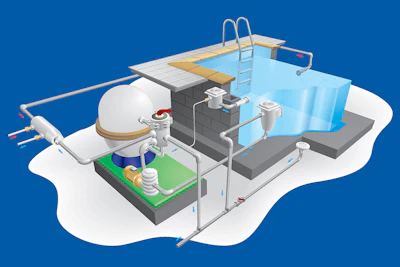
While it may appear at first that pool plumbing has devolved into just a simple connection to a main drain, two or three returns, and a skimmer or two, the subject bears re-examination from time to time lest we become complacent and produce a less-than-satisfactory final product. The old adage, “That’s the way we’ve always done it,” does not and should not be applied in pool building. But let’s face it — it is every day!
Here are some often overlooked plumbing tips pool builders should consider.
MAIN DRAINS
The term now is Suction Outlet Fitting Assembly (SOFA) because the selection and testing of drain covers now involves the whole system, including the cover, frame, sump, and pipe connection. The main drain is the selection and testing of drain technically the pipe back to the pool equipment.
A SOFA is not required on all pools. The language in the International Swimming Pool and Spa Code (ISPSC) is permissive but not mandatory. Especially in remodeling, where an old drain cover and suction pipe do not meet the modern requirements — including the Virginia Graeme Baker Pool & Spa Safety Act (VGBA) for suction entrapment — it may be advisable to plug the drain altogether.
Further, if you elect to have no main drain SOFA, you must have sufficient flow capacity from skimmers, gutters, or infinity edges to adequately turnover the pool. If you are using in-floor cleaning systems, you will need debris-catching suction outlets.
Many builders in the fiberglass and vinyl pool side of the industry are not installing main drains due to the difficulty of installing them and repairing or replacing them later. Recognize that these SOFAs are frequently equipped with hydrostatic relief valves. The requirement for hydrostatic relief does not go away just because the drain is deleted.
VENTURI SKIMMERS
Relatively new on the market are venturi skimmers. Venturi skimmers use a small venturi tube in the bottom of the skimmer body that, when connected to a filtered water return with about 10 gallons per minute or more, creates a suction in the skimmer which exceeds the typical skimmer performance. For example, a venturi skimmer might pull 80 to 90 gallons per minute through the skimmer throat, whereas a typical skimmer is usually rated at 40 to 50 gallons per minute. In areas with leaves and floating debris, this is a blessing indeed.
Some manufacturers give builders three ways to install their venturi devices:
- As a conventional skimmer, connected to the filter pump suction.
- As a filtered return skimmer only, not connected to any pump suction but using only filtered water to pull debris into the skimmer basket.
- As a hybrid or combination with filtered return to the venturi nozzle and pump suction connection as well.
At the new, lower, residential pool turnover rates prescribed by the federal energy codes for pool pumps, venturi skimmers are more efficient at surface cleaning than conventional skimmers.
LOOPING PIPES
The all-too-common problem of poor circulation through remote wall returns or from remote skimmers can be overcome with looping. A loop around a pool for either the skimmer system or the return system creates an auto-balancing system that ensures adequate flows to the farthest points in the system. A series installation — that is, running a pipe out one direction from the pump and branching to individual returns — will virtually guarantee poor flow at the farthest return or outlet.
Install a single return (or skimmer suction) out to the pool and then split to loop the pool. Size the loop all the way around the pool with the same size pipe, large enough to carry half the design flow. For example, if returning 60 gallons per minute filtered flow to the pool, at the loop split the flow and size for 30 gallons per minute each way, maintaining one uniform pipe size.
TWO PUMPS ON A SOFA
Putting two or more pumps on a pair of VGBA-rated SOFAs — for example, one pump for spa and one for spa boosted flow — is permitted by ANSI/APSP/ICC-7 American National Standard for Suction Entrapment Avoidance in Swimming Pools, Wading Pools, Spas, Hot Tubs, and Catch Basins, but only if each of the SOFAs is rated to carry the maximum possible pump flow from all the pumps operating at the same time. If you have more than two SOFAs, then consider the largest one blocked and all the remaining covers must cumulatively carry the maximum pump flow safely. Of course, the SOFA drains can be valved at the equipment but not independently valved. One valve can shut off all SOFAs, but you are not permitted to plumb in such a way as to allow operators to shut off one SOFA drain at a time.
There is a catch. Each pump must be in series with a check valve recommended to be placed after the pump discharge. This is to prevent pulling water backwards through a non-VGBA-rated wall return connected to an idle pump.
SURFACE AREA CALCULATIONS
The standards require calculating the number of returns and the number of skimmers on a water surface area formula. You must have at least one return for each 300 square feet of water surface and, in residential, one skimmer for each 800 square feet (500 square feet in non-residential pools). In general, that rule of thumb works well, but occasionally dividing the surface square feet by a factor yields either too much or too little flow through a fitting.
A skimmer needs at least 30 gallons per minute but not more than 50 gallons per minute (except for venturi skimmers) to operate properly. If you divide the surface area to arrive at a skimmer count, divide the design flow by that skimmer count to make sure you fall within operating parameters. The same applies to returns. Fittings should operate between 10 and 20 gallons per minute. If strictly adhering to the calculated return fitting count means the flow is outside those parameters, consider adjusting your fitting count up or down.
LOCAL RULES
Finally, be very aware that local authorities have something to say about plumbing. Some officials make requirements greatly exceeding the national standards and model codes, so be sure to consult with local building officials about their own specific requirements. Local regulations may require, for example, all skimmers be plumbed directly back to the equipment without a loop and furnished with a valve. Officials may require main drain SOFAs when the standards do not. Develop a relationship with reviewing authorities to better understand what their expectations will be before you have to rip things out of the ground.
This article first appeared in the May 2026 issue of AQUA Magazine — the top resource for retailers, builders and service pros in the pool and spa industry. Subscriptions to the print magazine are free to all industry professionals. Click here to subscribe.