













As pool heat pumps become a more prominent part of the heating market, advances in compressor technology are helping manufacturers push beyond traditional capacity limits.
AQUA spoke with Danny Yun, executive vice president at Prattco, LG’s North American distribution and market partner for compressor products, about the technology behind higher-capacity heat pumps and where the market is headed.
Here, Yun explains what greater capacity could mean for equipment selection, installation and the range of applications pool professionals can serve.

INTRODUCING THE TECHNOLOGY
AQUA: What role does LG play in the pool heat pump market, and how does Prattco fit into that relationship?
Danny Yun, Prattco: LG is primarily a technology and component supplier in this market. Rather than manufacturing the finished pool heat pump, LG develops and manufactures the compressor technology that goes inside the equipment.
Prattco serves as LG’s North American distribution and market partner for compressor products. Our role goes beyond simply supplying the compressor. We work closely with heat pump manufacturers to understand their application requirements, help identify the appropriate compressor solution, support product development, and provide the commercial and technical coordination needed to bring that technology into the North American market.
So, in simple terms, LG provides the compressor technology, Prattco helps connect and support that technology with the OEM, and the OEM designs and manufactures the finished pool heat pump that ultimately goes to the pool professional and homeowner.
CHOOSING A POOL HEATING SYSTEM
AQ: What criteria should be considered when choosing pool heating equipment?
DY: There are two major types of pool heating equipment: pool heat pumps and gas pool heaters. Heat pumps use electricity to transfer heat from free ambient air to the pool water, while gas heaters generate heat by burning natural gas or propane. The primary selection criteria are heating capacity, equipment and operating cost, and environmental impact. Heat pumps are commonly used for smaller capacities up to 145K BTU, whereas gas heaters are available in larger capacities up to 400K BTU which could provide faster heating performance.
AQ: On an actual project, when is a heat pump the right choice, and when might a gas heater be more appropriate?
DY: It really depends on how the pool is going to be used.
A heat pump is particularly attractive when the customer wants to maintain a comfortable pool temperature over an extended swimming season. Instead of creating heat directly, it transfers heat from the ambient air into the pool water, which can make it a very efficient way to maintain temperature.
Another important advantage is that many pool heat pumps can provide both heating and cooling. A gas heater can add heat quickly, but it cannot cool the pool. In warmer climates or during the hottest part of the summer, the ability to actively lower the water temperature can help maintain a more comfortable pool and potentially extend the period when the pool can be comfortably used.
Gas heaters still have an important role, especially when rapid temperature recovery is the priority. For example, if a homeowner uses a spa occasionally and wants to raise the water temperature very quickly, a gas heater may still be the more practical solution.
The decision should therefore be based on the application—pool size, climate, desired water temperature, usage pattern, available electrical and gas infrastructure, whether cooling is desired, and how quickly the customer expects the water temperature to change.
UNDERSTANDING THE MARKET SHIFT
AQ: What is driving the adoption of pool heat pumps, and what limitations do they currently face?
DY: Pool heat pumps are gaining adoption due to their lower operating costs, higher energy efficiency, and reduced environmental impact by utilizing renewable heat from ambient air and low-GWP A2L refrigerants. However, residential heat pump capacity is typically limited to approximately 145K BTU/h (AHRI 80/80/80) by available electrical service and circuit breaker capacity, whereas gas heaters can provide higher heating outputs and faster pool and spa heating. As regulations such as California's Title 24 increasingly favor electrification, heat pumps are becoming a primary pool heating solution, with higher-capacity models emerging as viable alternatives to traditional 125–175K BTU gas heaters.
AQ: Why has approximately 140,000 to 145,000 BTU/h traditionally been the practical capacity limit for residential pool heat pumps?
DY: There isn't necessarily one single technical barrier at 140,000 or 145,000 BTU/h. It has been more of a practical system-design boundary for the residential market.
As capacity increases, the compressor has to move more refrigerant and do more work. That affects compressor displacement, motor size, electrical input, heat exchanger capacity, airflow, refrigerant circuit design, cabinet size, and ultimately the electrical requirements of the complete unit.
Historically, manufacturers therefore had to balance greater capacity against the size, cost and electrical infrastructure expected in a residential installation.
That is one reason the industry has had so many products clustered around the 140,000-BTU range. For example, existing residential products in this category can already require 208–230-volt single-phase power and relatively substantial dedicated circuits.
The opportunity now is to push beyond that traditional capacity range while still designing a product that makes sense for residential applications.
Closing that capacity gap is particularly important because gas heaters have traditionally been available at significantly higher outputs. Expanding heat pump capacity gives OEMs an opportunity to address applications that previously may have defaulted to gas simply because greater heating capacity was required.
LG’S HIGHER-CAPACITY TECHNOLOGY
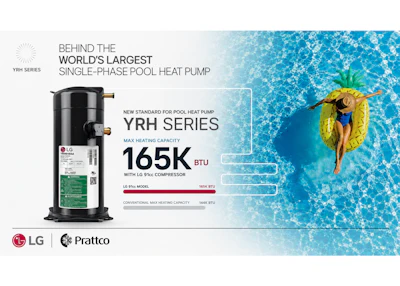
AQ: LG’s advertisement refers to “the world’s largest heat pump for the backyard pool.” What does that claim mean?
DY: “The world’s largest heat pump for the backyard pool” refers to a breakthrough in compressor technology that enables a residential pool heat pump to deliver approximately 165K BTU/h of heating capacity while operating within the electrical constraints of a conventional residential circuit breaker. By leveraging advanced LG compressor technology in a single residential circuit, pool heat pump manufacturers have expanded the practical capacity limit beyond the traditional 140–145K BTU/h range. This innovation allows homeowners to access higher heating performance without requiring major electrical infrastructure upgrades.
AQ: What role does the compressor play in allowing a pool heat pump to produce greater heating capacity?
DY: The compressor is really the heart of the refrigeration cycle, so it plays a major role in both heating and cooling performance.
Its job is to compress and circulate the refrigerant through the system. Increasing the amount of refrigerant mass flow and operating effectively across the required pressure conditions allows the overall heat pump system to transfer more heat to the pool water. In heating mode, that means transferring more heat into the pool water. In cooling mode, it means removing heat from the pool water more quickly.
But higher capacity is not simply a matter of installing a larger compressor. The compressor has to operate efficiently and reliably within the complete system design.
That is where compressor technology becomes especially important. A higher-capacity compressor platform gives the OEM more flexibility to design a system capable of delivering greater heating—and, in reversible systems, greater cooling—while managing efficiency, reliability, noise, vibration and the physical size of the equipment.
LG has specifically developed scroll compressor solutions for pool and spa heat pump applications, including higher-capacity platforms intended to support this next stage of the market.
AQ: What does “larger-capacity heat pump” mean in practical terms for a pool or spa?
DY: A larger-capacity heat pump delivers more heating output, allowing pool and spa water to reach the desired temperature faster. For example, compared with a 145K BTU/h heat pump, a 165K BTU/h model can heat a 19,200-gallon pool by 10°F approximately 12.7% faster and raise the temperature of a 650-gallon spa by 24°F approximately 12.7% faster upon rough calculation. Higher heating capacity reduces warm-up time while maintaining the energy-efficiency benefits of heat pump technology.
AQ: Which types of projects or customers are most likely to benefit from the additional heating capacity?
DY: Large residential pools are probably the most obvious application.
The greater the volume of water, the more energy and time it takes to change the water temperature. Additional capacity can therefore help reduce recovery time and make heat pump technology practical for applications where a traditional residential heat pump may have been considered undersized.
There is also an important gap between the traditional capacity ranges of residential pool heat pumps and gas heaters. Gas pool heaters are commonly available at much higher capacities, with approximately 400,000 BTU/h being a significant part of that market. That has historically given gas an advantage in applications requiring greater heating output.
The objective of higher-capacity heat pump technology is not necessarily to replace a 400,000-BTU gas heater on a one-for-one basis. Rather, by increasing the practical capacity range of heat pumps, we can begin to address some applications at the lower end of the gas-heater market that previously may not have been practical for a heat pump.
That opens an important new space for OEMs and pool professionals—projects where the customer wants to move away from gas, but where traditional residential heat pump capacity may not have been sufficient.
But heating is only part of the opportunity. In a reversible heat pump, additional capacity can also improve cooling performance. For customers in hot climates, or for pools that become uncomfortably warm during summer, greater cooling capacity can reduce the time required to bring the water down to a comfortable temperature and help maintain that temperature during periods of high ambient heat.
That means higher capacity can provide benefits at both ends of the swimming season: helping extend pool use into cooler periods through heating, while also improving comfort during the hottest periods through cooling.
Beyond traditional residential pools, we also see potential in larger luxury pools and certain light-commercial applications where customers want greater control over water temperature throughout the year.
Ultimately, higher capacity expands both the range of projects where a pool professional can realistically consider a heat pump and the range of temperature-control solutions that can be offered to the customer.
INSTALLATION AND SERVICE
AQ: What does a “standard residential circuit” mean in this context, and what electrical service does the finished heat pump require?
DY: This is an important distinction because the compressor itself does not determine the final electrical installation requirements. Those requirements are established by the manufacturer of the finished heat pump based on the complete system design.
In the North American residential market, larger pool heat pumps commonly operate on 208–230/240-volt, single-phase power. Existing products around the 140,000–145,000 BTU/h range often use dedicated circuits in roughly the 50- to 70-amp breaker range, depending on the specific product.
So when we talk about maintaining compatibility with residential infrastructure, the objective is to achieve greater heating and cooling capacity without automatically pushing the product into electrical requirements more typical of commercial equipment, such as three-phase service.
The actual voltage, minimum circuit ampacity, breaker size and conductor requirements must always come from the finished equipment manufacturer's specifications and applicable electrical codes.
AQ: Does the higher-capacity technology change anything for the pool professional who specifies or installs the finished unit?
LG: Ideally, it should not fundamentally change the way a pool professional approaches the project.
The installer is still working with a finished heat pump from the equipment manufacturer, not with the compressor as a separate component. The same basic considerations remain: proper equipment sizing, water flow, plumbing, electrical service, clearances, drainage and following the manufacturer's installation requirements.
What does change is the range of options available during specification.
If manufacturers can offer substantially greater capacity in a residential-format heat pump, pool professionals may be able to specify heat pumps for larger pools or more demanding applications that previously might have required a different heating strategy.
For reversible systems, specification can also take into account cooling demand—not just how quickly the pool needs to be heated, but how effectively the homeowner wants to manage water temperature during hot-weather conditions.
So the biggest change is not necessarily installation complexity. It is greater flexibility in system design and greater control over pool temperature.
AQ: Does the LG compressor create any different service, diagnostic, parts or training requirements?
LG: From the pool professional's perspective, service procedures should continue to be driven primarily by the finished heat pump manufacturer's documentation and service program.
LG manufactures the compressor, but the OEM integrates that compressor into a complete heat pump system with its own controls, heat exchangers, fan system, sensors and diagnostics.
LG's scroll technology is already used across HVAC and heat pump applications, so the underlying refrigeration principles are familiar to trained HVAC technicians.
Prattco's role is to support the OEM and the supply chain with compressor application knowledge, product availability and technical coordination. We want the adoption of higher-capacity technology to make the finished product more capable—not unnecessarily more complicated for the people installing and servicing it.
AVAILABILITY AND THE ROAD AHEAD
AQ: Are larger-capacity residential pool heat pumps currently available in the market?
DY: Availability of larger-capacity pool heat pumps is currently limited, as the technology is relatively new. However, products are entering commercial production, and more showing in the market is forthcoming. As demand for electrified pool heating grows, higher-capacity heat pumps are expected to become more widely available across the market.
AQ: Although electrification is often associated with California regulations, is the transition toward pool heat pumps occurring in other markets as well?
DY: Absolutely. California is an important market because regulations and electrification policies have accelerated the conversation, but we don't see pool heat pumps as a California-only trend.
There are several broader drivers.
Energy efficiency is one. Operating economics can be another, depending on local electricity and gas prices. Homeowners are also increasingly familiar with heat pump technology because they are seeing it in residential HVAC, water heating and other applications.
There is also a practical infrastructure consideration. Some projects may not have convenient access to natural gas or propane, while electrical infrastructure is already available.
And in warmer markets, the ability of a reversible heat pump to provide cooling as well as heating adds another reason to consider the technology. The value proposition is not limited to replacing gas heat; it can also be about giving the homeowner better year-round control of pool water temperature.
As heat pump technology improves—particularly in capacity, efficiency and operating range—it becomes relevant to a much wider geographic market.
So we view electrification as one driver, but the larger trend is about giving customers another efficient and increasingly capable option for pool temperature management.
AQ: What developments should pool professionals watch as higher-capacity heat pumps become more widely available?
DY: Capacity is obviously one of the major developments, but it shouldn't be viewed in isolation.
The industry should watch how manufacturers combine higher heating and cooling output with efficiency, variable-capacity operation, refrigerant changes, noise reduction, expanded operating ranges and smarter controls.
Electrical requirements will also be important. Increasing capacity is valuable, but the market becomes much larger if manufacturers can deliver that capacity without creating unreasonable installation requirements for residential customers.
We also think the industry will increasingly look at pool heat pumps not simply as heating equipment, but as temperature-management systems. As heating and cooling capabilities improve, pool professionals may be able to offer homeowners more precise control over water temperature across a wider portion of the year.
We also expect the line between traditional residential and light-commercial heat pump applications to become less defined as higher-capacity platforms become available.
For pool professionals, the important development is that heat pumps are becoming an option for a broader range of projects. As compressor technology continues to advance, OEMs will have more flexibility to design equipment that offers higher capacity without giving up the efficiency and practical advantages that have driven heat pump adoption in the first place.
From Prattco's perspective, our job is to work closely with LG and our OEM customers to help bring those technologies into practical products for the North American market.
Interested in learning more about high-capacity pool heat pump solutions?
Connect with an LG expert to discuss compressor technologies. Contact LG Electronics here: LG Pool Heat Pump Inquiry Form.