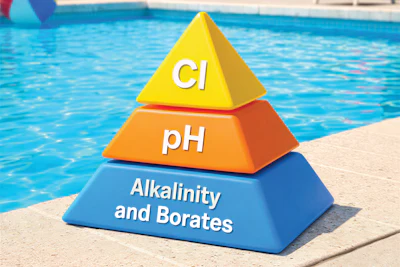
For years, I taught pool chemistry with pH as the headliner. But lately, I've taken a different angle on the same ideas, one I call the Chlorine Pyramid. It puts chlorine at the top, where the sanitizing happens, supported by the layers beneath it: pH, alkalinity, and borates. Get the supporting layers right, and the killer at the top can do its job. Get them wrong, and you'll fight your water all season. Let's go through it, one layer at a time.
A Pyramid, Not a Triangle
Chlorine sits at the tip of the pyramid. It's what kills the pathogens and algae in your water. Directly below it is pH, which must be spot-on for chlorine to work efficiently. Below that is alkalinity, the base that supports and steadies pH. I add one more foundation layer that I consider a must: borates, a larger buffering base that keeps everything stable.
Why a pyramid and not a triangle? Because a pyramid is multi-sided. The same elements that keep water clean also affect other things in your pool, such as corrosion and the Langelier Saturation Index (LSI). Change one component and you affect the others. Water chemistry isn't a flat diagram. It's a three-dimensional structure where every face touches the others.
Chlorine Is a Knife: pH Sharpens or Dulls the Blade
Chlorine is an EPA-registered pesticide. It's a killer, and we want it to be. It kills the pathogens that make people sick and the algae that fouls the water. Here's how I want you to picture it: Chlorine is a knife that can be sharpened or dulled, depending on pH.
The ideal pH range is 7.2 to 7.6, with 7.4 as the sweet spot. Move toward the acidic side of that range and the blade gets sharper, so chlorine becomes a more effective killer. Climb above 7.6 and the edge of that knife dulls.
Consider the science behind the blade. When chlorine enters water, it converts to hypochlorous acid, the true killer. As pH rises, it converts instead to hypochlorite ions, a far weaker form. At a pH of 7.2, about 68% of your chlorine exists as hypochlorous acid. Push the pH toward the top of the acceptable range and you're down to 45%. At a pH of 8, only about 25% is in its killing form.
Put another way, 1 ppm of chlorine at a pH of 7 delivers roughly the same killing power as 3 ppm at a pH of 8. If your neighbor runs his pool at a pH of 8, he needs three times as much chlorine as you do, all season long. When people tell me, "I keep adding chlorine and my pool still won't clear," the culprit is usually a dull blade. High pH has turned good chlorine into an ineffective form.
Keep a residual of 1 to 3 ppm in the water so that something is always standing guard. Keep the chlorine blade sharp because even 1 ppm can maintain beautiful swimming pool water.
Alkalinity and pH are linked, like two toes on the same foot.
Your Big Toe and Your Pointer Toe: pH and Alkalinity
Try this at home. Wiggle your pointer toe without moving your big toe. You can't because they're tied together. That's exactly the relationship between pH and total alkalinity. Move one and the other moves. Anyone who has spent time in this industry knows the frustration: You adjust alkalinity and pH drifts, then you chase pH and alkalinity shifts. They're not two separate readings. They're two toes on the same foot. Target a pH around 7.2 to 7.6 and total alkalinity around 100 ppm and treat them as a pair.
Know Your Tools: Hammers and chisels
If pH and alkalinity are tied together, how do you adjust one without wrecking the other? Know your tools. Consider pH to be the hammer on the jobsite: the big, blunt instrument that moves everything. Swing it and you move pH and alkalinity at once.
Alkalinity increaser, by contrast, is the fine-adjustment chisel tool. Standard pH increaser has a pH around 10.5, while alkalinity increaser sits closer to 8.5, much nearer to neutral. It therefore raises alkalinity (typically by adding carbonates) without dramatically moving pH levels. Want to raise both? Reach for the hammer. Want to nudge alkalinity alone? Use the fine tool.
Buffers: The Shock Absorbers for Rainy Days
Alkalinity and borates are buffers. They stop pH from swinging when it rains as well as when swimmers, and debris enter the water. Without solid buffering, your chlorine's killing power wobbles between very good and very poor as the pH bounces. That's harmful, and constantly correcting it with acids and bases is expensive.
There's another force always pushing on your pH. Every field has "its guy," and pool chemistry's guy is William Henry, whose law of solubility says water wants to be at equilibrium with the atmosphere. Pool water holds more dissolved carbon dioxide than the air above it, so it constantly spits out CO2. Since CO2 lowers pH, losing it means your pH is always slowly, subtly creeping upward. (There's a fun exception: An indoor pool with poor air exchange can trap CO2 in the water and drag pH the other way.)
This is why I call borates a must. Layer 50 ppm of borates on top of proper alkalinity, and a rainstorm that would have swung your pH by 0.2 to 0.6 might not move it at all, or the swing gets cut in half. If pH is the key to chlorine, then a second buffer protecting pH is the key to the key.
Chlorine: The Distracted Killer
Here's the problem with our cold-blooded killer: It's easily distracted. Chlorine doesn't discriminate between the algae and bacteria we want it to attack and the nuisances we don't, including sweat, urine, body oils, lotions, sunscreens, and metals. Studies suggest only about 10% of the chlorine you add goes toward actual sanitizing. The other 90% gets used up oxidizing everything else that falls into the water.
When chlorine meets ammonia (from sweat and urine), it combines with it. First it forms monochloramine, with one chlorine molecule attaching. Add more chlorine and it becomes dichloramine, then trichloramine, which goes airborne. That burning chlorine smell in a bad hotel pool? That's trichloramine. And here's the part that makes indoor pools so tricky: Trichloramine is heavier than the air around it. In a space with poor air exchange, it doesn't simply drift away. It lingers, and because it's heavier than air, it settles back down and reabsorbs into the water. Now you have an overabundance of combined chlorine building up in a pool that already had a problem. That's why air exchange in an indoor pool setting is so critical. Combined chlorine is chlorine building its own hurdles and then having to jump them.
Give Chlorine a Friend: The Buddy System
The fix for a distracted killer is simple: Don't send it into the world alone. My buddy system means pairing chlorine with at least one helper that handles the nuisances so that chlorine can focus on the bad stuff.
Algaecides are EPA-registered killers in their own right, and very effective.
Clarifiers clump contaminants so the filter can remove them. It's removal by filtration instead of by killing.
Enzymes work like turning apples into applesauce. Toss a whole apple in your backyard and it takes all summer to disappear, but pour out applesauce and it's gone quickly. Enzymes break down oils and long-chain molecules into forms that vanish fast. I'd put them in every body of water, hot tubs especially.
Borates, beyond buffering, help prevent algae. That's another "should be in every pool" for me.
Equipment buddies such as UV systems, mineral systems, and ozone all kill or remove contaminants without forming combined chlorine. UV kills bacteria in a different way as an add-on. Mineral systems typically add activated carbon along with metals. I'm not a huge fan of continually feeding metals into a pool, whether through an algaecide or through minerals, but the added benefits of a mineral system tend to outweigh the negatives, and it does help your chlorine do the job it should. Ozone is excellent as well. Anything that gives chlorine a friend does the job chlorine does without forming the combined chlorine you then have to overcome.
No pool needs all 100 products in a chemical line. Balance the water, maintain chlorine, and give it at least one friend. My personal picks are enzymes and borates. But remember that the friends can't do it alone, either. They're buddies, not replacements.
Handing Out Chlorine from a Basket: Stabilizer and the Sun
Unless you live in the far Arctic, the sun is stealing your chlorine. UV light destroys un-stabilized chlorine at a startling rate. Fifty percent of what you add is gone in 17 minutes, and 90% within two hours.
This is where cyanuric acid (CYA), the stabilizer, comes in. Here's how I picture it. Un-stabilized chlorine (liquid chlorine, Cal hypo) goes into the pool all at once. Stabilized chlorine, by contrast, puts that chlorine in a basket and hands it out slowly, one piece at a time, as needed. Just 25 ppm of CYA gives chlorine three to five times more life, meaning six to ten hours instead of just minutes. It's also important to note that CYA above 50 ppm provides no additional benefit.
Trichlor tabs (52% CYA) and dichlor granules (54% CYA) build the chlorine around a cyanuric acid core, so every dose adds stabilizer. Trichlor's very low pH (2.8 to 3.5) even helps offset Henry's-law pH creep. And a quality tab should be rock hard. If you can snap it by hand, it's a poor quality tab.
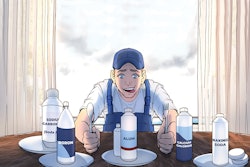
CYA slows down the time it takes for chlorine to eat a Baby Ruth.
Baby Food, Not Baby Ruth: The Cost of Over-Stabilization
Consider a scenario straight from a Certified Pool Operator course: a fecal incident, which I'd ask the younger crowd to think of as "baby food, not Baby Ruth" (see Caddyshack, required viewing). With zero CYA in the water, 20 ppm of chlorine neutralizes the fecal contamination in about 12.75 hours. Add just 15 ppm of CYA, a modest amount, and the same job takes 28 hours. Same chlorine, same kill, more than double the time, because the basket hands out chlorine too slowly to overcome the contamination.
Here the pyramid connects back to itself. Run a high pH and you'll add three times the chlorine, and if it's stabilized chlorine, three times the CYA along with it. So simply holding pH in the right zone dramatically decreases how much stabilizer ends up in your water over a season.
Prevention is the game. Remember the studies that show 90% of chlorine is used up in oxidation, which could be handled better by enzymes, by a non-chlorine oxidizer, or by more filtration. If you're filtering less than 24 hours a day, that's the easiest fix there is. Filtering 24 hours instead of 12 keeps pool water clearer than any chemistry can. Filtration, filtration, filtration is the key.
Once water is over-stabilized, there's no chemical cure. Like a totaled car, you can only deal with it, and the only way to remove cyanuric acid is to remove water that contains it and replace it. This is a hard concept for a lot of homeowners, and I understand why, because draining and refilling isn't cheap. But there's no choice, you simply must deal with it. The cheapest way to prevent this problem is maintaining correct pH so you never add three times the stabilizer in the first place.
Water Balance Should Be a Straight Line
Ideal water balance looks like a flat line, today the same as tomorrow, with no new headaches. No one wants brand-new headaches throughout the summer. You want happy customers with consistent pool water quality! So how do you get there? Automate, then mitigate.
It is easy to automate the sanitizer with a chlorine feeder or a salt chlorine generator rather than relying on remembering to pour sanitizer into the pool water. This matters especially if you're forgetful, or if you're not adding chlorine on a routine basis. When you automate the sanitizer, you know exactly how much chlorine is always going into the water. Automating chlorine this way does mean running your filtration and circulation on a regular basis. A routine amount of circulation is key, whether it's 8 hours or 12 hours. Twenty-four hours is ideal, but consistency is what counts.
The goal is to automate pH with proper buffering, keeping alkalinity in place and ideally borates on top. That locks pH into the same spot, or as close to it as possible. And automate cleaning, too. I have a fake word for this that I've been using for a while: "clean-nation." Run your filtration 24/7 and let a pool cleaning robot live in the water so it's cleaning all the time.
Unfortunately, water balance is not actually a straight line. It moves up and down because things enter your water that are out of your control. So after you automate, you mitigate. You do the best you can to deal with the problems that automation can't prevent.
The best way to mitigate contaminants is by adding hygiene to your normal pool operations. Make sure the people entering your pool are clean. Rinse the shampoo and conditioner out of their hair, keep their feet clean, and avoid peeing in the pool.
Pool covers help enormously here as well. An automatic cover will keep contaminants out of the pool overnight and will keep roughly a third of the contaminants out of the pool without a cover. During pollen season, that's huge. In some parts of the country, the pollen season runs from April until October, and it feels like it never ends. It's one plague after another. If you read the first few chapters of the Bible, it seems to me that the plagues are describing the pool environment over the summer. Once you're through one plague of pollen, another follows immediately. I wouldn't be surprised if frogs started falling into my pool. A cover does an amazing job of preventing all of it.
So mitigate chemical imbalances by testing and adjusting on a regular basis. After a rain event, test and adjust based on the results. But don't overdo it.
A bad pool opening is like a car wreck. You've failed to prevent it. All you can do now is clean up the mess.
A BAD POOL OPENING IS A CAR ACCIDENT
My last metaphor is for the season's bookends. There's one more thing to mitigate, and that's a bad opening. The only way to do it is with a good closing, and by opening time, we're well past the point of prevention. So open as early as possible, ideally in cold weather.
A bad pool opening is like a car accident. Once it's happened, there's nothing to do but deal with the results, whether that's a fender bender or a total loss. You just have to handle it. You can't sit there and cry about it. What's critical is the closing that came at the end of the previous season. Pool owners who will only pay for either an opening or a closing by a pool professional, one or the other, should choose spending the money on a professional pool closing. So many things can go wrong over the winter because the closing wasn't done correctly, and you end up dealing with all of it at the opening.
A proper closing comes down to getting the right chemistry into the water, sealing the pool correctly, and giving chlorine a buddy for the winter. You can't let chlorine do all the work. Even under a mesh cover, a pool can open clear in the spring if you add the right buddies at closing. Chlorine only lasts 10 to 14 days under a winter cover, so something else has to carry the water through to spring. If you have a lot of metals in your water, are you adding metal-sequestering products over the winter so they don't stain? For me, the key buddy is borates, because borates prevent algae. That's what makes my pool open clear under a mesh cover.
The Pyramid Has More Sides
Chlorine at the tip, pH sharpening the blade, alkalinity and borates holding the foundation steady, and a buddy at chlorine's side: that's the Chlorine Pyramid. But remember that it's multi-sided. The same elements that keep your water clean also determine how your water treats your pool and its equipment, and that's the Langelier Saturation Index (LSI). Adjust these elements and you greatly affect how LSI works to preserve your equipment and keep it clear. The reverse is true as well: Your LSI needs to sit at the right levels so that it doesn't act against your sanitation and water quality. Maintaining water quality at the sacrifice of LSI, or the other way around, is a balancing act, and that's what I'll dig into in my next webinar.
A big part of that next conversation is the one thing I've been careful to avoid in this article: calcium. As we approach the fall and winter, as cold temperatures arrive, calcium falls out of the water and it introduces a whole new set of considerations for both sanitation and LSI. Part 2 in my webinar series currently has a working title that says it all: Calcium Strikes Back.
John Bereza is the Great Lakes regional sales manager for Haviland Pool & Spa Products, a manufacturer of water treatment products in Grand Rapids, Mich. Bereza has worked at Haviland since 2003 in various roles, including decorative coatings technical support and marketing, and, since 2020, has been in the current sales role with a primary focus on technical training. He can be reached via email at [email protected].















 Alkalinity and pH are linked, like two toes on the same foot.
 Alkalinity and pH are linked, like two toes on the same foot.
 CYA slows down the time it takes for chlorine to eat a Baby Ruth.
 A bad pool opening is like a car wreck. You've failed to prevent it. All you can do now is clean up the mess.