








 Steve Santucci | Director of Sales, Canada and Northeast | PAL Lighting
In his seminar during The Pool & Spa Show in January, PAL Lighting’s Steve Santucci emphasized the importance of lighting with forethought while he presented several of the latest innovative lighting options gaining popularity in the industry today.
“Traditional pool design has placed an over-reliance on in-pool lighting, as opposed to a full backyard concept,” Santucci says. “Adding wall lighting and other ambient lighting sources creates a cohesive mood.”
This sentiment becomes his overarching thesis as he presents specific upsell opportunities that are making it easier for homeowners to achieve a look of luxury in their backyards without being forced to break the bank.
 One way builders can diverge from traditional lighting solutions is to introduce zoning to the backyard, which allows homeowners to light certain areas at one time.

ZONING (BUT REALLY, PLANNING)
One way builders can diverge from traditional lighting solutions is to introduce zoning to the backyard, which allows homeowners to light certain areas at one time. In this instance, value added to the backyard is both aesthetic and functional, whether that means spotlighting an outdoor kitchen, adding some ambience to the landscaping around the pool, or another configuration of the client’s choosing.
Of course, this method can make your wiring a bit more difficult, Santucci says, and conduit planning is a crucial part of making your zone lighting successful.
“It’s just important to know the plan,” he says. “Whether you’re going to use J-boxes or home runs, you want to plan ahead so you minimize unnecessary conduit runs and costs.”
Duh! you might be thinking, We have to plan ahead in order to build the pool in the first place.
But Santucci’s lighting recommendations go beyond the pool, which is why each step of planning the backyard is so crucial. “You have to figure out your conduit and how you’re going to zone,” he continues. “All of this has to be figured out ahead of time, because if it’s not, then you turn it into a mess and an extra cost. No one wants to go back to the customer and say, ‘Hey, we messed this up.’”
What’s more, he says, is that customers are getting smarter with each passing year. “A lot of times, we’re finding that customers are asking builders about these things. If you familiarize yourself with new types of lighting options, you’re going to have hot points that you can talk to your customers about because they’re already looking at this stuff.”
The notion that gets repeated throughout Santucci’s presentation is simple, but effective: think about ways to light away from the pool, and you’re on your way to adding more value to the client’s backyard and more money to your pocket.
LUXURY VIA LAYERING
Beyond zoning, Santucci proposes layering as another strategy to spruce up your client’s backyard, which can be done in a myriad of ways. The most important thing to remember, he says, is to “own the backyard” that you’re working in. Be thorough in your conversations about lighting solutions to your customer; leave no stone unturned.
Of course, customers don’t want to feel like they’re being sold unnecessary additions to the backyard. To circumvent this, adjust the client’s perception of the extra lighting as instrumental to the final look.
“You have the ability to tie the whole backyard into what you’re doing,” Santucci says. “We’re past the idea of just putting lights in the pool for safety; now we’re trying to upgrade these backyards. We’re trying to get more out of them — but we don’t want to just throw light at it. We want to light aesthetically and artistically as much as we light with safety in mind.”
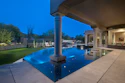
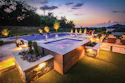
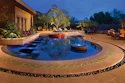
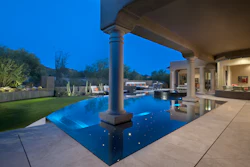
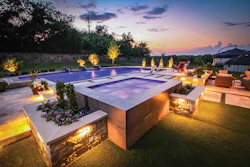
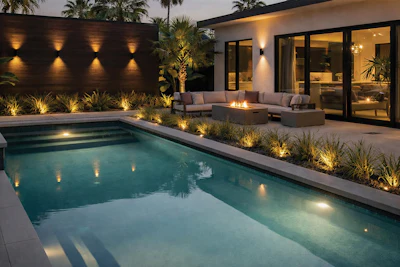
One way to present options to customers is to give them a line up of what their backyard could look like at each level of lighting: good, better, best. In the examples shown, the lighting shifts from being pool-focused to lighting the entire space, serving as an invitation for the homeowner and their family to gather.
From filling empty spaces with a tasteful wall sconce, to brightening the greenery beyond the pool, consider the backyard an empty canvas, waiting for its art to be accentuated with cleverly-placed lighting.


AUTOMATION: MAXIMUM CONTROL
As pool and backyard lighting solutions have evolved, so have the control systems that help homeowners achieve the backyard of their dreams. From light switches to remotes to automation, the new possibilities are endless.
“Back when lighting really started becoming a thing, you had a light switch and that was it,” Santucci says. “But now with automation, remotes and even apps, you have different options.”
If your customer isn’t interested in automation, Santucci recommends looking at the different options remotes can present, as they are more versatile than traditional light switches and less involved than app-based systems. “You can wire things really anywhere you want when you use a remote,” he says, and praises the color options they come with, which gives the homeowner more freedom over their backyard lighting at any given time.
But the future is now, and the latest control systems are no exception. One of the major benefits of automation in lighting is the amount of control given to homeowners, something that Santucci says is becoming more of an expectation than an added perk to upgrading a control system.
“When you’re power cycling, you’re turning the circuit on and off multiple times to get to the color you want,” he says, referring to older control systems. “If you move away from the light switch and go to a remote or automation, the ease of turning the lights on and off, and getting the exact color they want, is so much better.”
Reasons for this are due to the differences between two-wire and four-wire lights. Only the latter allows color options to blend, because, in Santucci’s words, “you can take a little bit of green, a little bit of red, a little bit of blue, and blend them to get your color.” Two-wire lights, on the other hand, are “more of a pre-programmed light,” which is why homeowners are limited to pre-determined colors.
But perhaps most importantly, automation gives the homeowner the ability to control their lighting from virtually anywhere.
“There’s no more getting to the switch in the middle of the night. There’s no more stumbling over things. It’s like in your house — no one wants to walk into a room without the light on. You want the switch closest to where you are. With backyard lighting now, you don’t want to be walking through a dark backyard. With automation, customers can turn their lights on instantly.”

It’s an ease that customers have been yearning for in recent years, Santucci says, and one that can be more easily delivered as the industry continues to evolve. But the peace of mind from automation doesn’t just go to the homeowner — it can also impact the builder.
“As a builder, you don’t really want the homeowner to go into the pad with access to all the equipment. If you go to a remote- or app-based control system, they only control one thing — the lights. Everything you did won’t accidentally get undone by the homeowner, and they can rest easy knowing how to control their backyard.”
In previous years, Santucci recalls some pushback from customers when app-based control was introduced; many people would reject the idea of downloading yet another app exclusively for lighting control. However, this exclusivity can add to the peace of mind that homeowners are looking for. “If you have the ability to let the customer — or their kids — play with the lights in a safe space where they’re not going to mess with the variable-speed pump or anything, I think we’ve overcome the objection to another app.”
The lighting solutions discussed here are far from the only options available for builders and their customers, but the sentiment remains: customers are getting more informed, their desire for control over a cohesive backyard is only increasing, and the industry must continue evolving to meet their desires.
“It might not seem like a big deal to you as the pool pro, but for the homeowner who’s spending upwards of a hundred thousand dollars, the lighting is what they’re going to see. When you’re done building the pool, they’re not going to sit there and look at the equipment. They’re going to look at the lights, show them off to their friends, family, and their neighbors. Lighting is what remains at the end, after you leave.”